Smoke Damage Restoration in Westfield
24/7 smoke damage restoration in Westfield, NJ. IICRC-certified, insurance billing accepted. Call (908) 970-8533.
Our IICRC-certified technicians are dispatched from our Fair Lawn, NJ headquarters and are typically on-site in Westfield within 60 minutes of your call.
A kitchen fire in a Victorian on Wychwood’s tree-lined streets leaves more than charred cabinets — it leaves smoke chemistry embedded in a century of plaster, horsehair, and original woodwork that modern drywall simply doesn’t replicate. In Westfield’s 07090 ZIP code, where homes routinely date to the 1900s–1930s and carry original interior finishes, smoke residue behaves differently than it does in a postwar ranch, and the cleanup has to match. The Restoration Group responds around the clock from our Kenilworth base, reaching most of Union County within the hour.
Why Westfield Homes Are Especially Vulnerable to Smoke Damage
Westfield’s housing stock is part of what makes it desirable — and part of what makes post-fire recovery complicated. Tudor and center-hall colonial homes built before 1940 were constructed with dense plaster walls, open balloon-frame cavities, and natural wood millwork that acts like a sponge for smoke particulates. When a fire starts in a kitchen or utility room, smoke travels vertically through those open stud bays before the homeowner even sees it, depositing oily, acidic residue on surfaces two or three rooms away from the actual burn.
The old-growth tree canopy throughout neighborhoods like The Gardens and Manor Park also plays a role: wind-thrown limbs during nor’easters frequently breach slate or cedar roofs, and the resulting water intrusion — if left unaddressed — creates humid interior conditions that cause smoke odor to reactivate months after a fire. Wet plaster and smoke residue together produce a persistent, musty-acrid smell that no amount of airing out will resolve. Proper drying and deodorization have to happen in sequence, not simultaneously.
Our Smoke Damage Restoration Process in Westfield
When we arrive, the first priority is containment — sealing HVAC registers and doorways so that soot-laden air doesn’t migrate into finished basement spaces. In Westfield, those lower levels are frequently home theaters, gyms, or home offices with expensive finishes, and cross-contamination turns a manageable claim into a five-figure rebuild.
From there, the process moves through several distinct phases:
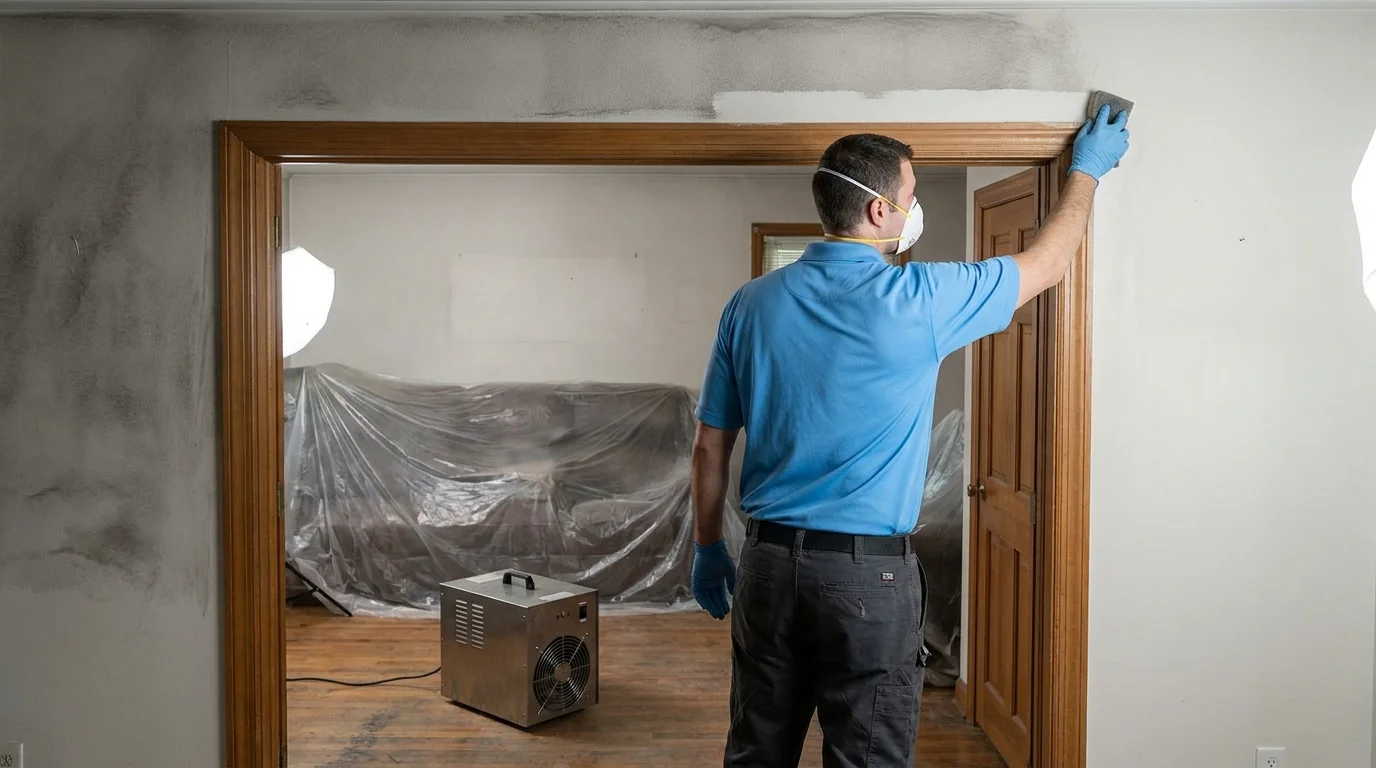
- Dry residue removal: Dry chemical sponges lift loose soot from plaster ceilings and walls before any wet cleaning begins. Applying liquid cleaners to unsettled soot drives it deeper into porous surfaces.
- Chemical cleaning: Alkaline and acidic cleaning agents are matched to the specific residue type — protein smoke from cooking fires requires different chemistry than the heavy petroleum soot left by synthetic materials.
- Thermal fogging and hydroxyl treatment: Odor molecules trapped inside plaster, subflooring, and original wood trim require penetrating deodorization. Hydroxyl generators run continuously rather than in a single pass, which matters in thick-walled older construction.
- Air filtration: HEPA-filtered negative air machines run throughout the project, capturing fine particulates that would otherwise resettle on cleaned surfaces.
- Reconstruction coordination: Where smoke damage requires plaster repair, millwork replacement, or refinishing, we coordinate with subcontractors who understand period-appropriate materials — critical in a town where matching 1920s crown molding matters to both homeowners and resale value.
All drying and deodorization work follows IICRC S500 and S520 standards, and The Restoration Group holds IICRC Certified Firm status (#210213).
Reaching Westfield from Kenilworth
Our Kenilworth headquarters sits roughly 4 miles northeast of Downtown Westfield, accessible via Central Avenue directly into the heart of town. For addresses near Mindowaskin Park or along the Quimby Street corridor, travel time is typically short even during evening hours. We operate 24/7, so a call at 2 a.m. after a kitchen fire gets the same response as a call at noon — a crew dispatched, not a voicemail.
For properties near Tamaques Park or in the Indian Forest section on the western edge of town, we route via South Avenue or Prospect Street depending on traffic. If your street has limited staging space — a common issue on the narrower residential blocks off Elm Street — let us know when you call and we’ll plan equipment placement accordingly.
Westfield Insurance Coordination
Smoke damage claims in Westfield tend to be complex because the affected square footage often exceeds what’s immediately visible. Adjusters unfamiliar with balloon-frame construction sometimes underestimate how far smoke has traveled through wall cavities. We document affected areas with thermal imaging and detailed written scope before any cleaning begins, giving your carrier a defensible record of the full loss.
We bill most major carriers directly and can provide a line-item estimate formatted to standard Xactimate coding, which speeds adjuster review. If your policy includes code-upgrade coverage — relevant in pre-1940 homes where restoration work may trigger current NJ electrical or plumbing requirements — we flag those items early so they’re included in the initial claim rather than added as a supplement.
Local Note
Westfield’s original plaster walls — common throughout Wychwood, The Gardens, and the blocks surrounding Downtown Westfield — absorb smoke odor compounds at a molecular level that painted drywall does not. We’ve found that a single thermal fogging pass, which is often sufficient in newer construction, rarely eliminates odor in pre-war plaster. Our standard protocol for Westfield’s older homes includes a minimum 48-hour hydroxyl treatment cycle after fogging, with a sniff-test walkthrough before equipment is removed. It adds time to the job, but it’s the difference between a home that smells clean and one that reminds you of the fire every winter when the heat comes on.
If your home has experienced smoke damage — whether from a contained kitchen incident or a larger structural fire — call The Restoration Group at (908) 970-8533. We’ll assess the full scope of the damage, explain what the cleanup involves in plain terms, and work directly with your insurance company so the process moves as quickly as the work allows.
Smoke Damage Restoration in Westfield: Service Coverage
Frequently Asked Questions
How fast can you arrive for smoke damage restoration in Westfield?
How quickly can The Restoration Group reach a home near Mindowaskin Park or Downtown Westfield after a fire?
Westfield's older Victorian and Tudor homes have original plaster walls — does that change how smoke damage is cleaned?
My finished basement in Westfield wasn't near the fire — can smoke damage still reach it?
Will my insurance adjuster understand the full scope of smoke damage in a pre-1940 Westfield home?
What type of smoke residue is hardest to remove, and is it common in Westfield kitchen fires?
Smoke Damage Restoration response in Westfield
Most Westfield calls see a technician on-site within 60 minutes from our Fair Lawn headquarters.