Flood Damage Restoration in Kenilworth
24/7 flood damage restoration in Kenilworth and surrounding areas. IICRC-certified, insurance billing accepted. Call (908) 970-8533.
What happens in the first 24 hours matters more than anything else
Floodwater doesn’t wait. Whether a storm drain backed up into your finished basement, a river crested and pushed water through your crawl space, or a municipal main broke and sent Category 3 water across your first floor, the clock starts the moment the water stops rising. Within 24 to 48 hours, wet drywall begins to wick moisture upward, subfloor panels start to delaminate, and the humidity trapped under cabinets creates the exact conditions mold needs to colonize. Flood damage restoration is the race against that timeline — and the difference between a contained repair and a gut renovation often comes down to how fast and how thoroughly the response begins.
What flood damage restoration actually involves
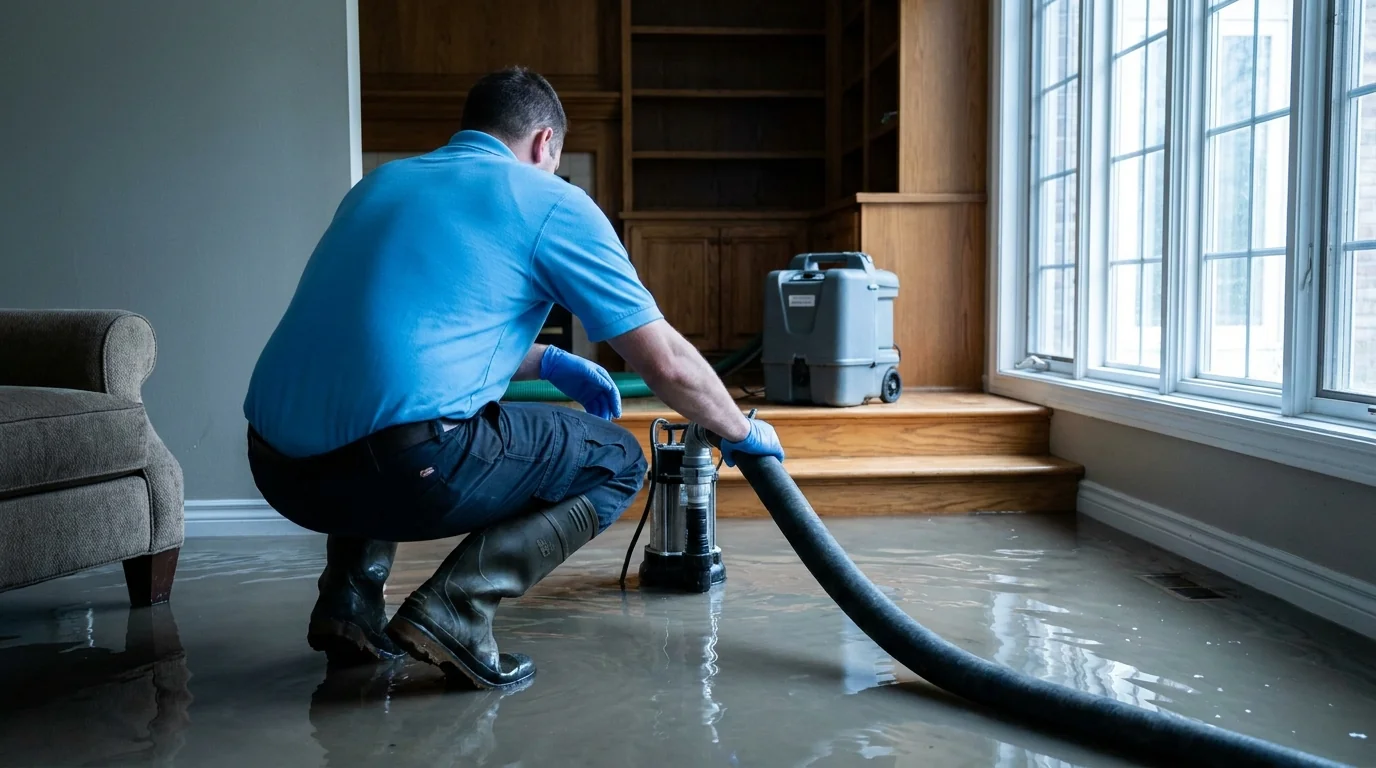
Flood cleanup is not pumping out water and running a fan. The visible water is only part of the problem. Floodwater — especially water that entered from outside, from a sewer backup, or from an overflowing street — is classified as Category 3 contaminated water under IICRC standards, meaning it carries bacteria, sewage, and chemical runoff that require controlled handling and disposal, not just extraction.
The real work happens after the water is gone. Technicians use thermal imaging cameras to map moisture hidden inside wall cavities, under tile, and inside insulation bays that look dry to the eye. Industrial desiccant dehumidifiers — not the box-store units — pull moisture out of structural materials at a rate that makes the difference between saving a hardwood floor and replacing it. Air movers are positioned at calculated angles to create directed airflow across wet surfaces, not just pointed at walls randomly. Moisture readings are logged daily against the IICRC S500 drying standard to confirm that materials are reaching acceptable equilibrium moisture content before anything is closed up.
Timeline is honest: most residential flood drying takes 3 to 5 days for Category 1 or 2 water in a well-ventilated space. Category 3 losses — sewage, groundwater, storm surge — routinely run 5 to 7 days or longer, and may require selective demolition of drywall, insulation, and flooring before drying can even begin effectively.
Our process
-
Contamination classification and safety staging. Before any equipment enters, technicians assess the water source to confirm the contamination category. Category 3 water requires PPE, containment barriers between affected and unaffected areas, and proper waste handling for extracted material. Skipping this step exposes your family to pathogens and can void an insurance claim if the adjuster finds the loss was mishandled.
-
Rapid extraction. Truck-mounted or portable extraction units remove standing water — including water trapped under flooring and inside wall base cavities — at a rate no consumer equipment can match. For groundwater intrusion through foundation walls or floor cracks, extraction continues in tandem with identifying and temporarily mitigating the entry point.
-
Selective demolition where required. Wet insulation holds moisture against framing and cannot be dried in place. Saturated drywall below the flood line is typically removed to the next stud bay above the waterline to allow air movement through the wall cavity. This step is documented photographically for your insurance claim before any material is removed.
-
Structural drying with daily monitoring. Industrial dehumidifiers and air movers run continuously. A technician returns each day to record moisture readings at mapped measurement points. Drying is not declared complete until readings meet the IICRC S500 benchmark — not when the space “feels dry” or when a schedule says it should be done.
-
Antimicrobial treatment and clearance documentation. Once materials reach target moisture content, affected surfaces receive an EPA-registered antimicrobial application. Final moisture readings are logged and provided to you and your insurance carrier as the drying certificate — the document that closes the mitigation phase and authorizes reconstruction to begin.
What separates a good flood response from a bad one
The most common failure in post-flood restoration is incomplete drying hidden behind a fast close-up. A crew that extracts visible water, runs equipment for two days, and then installs new drywall over framing that reads 22% moisture content is setting up a mold problem that will surface in 60 to 90 days — often after the warranty window closes. Insurance adjusters and independent inspectors look specifically for drying logs: if a contractor cannot produce dated moisture readings for every day of the drying phase, that is a red flag.
A second common failure is misclassifying the water source to reduce scope. Groundwater that enters during a storm event is Category 3 regardless of how clear it looks. Treating it as Category 1 means skipping the antimicrobial protocol and the contaminated-waste handling that protects your family and satisfies your carrier.
The Restoration Group is an IICRC Certified Firm (#210213) and an NJ Licensed Home Improvement Contractor. Every flood job produces a written drying log, a photo-documented scope, and a moisture certificate — the paperwork your adjuster will ask for.
Seasonal and regional considerations
Northern New Jersey’s flood risk is not uniform across the calendar. Spring snowmelt combined with saturated ground is the most common driver of basement flooding in Kenilworth and the surrounding Union County communities, typically peaking between March and May. Late summer brings tropical remnants and high-intensity convective storms that overwhelm storm drains in older municipalities where combined sewer systems were never designed for current rainfall rates. Homes built before 1980 in this region frequently have stone or cinder-block foundation walls with no waterproof membrane — they transmit groundwater directly into crawl spaces and basements during any sustained rain event.
Because The Restoration Group operates 24/7, we can begin extraction the same night a storm passes rather than waiting for a next-day appointment window.
Service area
The Restoration Group is based in Kenilworth, NJ and provides flood damage restoration across Union County and into Essex, Middlesex, and Morris counties — including Cranford, Westfield, Springfield, Summit, Linden, Elizabeth, and surrounding communities. City-specific pages detail local considerations; this page covers the full scope of the service.
If your basement is still wet or you’re looking at a waterline on your walls, call (908) 970-8533 now to start your flood damage assessment. The sooner extraction begins, the more of your structure — and your flooring, your framing, your finishes — can be saved.
Frequently Asked Questions
What is the difference between Category 1, 2, and 3 floodwater, and why does it change the scope of work?
How do technicians find moisture that isn't visible after a flood?
Why is selective demolition sometimes necessary even when the walls look intact?
What should I do — and not do — while waiting for the restoration crew to arrive?
How does the drying certificate affect my insurance claim for flood damage?
Looking for the best flood damage restoration company in Fair Lawn?
The Restoration Group provides licensed and insured flood damage restoration in Fair Lawn, NJ and the surrounding area, and has served local property owners since 2021. We answer calls 24/7 — call (908) 970-8533 for immediate help.
Need Flood Damage Restoration now?
We respond 24/7 across Fair Lawn and surrounding NJ cities.
Related Coverage
- Our Restoration Services
- Contact The Restoration Group
- Flood Damage Restoration in Brooklyn
- Flood Damage Restoration in Cranford
- Flood Damage Restoration in Elizabeth
- Flood Damage Restoration in Jersey City
- Flood Damage Restoration in Kenilworth
- Flood Damage Restoration in Manhattan
- Flood Damage Restoration in Newark
- Flood Damage Restoration in Springfield
- Flood Damage Restoration in Summit
- Flood Damage Restoration in Union
- Flood Damage Restoration in Westfield