Mold Remediation in Kenilworth
24/7 mold remediation in Kenilworth and surrounding areas. IICRC-certified, insurance billing accepted. Call (908) 970-8533.
You notice a musty smell in the basement after a wet spring, or a dark patch spreading behind the bathroom vanity you pulled out during a renovation. Within 24 to 48 hours of a moisture event, mold spores already present in any indoor environment can begin colonizing porous materials — drywall paper, wood framing, carpet backing, insulation. By the time a colony is visible to the naked eye, it has typically been growing for days. Mold remediation is not cleaning with bleach; it is a structured, containment-first process designed to remove active growth, eliminate the conditions that caused it, and verify through air sampling that the space is safe to reoccupy.
What mold remediation actually involves
Remediation begins before a single piece of drywall comes down. A technician identifies the moisture source — slab leak, roof intrusion, condensation on an uninsulated pipe, or residual saturation from a flood event — because removing mold without fixing the moisture source is a temporary fix at best. Once the source is confirmed and corrected, the affected area is assessed for the extent of colonization, which often extends beyond what is visible. Mold grows inside wall cavities, beneath subfloor sheathing, and behind insulation batts where humidity lingers long after the surface appears dry.
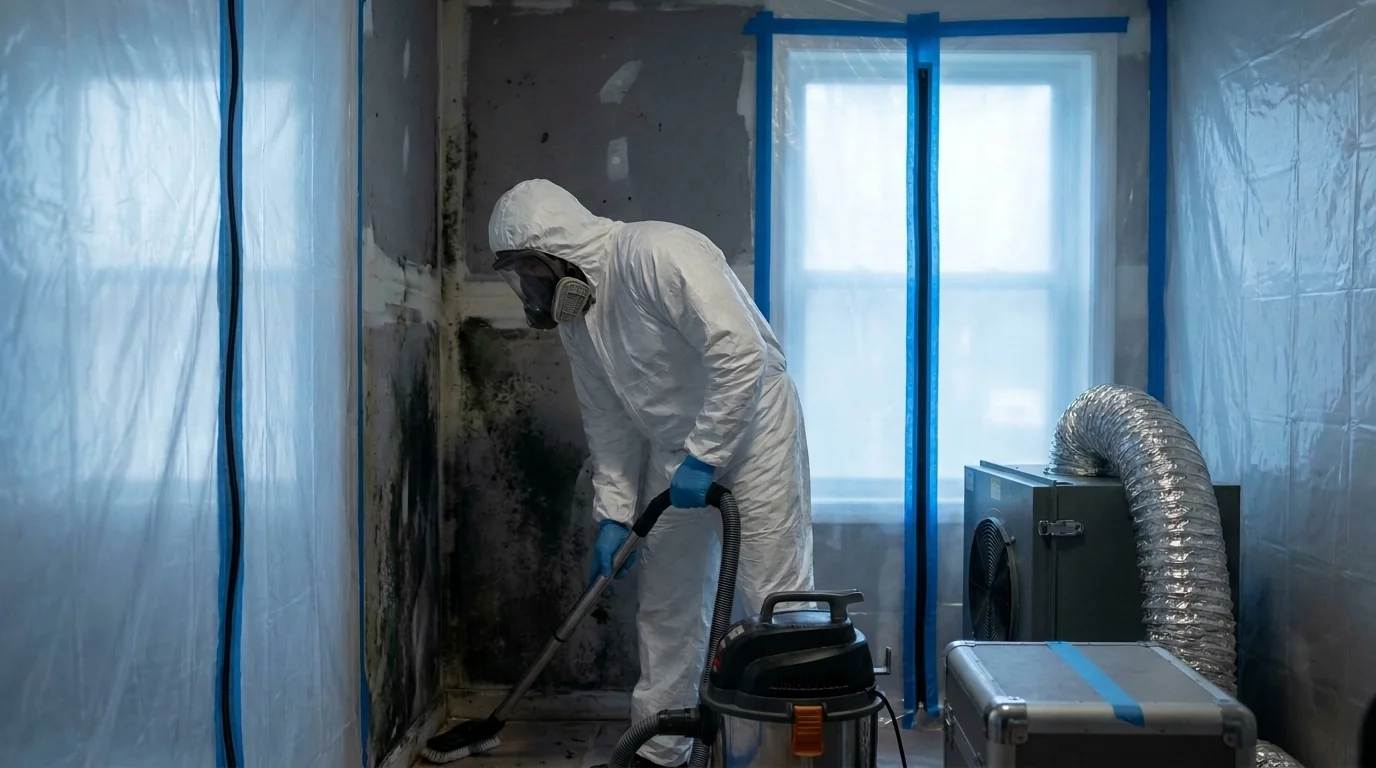
The physical work involves negative-air containment chambers built with 6-mil poly sheeting and sealed with tape, HEPA-filtered air scrubbers running continuously to capture airborne spores during demolition, and hand-removal of contaminated materials into sealed disposal bags. Surfaces that can be cleaned rather than removed — concrete block, metal studs, solid wood framing — are treated with EPA-registered antimicrobial agents and wire-brushed or sanded where necessary. The goal is to bring total spore counts in the affected area back to or below outdoor ambient levels, verified by post-remediation air sampling before containment is removed.
Timelines vary by scope. A single bathroom wall cavity with limited growth can be completed in one day. A crawl space with widespread colonization across floor joists and subfloor sheathing may take three to five days, with additional time for structural drying if moisture levels in the wood are still elevated.
Our process
-
Moisture source identification and documentation. Before containment goes up, a technician uses thermal imaging and pin-type moisture meters to map where water entered and where it traveled. This documentation matters for insurance claims and for confirming the source is corrected prior to remediation.
-
Containment and negative air pressure. The work area is isolated with poly sheeting at all openings. An HEPA air scrubber exhausts to the exterior, creating negative pressure so that spore-laden air cannot migrate to clean areas of the building during demolition. This step is non-negotiable for any remediation that involves disturbing active growth.
-
Controlled demolition and material removal. Contaminated drywall, insulation, carpet, and other porous materials are removed in manageable sections, double-bagged in 6-mil poly, and sealed before transport through the building. Structural components that are salvageable are HEPA-vacuumed, treated with antimicrobial solution, and allowed to dry to acceptable moisture content before encapsulation or rebuild.
-
Post-remediation air sampling. Clearance testing is performed by collecting air samples inside the former containment zone and comparing spore species and counts against outdoor control samples collected the same day. The remediation is not complete until sampling confirms the space meets clearance criteria consistent with the IICRC S520 standard. Results are documented and provided to the property owner.
-
Rebuild coordination. Once clearance is confirmed and containment is removed, affected areas are ready for reconstruction — new drywall, insulation, and finishes. The Restoration Group coordinates that phase directly, so you are not managing two separate contractors.
What separates a good mold remediation response from a bad one
The most common failure in residential mold remediation is treating the visible symptom without resolving the moisture condition. A contractor who removes the drywall, sprays an antimicrobial, and closes the wall without verifying that the framing has dried below 19 percent moisture content is setting up a repeat problem within one to two seasons.
A second common shortcut is skipping containment on smaller jobs. Disturbing even a modest colony without negative air pressure can spike airborne spore counts throughout the house — sometimes to levels higher than the original affected area. Insurance adjusters and industrial hygienists reviewing a claim file will look for documentation that containment was established and that post-remediation air sampling was performed. Without clearance testing, there is no objective evidence the work was effective, which can complicate both insurance settlements and future property sales.
Working as an IICRC Certified Firm (#210213), the process here follows the S520 Standard for Professional Mold Remediation — not because it is a marketing point, but because that standard exists specifically to prevent the shortcuts above.
Seasonal and regional considerations
New Jersey’s humid summers and freeze-thaw winters create two distinct mold windows. July through September, when outdoor relative humidity regularly exceeds 70 percent, is when crawl spaces and basement rim joists are most vulnerable — especially in older construction without vapor barriers. The second window is late winter, when ice damming on roofs forces meltwater under shingles and into attic sheathing, often going undetected until spring when temperatures rise and growth accelerates. Properties in Kenilworth and surrounding Union County communities with older slab-on-grade construction are also prone to slab moisture migration during prolonged wet periods, which can colonize carpet and wall base in finished basements within days.
Service area
The Restoration Group is based in Kenilworth, NJ and provides mold remediation throughout Union County and surrounding areas, including Cranford, Westfield, Roselle, Clark, Garwood, Springfield, and Summit. Dedicated service-area pages cover each community in detail.
If you are seeing visible growth, smelling musty odors in a closed space, or dealing with a recent water event that was not professionally dried, call (908) 970-8533 to request an air quality assessment. Crews are available around the clock — the earlier the call, the more material is typically salvageable.
Frequently Asked Questions
What level of mold growth requires full containment under the IICRC S520 standard?
What is post-remediation air sampling, and why does it matter?
Can mold grow back after professional remediation?
Should I stay in my home during mold remediation?
How do I document mold damage for an insurance claim?
Looking for the best mold remediation company in Fair Lawn?
The Restoration Group provides licensed and insured mold remediation in Fair Lawn, NJ and the surrounding area, and has served local property owners since 2021. We answer calls 24/7 — call (908) 970-8533 for immediate help.
Need Mold Remediation now?
We respond 24/7 across Fair Lawn and surrounding NJ cities.
Related Coverage
- Our Restoration Services
- Contact The Restoration Group
- Mold Remediation in Brooklyn
- Mold Remediation in Cranford
- Mold Remediation in Elizabeth
- Mold Remediation in Jersey City
- Mold Remediation in Kenilworth
- Mold Remediation in Manhattan
- Mold Remediation in Newark
- Mold Remediation in Springfield
- Mold Remediation in Summit
- Mold Remediation in Union
- Mold Remediation in Westfield
- How To Choose a Restoration Company in (Without Getting Burned)
- How To Test for Mold in Your Home (DIY Kits vs a Pro Inspection)
- 7 Signs You Have Hidden Mold (and What To Do Next)