Commercial Restoration in Kenilworth
24/7 commercial restoration in Kenilworth and surrounding areas. IICRC-certified, insurance billing accepted. Call (908) 970-8533.
A burst pipe at 2 a.m. in a commercial building hits differently than one in a residential home. You’re not just dealing with damaged drywall — you’re managing tenant notifications, liability exposure, inventory at risk, and a clock that starts ticking the moment the water touches your flooring system. Commercial restoration is a different discipline than residential work, and the gap between a crew that understands that and one that doesn’t shows up in your downtime, your claim settlement, and your building’s long-term condition.
What commercial restoration actually involves
Commercial water damage, fire damage, and mold remediation share the same physics as their residential counterparts, but the scale, stakeholder complexity, and documentation requirements are in a different category entirely. A retail space with saturated concrete slab and wet insulation behind metal studs requires different drying calculations than a wood-framed house. An office suite with smoke-damaged server equipment needs contents specialists, not just a shop-vac and an ozone machine.
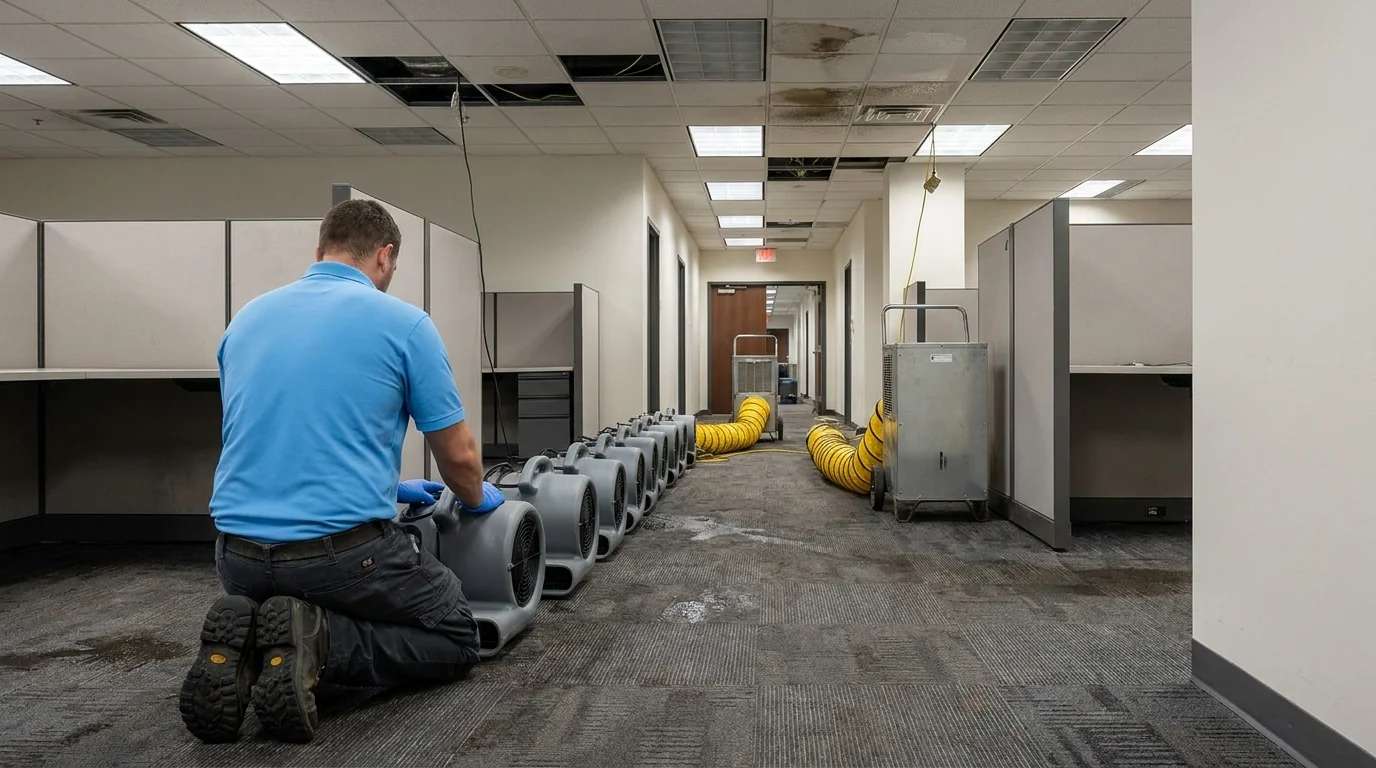
The equipment reflects this. Commercial drying jobs typically deploy large-format desiccant dehumidifiers or refrigerant units rated for high-volume air movement, supplemented by industrial air movers staged to create a pressure differential across the affected zone. Moisture mapping in a multi-tenant building means tracking readings across multiple floors, through fire-rated assemblies, and into ceiling plenum spaces where water migrates silently before anyone notices the damage.
Timeline depends on loss category and material type. Category 1 water in a concrete-and-steel structure may dry in 3–5 days. Category 2 or 3 losses — sewage backup, floodwater, or water that has sat more than 24–48 hours — can push structural drying past two weeks and require selective demolition of non-salvageable materials before drying can even begin. Smoke damage to a multi-floor office after a kitchen fire can take a week of active treatment before the space is occupiable.
Our process
-
Emergency stabilization and loss scoping. The first hours on a commercial loss are about stopping the bleeding — shutting off water supply, boarding compromised openings, isolating HVAC systems that could spread smoke or contaminated air, and documenting the pre-mitigation condition with photo and video evidence that holds up to adjuster review.
-
Moisture mapping and contamination classification. Before any equipment is placed, we map the full extent of moisture migration using thermal imaging and calibrated moisture meters. Water in a commercial building rarely stays where it started — it follows the path of least resistance through concrete, under raised flooring, and into wall cavities behind fire-rated assemblies. Contamination class (Categories 1, 2, or 3) is established here, because it determines the entire scope of demolition and sanitation that follows.
-
Selective demolition and containment. Saturated materials that cannot be dried in place — certain insulation types, wet particleboard, Category 3-affected drywall — are removed before drying equipment is deployed. On fire losses, this step includes soot characterization: dry soot from wood combustion responds to dry-sponge methods, while wet or protein-based soot from synthetic materials or cooking fires requires chemical cleaning agents and often thermal fogging to neutralize odor embedded in structural cavities. Containment barriers protect unaffected tenant spaces and common areas throughout.
-
Structural drying and air quality control. Equipment is staged based on psychrometric calculations, not guesswork. Daily moisture readings track drying progress against a goal standard and are logged in a format that supports your insurance claim. On mold-risk losses, air scrubbers with HEPA filtration run continuously. The job is not complete when the surface feels dry — it’s complete when readings confirm the material has returned to an acceptable moisture content for its assembly type.
-
Documentation, clearance, and handoff. Every commercial loss we handle is documented with a drying log, moisture reading reports, photo evidence, and a scope-of-loss summary formatted for carrier review. If reconstruction is required, we coordinate the transition so there is no gap between mitigation completion and rebuild start.
What separates a good commercial response from a bad one
The most common failure on commercial losses is underscoping the initial assessment. A crew that places drying equipment without thermal imaging will miss water that has migrated into the plenum or under a raised access floor. That moisture sits, mold colonizes within 24–72 hours of saturation, and what should have been a three-day drying job becomes a remediation project.
Insurance adjusters on commercial claims look for psychrometric logs, not just before-and-after photos. They want to see daily moisture readings tied to specific structural assemblies, equipment placement records, and a clear rationale for any demolition. Documentation gaps are the single most common reason commercial claims are underpaid or disputed.
On fire losses, the mistake is treating all soot the same. Synthetic materials — carpet, furniture foam, PVC wiring — produce a wet, ionically charged soot that bonds aggressively to surfaces and requires a different chemical approach than the dry, powdery soot from a wood or paper fire. Misidentifying soot type leads to recontamination after cleaning and callbacks that delay reopening.
Seasonal and regional considerations
New Jersey’s commercial building stock — particularly older office and mixed-use properties in Union County and Essex County — tends toward aging HVAC and plumbing infrastructure that becomes a liability in winter. Freeze events along the I-78 corridor regularly produce burst pipe losses in buildings where heating systems were not properly winterized or where a thermostat failure went unnoticed over a weekend. Spring thaw and heavy rain events push groundwater into below-grade commercial spaces, particularly in river-adjacent areas. Summer humidity in the region sustains the elevated indoor moisture levels that accelerate mold growth in any space that lost climate control during a loss event.
Service area
The Restoration Group is based in Kenilworth, NJ and handles commercial restoration throughout Union County, Essex County, and the surrounding region — including Springfield, Cranford, Westfield, Summit, Roselle, and neighboring communities. The city-specific pages linked from this section provide additional detail on local response and common loss types by area.
If your building has sustained water, fire, or mold damage, call (908) 970-8533 now to begin your commercial damage assessment — available 24/7. The sooner the scope is established, the shorter your path back to full operation.
Frequently Asked Questions
How does drying timeline differ between Category 1, 2, and 3 water losses in a commercial building?
What documentation does a commercial insurance adjuster typically require from a restoration contractor?
Can commercial restoration work be phased to keep part of the building operational during mitigation?
Why does soot type matter for commercial fire damage cleanup, and how is it identified?
At what point does a commercial mold discovery require formal containment rather than spot treatment?
Looking for the best commercial restoration company in Fair Lawn?
The Restoration Group provides licensed and insured commercial restoration in Fair Lawn, NJ and the surrounding area, and has served local property owners since 2021. We answer calls 24/7 — call (908) 970-8533 for immediate help.
Need Commercial Restoration now?
We respond 24/7 across Fair Lawn and surrounding NJ cities.
Related Coverage
- Our Restoration Services
- Contact The Restoration Group
- Commercial Restoration in Brooklyn
- Commercial Restoration in Cranford
- Commercial Restoration in Elizabeth
- Commercial Restoration in Jersey City
- Commercial Restoration in Kenilworth
- Commercial Restoration in Manhattan
- Commercial Restoration in Newark
- Commercial Restoration in Springfield
- Commercial Restoration in Summit
- Commercial Restoration in Union
- Commercial Restoration in Westfield