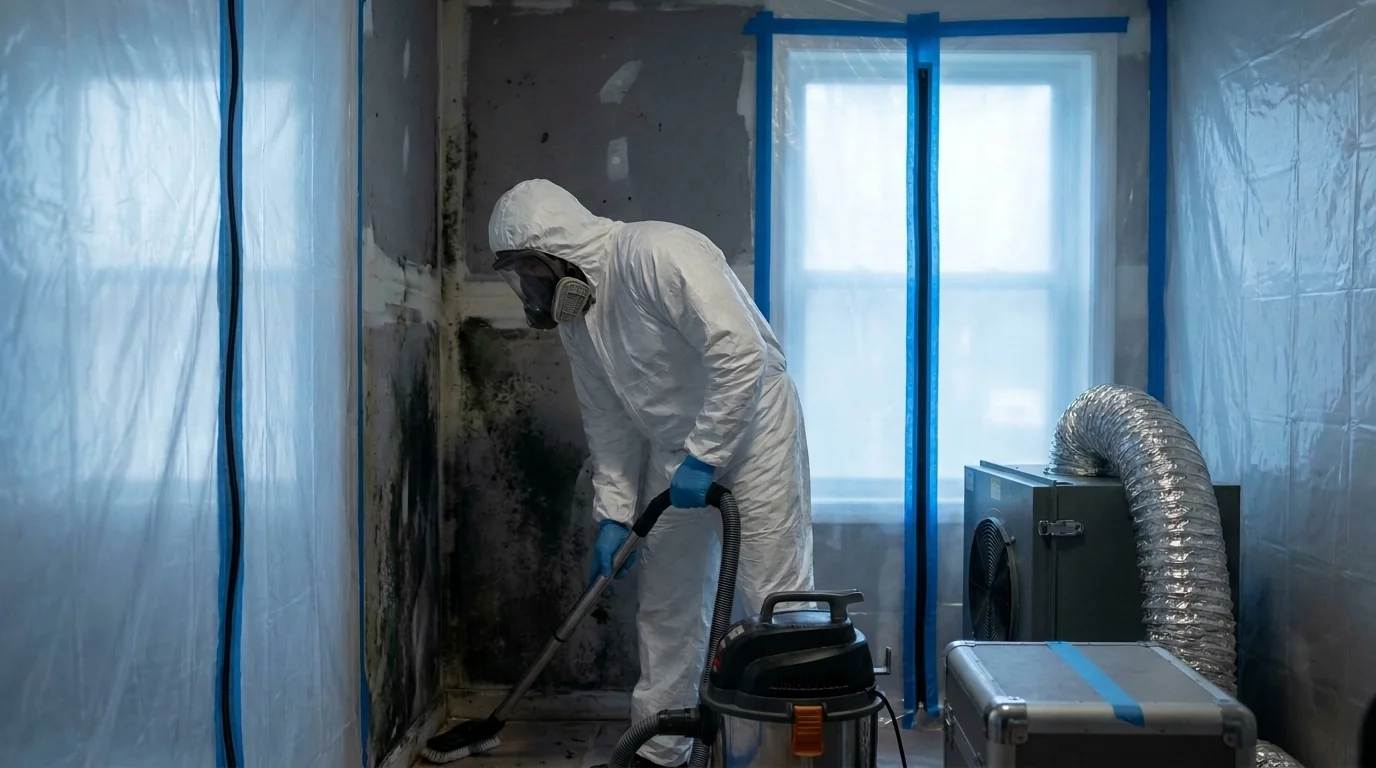
Mold Remediation in Brooklyn
24/7 mold remediation in Brooklyn, NY. IICRC-certified, insurance billing accepted. Call (908) 970-8533.
Our IICRC-certified technicians are dispatched from our Fair Lawn, NJ headquarters and are typically on-site in Brooklyn within 60 minutes of your call.
Brooklyn’s brownstone belt holds a particular kind of mold problem that most remediation guides don’t mention: garden-level and cellar apartments in Park Slope and Brooklyn Heights rowhouses sit below grade in 1880s-era masonry that wicks groundwater year-round, and when a storm like Ida drops record rainfall in a single night, those spaces don’t just flood — they stay damp for weeks inside walls that were never designed to dry quickly. That combination of age, density, and coastal climate makes mold remediation in Brooklyn a different job than it is almost anywhere else.
Why Brooklyn Properties See Mold Problems
The borough’s housing stock is one of the oldest in the country. Masonry rowhouses built between roughly 1880 and 1930 — the kind that line block after block from Flatbush to Bay Ridge — rely on lime mortar and unreinforced brick that absorbs moisture rather than shedding it. Unlike modern construction with vapor barriers and pressure-treated framing, these buildings breathe in both directions: humidity comes in during humid summers, and it lingers.
Coastal exposure compounds the problem. Neighborhoods from Canarsie to Coney Island carry storm-surge memory from Sandy, and the low-lying topography means that even a moderate nor’easter can push water into crawl spaces and mechanical rooms. Brooklyn also sits on a high water table in many ZIP codes — including parts of 11201 and 11211 — so even without a named storm, basements can take on seepage after sustained rain. Mold colonization can begin within 24 to 48 hours on wet organic material like plaster lath, wood joists, and paper-faced insulation, which means a slow leak behind a kitchen wall can become a significant remediation project before a homeowner notices any visible growth.
Our Mold Remediation Process in Brooklyn
Every job starts with a thorough inspection — moisture mapping with thermal imaging and pin meters across walls, floors, and ceilings to find hidden saturation before any demolition begins. In older Brooklyn rowhouses, that step matters more than usual because plaster walls can hold moisture deep in the substrate long after the surface looks and feels dry.
Once the scope is confirmed, we establish containment using 6-mil poly barriers and negative air pressure with HEPA-filtered air scrubbers. This is especially important in attached rowhouses and co-op buildings, where a party wall connects directly to a neighbor’s unit — containment prevents cross-contamination and protects adjacent occupants during the remediation window.
Affected materials are removed following IICRC S520 protocols and bagged for disposal per New York City Department of Sanitation guidelines. Where original woodwork, plaster medallions, or historic millwork can be saved, we work to preserve it rather than defaulting to full tear-out — a consideration that matters to brownstone owners who’ve invested in restoring period details. Antimicrobial treatment is applied to structural cavities, and we run drying equipment until moisture readings return to baseline before any reconstruction begins.
Brooklyn Insurance and Co-op Board Coordination
Mold claims in Brooklyn frequently involve layers of documentation that a standard residential claim doesn’t require. Co-op boards and condo associations typically need written scope-of-work reports, moisture logs, and sometimes third-party clearance testing before they’ll approve work that touches shared structural elements — particularly anything near a party wall or a building’s common plumbing stack.
We prepare the documentation packages that management companies and insurers actually need: photo logs keyed to a floor plan, moisture readings before and after drying, and itemized material removal records. For commercial landlords managing multi-unit buildings in Bushwick or Williamsburg, that paper trail also satisfies the NYC Local Law requirements that apply when mold affects more than 10 square feet.
Local Note
One thing worth knowing if you own or manage a pre-war rowhouse in Brooklyn Heights or Park Slope: original horsehair plaster absorbs water at a slower rate than modern drywall, but it also releases moisture more slowly during drying. Air movers alone won’t do the job — effective drying in these walls requires a combination of desiccant dehumidification and extended monitoring, often 30 to 50 percent longer than a comparable modern construction project. Rushing the drying phase to close out a job faster is one of the most common reasons mold returns in these buildings within a season.
If you’re dealing with visible mold growth, a persistent musty odor, or water damage that wasn’t fully dried after a flood or leak, call The Restoration Group at (908) 970-8533. We’re available around the clock and respond to Brooklyn addresses from our NY-metro operations — ready to assess the situation, contain the problem, and give you documentation your insurer and building management will accept.
Mold Remediation in Brooklyn: Service Coverage
Frequently Asked Questions
How fast can you arrive for mold remediation in Brooklyn?
How quickly can The Restoration Group reach a mold emergency in Park Slope or Brooklyn Heights?
Does New York City have specific rules about mold remediation that affect Brooklyn properties?
Are brownstone garden apartments in Flatbush and Bay Ridge more prone to recurring mold than upper-floor units?
What does the mold containment process look like inside an occupied co-op or condo building?
How long does mold remediation typically take in an older Brooklyn rowhouse versus a newer building?
Will my homeowners insurance cover mold remediation in Brooklyn?
Mold Remediation response in Brooklyn
Most Brooklyn calls see a technician on-site within 60 minutes from our Fair Lawn headquarters.