Mold Remediation in Cranford
24/7 mold remediation in Cranford, NJ. IICRC-certified, insurance billing accepted. Call (908) 970-8533.
Our IICRC-certified technicians are dispatched from our Fair Lawn, NJ headquarters and are typically on-site in Cranford within 60 minutes of your call.
Cranford earned its nickname — the ‘Venice of New Jersey’ — because the Rahway River genuinely runs through the heart of town. After Hurricanes Floyd, Irene, and Ida each pushed that river into basements and first floors across the 07016 ZIP code, many homeowners already know what standing water smells like two days later. What’s less visible is what comes next: mold colonies can begin forming on wet framing, insulation, and drywall within 24 to 48 hours of a flood event, and in Cranford’s older housing stock, that window closes fast.
Why Cranford Properties See Repeated Mold Problems
The town’s charm is inseparable from its flood risk. Riverside Drive properties sit directly in the Rahway River’s path, and homes further inland — through Sunny Acres and into Cranford West — contend with storm sewers that overwhelm quickly during heavy rain. The result is a pattern most local contractors recognize: a basement floods, gets pumped out, appears dry, and three weeks later the homeowner notices a musty odor behind the furnace or dark staining along the base of the framing.
The housing stock compounds the problem. Most of Cranford’s colonials and cape cods were built between 1900 and 1945, which means full basements with stone or cinder-block foundations, original wood framing, and in many cases kraft-faced insulation that acts like a sponge. Older homes also tend to have less vapor barrier between the slab and the living space, so moisture migrates upward even after surface water is gone. That combination — repeated flood exposure plus porous building materials — is exactly the environment where mold establishes itself quietly and spreads before it’s noticed.
Our Mold Remediation Process in Cranford
Every job starts with a thorough inspection of the affected area, including moisture readings taken at multiple depths in walls and subfloors. In Cranford’s pre-war homes, we pay particular attention to the rim joist area — the band of framing that runs along the top of the foundation wall — because floodwater almost always reaches it and it’s one of the first places mold colonizes after a basement event.
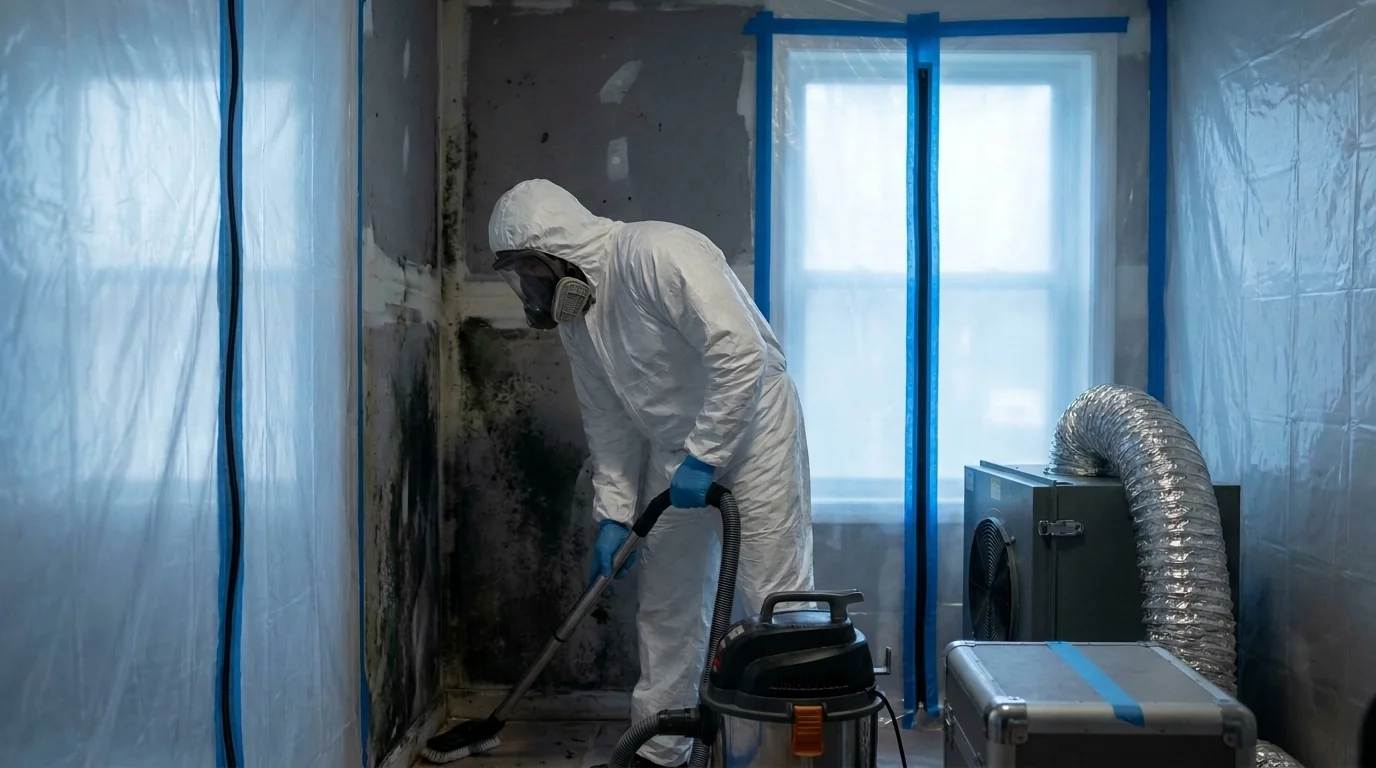
Once we’ve mapped the contamination, we establish negative air pressure containment using 6-mil poly barriers and HEPA-filtered air scrubbers. This prevents mold spores from migrating to unaffected rooms during removal. Affected materials — insulation, drywall, damaged framing — are removed, bagged, and disposed of properly. Structural surfaces are then HEPA-vacuumed and treated with an EPA-registered antimicrobial agent. Drying equipment stays on-site until moisture readings confirm the structure has returned to acceptable levels, typically measured against regional baseline humidity for Union County. As an IICRC Certified Firm (#210213), our process follows the S520 Standard for Professional Mold Remediation from start to finish.
We photograph and document every step — affected materials before removal, moisture readings, containment setup, and post-treatment conditions. For Cranford homeowners filing with NFIP flood insurance or a private carrier, that documentation record is often the difference between a fully covered claim and a disputed one.
Reaching Cranford from Kenilworth
Our headquarters sits in Kenilworth, directly adjacent to Cranford’s eastern border. North Avenue and South Avenue both run straight into town, putting us within a short drive of Downtown Cranford, the Nomahegan Park area, and neighborhoods along the Rahway River Parkway. Because we’re 24/7, a call at 2 a.m. after a sump pump failure gets the same response as a weekday morning call — a crew dispatched, not a voicemail.
Cranford Insurance Coordination
Cranford has one of the highest NFIP policy concentrations in Union County, and many homeowners have filed at least one flood claim in the past decade. We’re familiar with the documentation requirements those claims demand: scope of loss reports, moisture logs, material inventories, and photos that show the extent of damage before remediation begins. We provide all of it. We also work directly with private homeowners’ insurance carriers when mold results from a covered peril — a burst pipe, appliance leak, or storm-driven water intrusion — and can communicate with adjusters directly to reduce the back-and-forth on your end.
Local Note
One thing we’ve learned working in Cranford specifically: the stone and cinder-block foundation walls common in homes near Droescher’s Mill and along the older Riverside Drive blocks hold moisture in their mortar joints long after the visible water is gone. A moisture meter reading taken at the surface of those walls can look acceptable while the interior of the block is still saturated. We use both surface and deep-penetration readings — and in some cases thermal imaging — to confirm that remediation is complete rather than just surface-level. Skipping that step is why mold returns in the same spot six months later.
If you’ve noticed a musty smell in your basement, visible dark staining on walls or framing, or you’ve had any water intrusion in the past 90 days, call The Restoration Group at (908) 970-8533. We’ll assess the situation honestly, explain what we find, and give you a clear scope before any work begins.
Mold Remediation in Cranford: Service Coverage
Frequently Asked Questions
How fast can you arrive for mold remediation in Cranford?
My Cranford home flooded during a storm and I had it pumped out — do I still need mold remediation?
Are homes in the Riverside Drive area more prone to recurring mold after flooding?
How does NFIP flood insurance documentation work when mold is involved in a Cranford claim?
What does mold containment actually involve, and why does it matter in an older Cranford home?
How long does mold remediation typically take for a Cranford basement that flooded?
Mold Remediation response in Cranford
Most Cranford calls see a technician on-site within 60 minutes from our Fair Lawn headquarters.