Smoke Damage Restoration in Springfield
24/7 smoke damage restoration in Springfield, NJ. IICRC-certified, insurance billing accepted. Call (908) 970-8533.
Our IICRC-certified technicians are dispatched from our Fair Lawn, NJ headquarters and are typically on-site in Springfield within 60 minutes of your call.
A kitchen fire that gets knocked down fast can still leave a house smelling like a campfire for months — and in Springfield’s older colonials and capes, where plaster walls and horsehair insulation have been absorbing decades of household odors, smoke residue finds places to hide that a coat of paint will never fix. Whether the source was a stove fire on Mountain Avenue, a garage blaze near Jonathan Dayton High School, or smoke infiltration from a neighboring unit in one of the townhome complexes toward the Millburn line, the clock starts the moment the fire department leaves. Soot is acidic. Within 24 to 72 hours it begins etching glass, pitting metal fixtures, and permanently yellowing porous surfaces.
Why Springfield Homes Are Particularly Vulnerable to Smoke Damage
Springfield’s housing stock tells the story in the walls themselves. The 1920s through 1950s colonials and capes that line the Mountain Avenue corridor and the streets around Baltusrol Golf Club were built with plaster-over-lath construction, not modern drywall. Plaster is denser and more porous at the same time — it absorbs smoke odor compounds deep into the substrate, which means surface cleaning alone will not eliminate the smell. Protein smoke from kitchen fires is especially insidious in these homes because it leaves an almost invisible film that only becomes apparent when it starts to yellow paint and produce a persistent, acrid odor weeks later.
The Route 22 commercial strip adds a different dimension. Restaurant and retail losses here often involve cooking oils and synthetic materials — two smoke profiles that require different chemistry than a residential wood fire. Grease smoke leaves a sticky, amber residue that bonds to HVAC ducts and ceiling tiles; synthetic smoke from burning plastics and insulation carries toxic particulates that require proper containment and disposal under New Jersey DEP guidelines. Treating both with the same off-the-shelf deodorizer is a common mistake that leads to callbacks.
Our Smoke Damage Restoration Process in Springfield
When the call comes in from a 07081 address, the first step on-site is a structured scope assessment — not a quick walkthrough, but a room-by-room documentation of soot type, surface materials, and HVAC pathway. Smoke travels. In a two-story colonial, a first-floor fire can push smoke through wall cavities and into second-floor closets within minutes, depositing residue on clothing and stored items that homeowners often don’t discover until weeks later.
From there, the process moves in a defined sequence:
- Containment and air scrubbing — HEPA air scrubbers run continuously to reduce airborne particulate while the crew works, protecting both occupants (if any remain) and technicians.
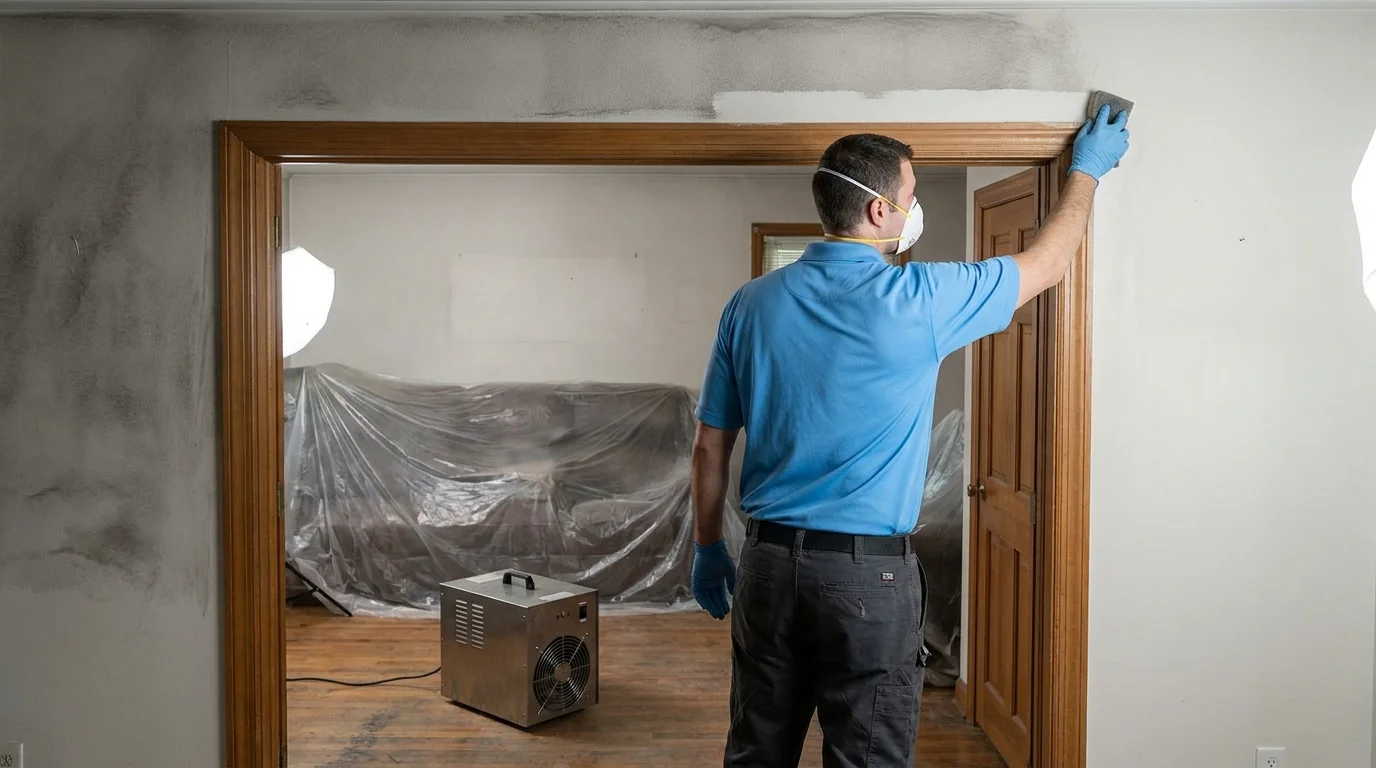
- Dry soot removal — Chemical sponges and HEPA-vacuuming lift loose soot before any wet cleaning begins. Wiping soot before dry-removing it drives it deeper into porous surfaces.
- Surface cleaning by material type — Plaster walls get a different cleaning agent than painted drywall, wood trim, or fabric upholstery. Matching chemistry to substrate prevents secondary damage.
- HVAC decontamination — Duct systems are inspected and cleaned; smoke that enters the air handler will recirculate odor indefinitely if left untreated.
- Thermal fogging or hydroxyl treatment — For persistent odor, we deploy hydroxyl generators or thermal foggers calibrated to the square footage and construction type of the specific home.
- Final clearance documentation — Written scope of work, before-and-after photos, and material logs formatted for insurance submission.
The team is IICRC Certified (Firm #210213) and operates under NJ Licensed Home Improvement Contractor status through the NJ Division of Consumer Affairs, which matters when permits or contractor documentation are required for the repair phase.
Reaching Springfield from Kenilworth
The Restoration Group’s base in Kenilworth puts Springfield within a short drive — Route 22 east connects the two directly, and the Garden State Parkway offers an alternate route when 22 is congested. Because the team operates 24/7, a call at 2 a.m. from the Springfield center or the Baltusrol area reaches a live dispatcher, not an answering service, and a crew can be dispatched without waiting for business hours.
Insurance Coordination for Springfield Fire and Smoke Claims
Smoke damage claims in Union County frequently involve disputes over scope — insurers sometimes push back on HVAC cleaning, contents pack-out, or odor treatment line items. The Restoration Group documents losses with moisture mapping, photo logs, and itemized material reports formatted to align with Xactimate, the estimating platform most NJ carriers use. That documentation reduces the back-and-forth and helps adjusters approve realistic scopes rather than minimum-cost alternatives that leave odor behind.
Local Note
Springfield’s older plaster homes — particularly those on streets that run off the Mountain Avenue corridor — often have original cast-iron radiator systems with decades of accumulated dust in the fins. When a fire occurs, that dust becomes a secondary smoke carrier: the first time the heat kicks on after restoration, it can volatilize residual odor compounds and make a cleaned home smell like the fire happened yesterday. During every smoke job in a pre-1960 Springfield home, the crew inspects and wipes down radiator fins as part of the deodorization scope. It’s a small step that prevents a frustrating callback.
If your Springfield property has smoke damage — whether from a contained kitchen fire or a larger loss — call The Restoration Group at (908) 970-8533. The team is available around the clock, the documentation is built for insurance, and the process is calibrated to the specific building materials found in Union County’s older housing stock.
Smoke Damage Restoration in Springfield: Service Coverage
Frequently Asked Questions
How fast can you arrive for smoke damage restoration in Springfield?
How quickly can The Restoration Group reach the Baltusrol area or Springfield center after a smoke damage call?
Springfield has a lot of pre-1950 plaster-wall homes — does that change how smoke damage restoration is handled?
A fire started in my finished basement in the 07081 ZIP — will smoke damage in the upper floors be covered in the same claim?
What types of smoke residue are hardest to remediate, and are any of them common in Springfield's Route 22 commercial properties?
How long does smoke odor restoration typically take in a Springfield colonial or cape?
Will my homeowners insurance cover smoke damage restoration in Springfield?
Smoke Damage Restoration response in Springfield
Most Springfield calls see a technician on-site within 60 minutes from our Fair Lawn headquarters.