Mold Remediation in Springfield
24/7 mold remediation in Springfield, NJ. IICRC-certified, insurance billing accepted. Call (908) 970-8533.
Our IICRC-certified technicians are dispatched from our Fair Lawn, NJ headquarters and are typically on-site in Springfield within 60 minutes of your call.
Springfield’s finished basements were already vulnerable before Ida made Route 22 look like a tributary of the Rahway River — and wherever floodwater lingers, mold follows within 24 to 48 hours. The west branch of the Rahway drains off the Watchung ridges right through the township’s low-lying pockets, meaning a single heavy storm cycle can push moisture into wall cavities and subfloor assemblies that homeowners won’t notice for weeks. If you’re smelling something musty in a Springfield home or seeing discoloration along a basement wall, the window to contain it is short.
Why Springfield Properties See Mold Issues
The housing stock tells most of the story. Colonials and cape cods built between the 1920s and 1950s — common throughout Springfield Center and the Mountain Avenue corridor — were constructed before modern vapor barriers became standard. Their basement walls are often poured concrete or block, both of which wick groundwater steadily during the extended wet seasons New Jersey sees. Finished basement renovations added over the decades frequently used paper-faced drywall directly against those walls, creating a near-perfect growth medium the moment moisture gets in.
The newer townhome complexes closer to the Millburn line introduce a different challenge: shared wall assemblies and mechanical chases that let mold travel between units before either resident realizes there’s a problem. A slow leak behind a shared plumbing wall can colonize insulation in both units while the source goes undetected for months. The Baltusrol area’s mix of older single-family homes and mature tree canopy also means shaded rooflines stay damp longer after rain, accelerating surface mold on soffits and attic sheathing.
Our Mold Remediation Process in Springfield
Every job starts with a thorough assessment — moisture mapping with thermal imaging and pin meters to find hidden saturation behind finished surfaces, not just what’s visible. In Springfield’s older colonials, that often means checking inside plaster wall cavities and beneath original hardwood subfloors, where moisture readings can stay elevated long after the surface feels dry to the touch.
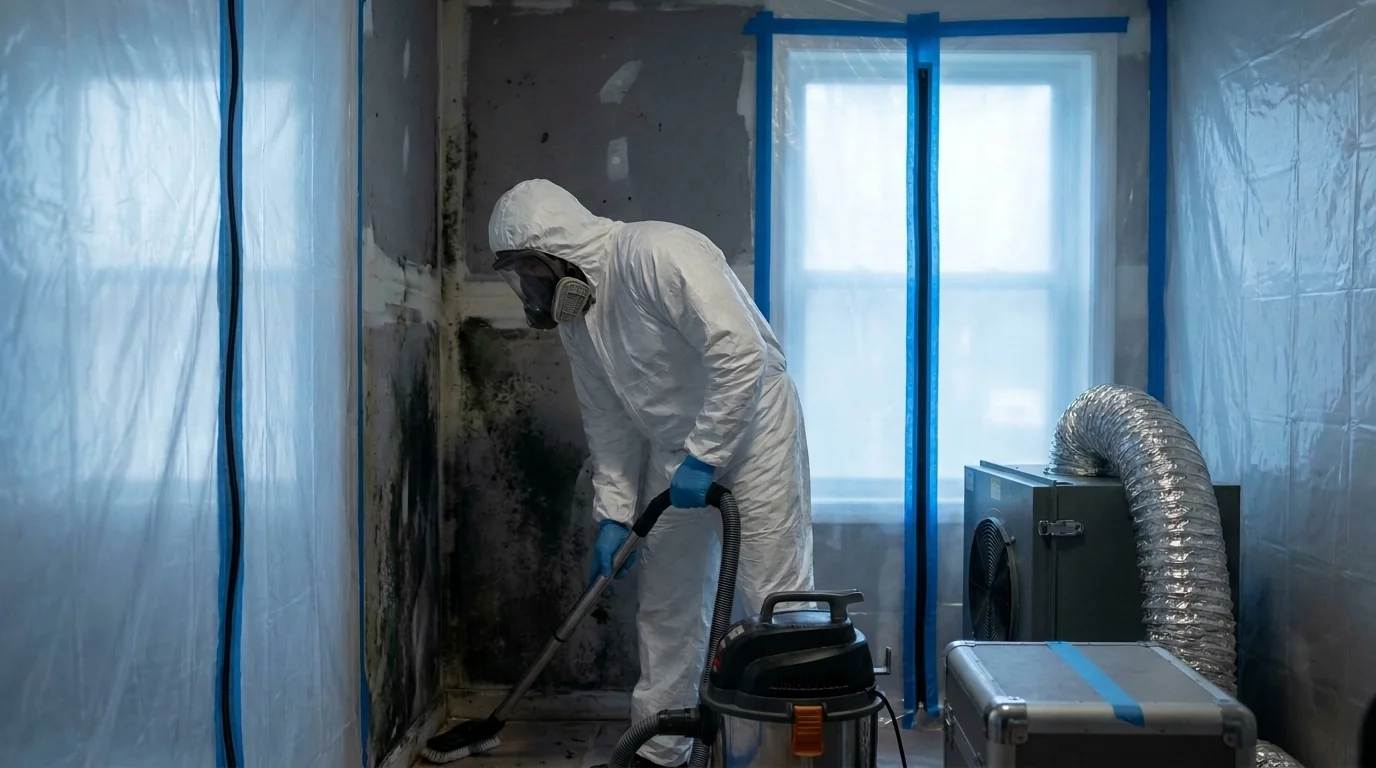
Once the scope is clear, we establish negative-air containment using 6-mil poly barriers and HEPA-filtered air scrubbers to prevent spores from migrating to unaffected areas of the home. Affected materials — drywall, insulation, framing with surface growth — are removed, bagged, and disposed of per New Jersey Department of Environmental Protection guidelines. Remaining structural surfaces are HEPA-vacuumed, treated with an EPA-registered antimicrobial, and dried to verified moisture targets before any reconstruction begins. We document every step with photos and moisture logs, which matters when an insurance adjuster needs to see proof of scope.
Reaching Springfield from Kenilworth
The Restoration Group operates out of Kenilworth, which puts Springfield within a short drive via Route 22 east — the same corridor that floods during major storm events, which is precisely when calls come in. We’re available around the clock, so whether a homeowner near Meisel Avenue Park discovers a burst pipe at 2 a.m. or a property manager on the Route 22 commercial strip finds a leak on a Sunday morning, we can dispatch immediately. Crews familiar with the township’s layout know which neighborhoods sit in the lower drainage paths and arrive ready for the conditions those addresses typically present.
Springfield Insurance & HOA Coordination
Most mold claims in Springfield stem from a covered water loss — a failed sump pump, a roof leak, a burst supply line — and the documentation we produce is built to support that claim from day one. We photograph affected materials before removal, record moisture readings at each test point, and provide a written scope of work your adjuster can review directly. For townhome communities near the Millburn line where HOA master policies may overlap with individual unit coverage, we can help clarify which surfaces fall under which policy before work begins, reducing the back-and-forth that delays remediation.
Local Note
In Springfield’s pre-1950 colonials, original plaster-and-lath walls behave very differently from modern drywall when mold takes hold. Plaster itself doesn’t support mold growth the way paper-faced drywall does, but the wood lath behind it absolutely does — and because plaster is dense, surface readings can look acceptable while the lath cavity behind it is actively colonized. Crews working in Springfield Center and the Mountain Avenue corridor are trained to probe behind plaster rather than rely on surface moisture alone, because missing lath mold means the problem comes back inside a year.
If you’re in the 07081 ZIP code and dealing with visible growth, an unexplained musty odor, or a recent water event in a finished basement, call (908) 970-8533 now. We’ll assess the situation, contain what’s there, and walk you through every step so there are no surprises — not in the process, not in the paperwork.
Mold Remediation in Springfield: Service Coverage
Frequently Asked Questions
How fast can you arrive for mold remediation in Springfield?
Are Springfield's older colonials along the Mountain Avenue corridor more prone to recurring mold than newer construction?
How quickly can your team reach a home near Meisel Avenue Park or Springfield Center for an emergency mold assessment?
Springfield saw significant flooding during Ida — if a basement was flooded then and never fully dried, is mold likely even if nothing is visible?
For townhomes near the Millburn line with shared walls, how do you handle mold that may have spread between units?
What does the mold remediation process actually involve, and how long does a typical Springfield job take from start to clearance?
Will my homeowners insurance cover mold remediation in Springfield?
Mold Remediation response in Springfield
Most Springfield calls see a technician on-site within 60 minutes from our Fair Lawn headquarters.