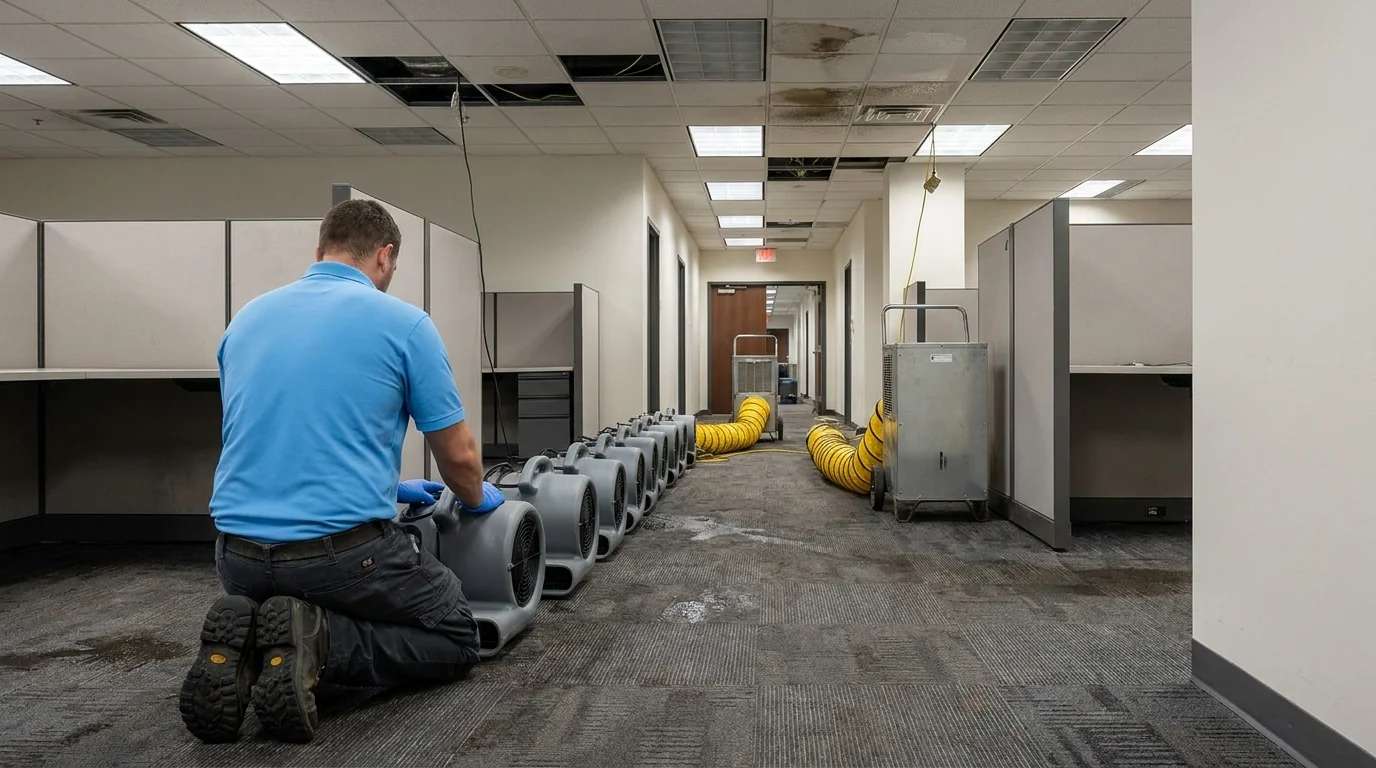
Commercial Restoration in Brooklyn
24/7 commercial restoration in Brooklyn, NY. IICRC-certified, insurance billing accepted. Call (908) 970-8533.
Our IICRC-certified technicians are dispatched from our Fair Lawn, NJ headquarters and are typically on-site in Brooklyn within 60 minutes of your call.
Brooklyn’s commercial corridors — from the ground-floor retail lining Flatbush Avenue to the converted industrial lofts near the Brooklyn Navy Yard — sit inside some of the oldest built fabric in New York City. When a burst pipe floods a co-working space or a kitchen fire chars the back wall of a restaurant in Williamsburg, the recovery isn’t just about drying drywall. It’s about navigating landmarked facades, shared party walls, co-op board approval processes, and insurance documentation rigorous enough to satisfy a Manhattan-based property management company. The Restoration Group responds 24/7 and brings the kind of structured commercial restoration process that Brooklyn’s dense, layered building stock actually demands.
Why Brooklyn Commercial Properties Face Distinct Restoration Challenges
Brooklyn’s commercial real estate is inseparable from its residential fabric. A retail tenant in Park Slope occupies the garden level of an 1890s brownstone; a Bushwick creative studio is housed in a masonry warehouse with a century of moisture history baked into its brick. That building stock creates conditions that generic restoration contractors routinely underestimate.
First, there’s water. Brooklyn sits on a glacial outwash plain with a high water table in low-lying neighborhoods, and storm events have only intensified that exposure. Hurricane Ida turned basement-level commercial spaces across the borough into retention ponds overnight. Coastal ZIP codes like 11235 — covering Coney Island and Brighton Beach — carry storm-surge memory from Sandy that shaped how insurers now underwrite flood losses there. Even inland, the combined sewer system backs up under heavy rain, pushing contaminated water into cellar-level mechanical rooms and below-grade retail.
Second, there’s fire. Older masonry buildings with balloon-frame interior partitions allow fire and smoke to travel vertically through wall cavities in ways that modern platform-frame construction doesn’t. A kitchen fire in one tenant’s space can leave odor and soot in an adjacent unit’s HVAC supply before the sprinkler system even activates.
Third, there’s the regulatory layer. New York City’s Department of Buildings, Local Law 11 facade inspection requirements, and the city’s strict rules around asbestos and lead disturbance all add compliance steps that don’t exist in most other markets. Commercial restoration work that disturbs pre-1978 materials in Brooklyn requires documented protocols — not optional best practices.
Our Commercial Restoration Process, Calibrated for Brooklyn
Every commercial loss is different, but the sequence matters: contain the damage, document it thoroughly, dry or clean to a measurable standard, then restore. In Brooklyn, each of those steps has a local wrinkle.
Containment and access. Dense blocks in Brooklyn Heights or Bay Ridge mean neighboring tenants and building residents share walls, HVAC systems, and egress routes. Before work begins, we assess party-wall exposure and coordinate with building management so remediation doesn’t create secondary problems for adjacent occupants.
Documentation. Commercial property managers and co-op boards need more than photos. We produce moisture mapping reports, scope-of-loss summaries, and material inventories formatted for direct submission to carriers — including the documentation language New York-based adjusters expect to see on commercial claims.
Drying to standard. We dry structural assemblies to the IICRC S500 standard using commercial-grade desiccant dehumidifiers and negative-air containment. In masonry buildings, that process takes longer than it does in wood-frame construction — brick and plaster release absorbed moisture slowly, and cutting corners here leads to mold colonization within days.
Restoration. Original tin ceilings, plaster medallions, and exposed brick are not decorative afterthoughts in Brooklyn commercial spaces — they’re part of what tenants pay for. Our restoration phase accounts for historic materials, and we document what’s salvaged versus replaced for both insurance and landmark compliance purposes.
Reaching Brooklyn from Kenilworth
The Restoration Group is based in Kenilworth, NJ, and reaches Brooklyn via the Goethals Bridge to the Staten Island Expressway and across the Verrazzano-Narrows into Bay Ridge, or via the Holland Tunnel and the Brooklyn-Battery Tunnel depending on traffic and destination. Because we operate 24/7, we can dispatch crews at off-peak hours when tunnel and bridge crossings move faster — a real advantage when a commercial client needs a crew on-site before their tenants arrive in the morning.
For businesses in the 11201 ZIP code — DUMBO, Brooklyn Heights, downtown Brooklyn — the Battery Tunnel route typically delivers the fastest access. Calls from Canarsie or the southeastern neighborhoods route differently, and our dispatch team accounts for that when confirming arrival windows.
Brooklyn Insurance and Property Management Coordination
Commercial losses in Brooklyn almost always involve a third party beyond the business owner: a landlord, a co-op board, a property management company, or a commercial carrier with a New York-specific policy endorsement. We’ve worked through that layer before.
We communicate directly with adjusters, provide line-item estimates in Xactimate format, and can coordinate with the building’s own engineer or architect when structural assessments are required. For co-op and condo boards, we provide the board-ready documentation packages that management companies need before authorizing work — because in Brooklyn, getting that paperwork right is often what determines whether restoration starts in 48 hours or two weeks.
Local Note
In Brooklyn’s brownstone belt — particularly in blocks between Park Slope and the Bed-Stuy fringe — commercial spaces in garden-level and cellar units often share a drainage plane with the residential units above. When a commercial tenant experiences a sewage backup or a significant water intrusion, the moisture doesn’t stay contained to the commercial floor. It wicks upward through the party floor assembly into the residential unit above, sometimes without visible signs for days. Experienced crews check the floor above as a standard step on any below-grade commercial loss in this building type — not because it’s required, but because missing it means a second claim six weeks later.
If your Brooklyn business has taken on water, smoke, or structural damage, call The Restoration Group at (908) 970-8533. We’re available around the clock and understand what commercial restoration in this borough actually involves.
Commercial Restoration in Brooklyn: Service Coverage
Frequently Asked Questions
How fast can you arrive for commercial restoration in Brooklyn?
Can you reach a commercial property in downtown Brooklyn or DUMBO quickly given your New Jersey location?
How does Brooklyn's older building stock affect the timeline for commercial water damage restoration?
Do Brooklyn's lead and asbestos regulations affect commercial restoration work, and how do you handle that?
What documentation do Brooklyn co-op boards and property management companies typically require before restoration work can start?
Are below-grade commercial spaces in Park Slope or Brooklyn Heights at higher risk for recurring water intrusion after a restoration?
Will my homeowners insurance cover commercial restoration in Brooklyn?
Commercial Restoration response in Brooklyn
Most Brooklyn calls see a technician on-site within 60 minutes from our Fair Lawn headquarters.