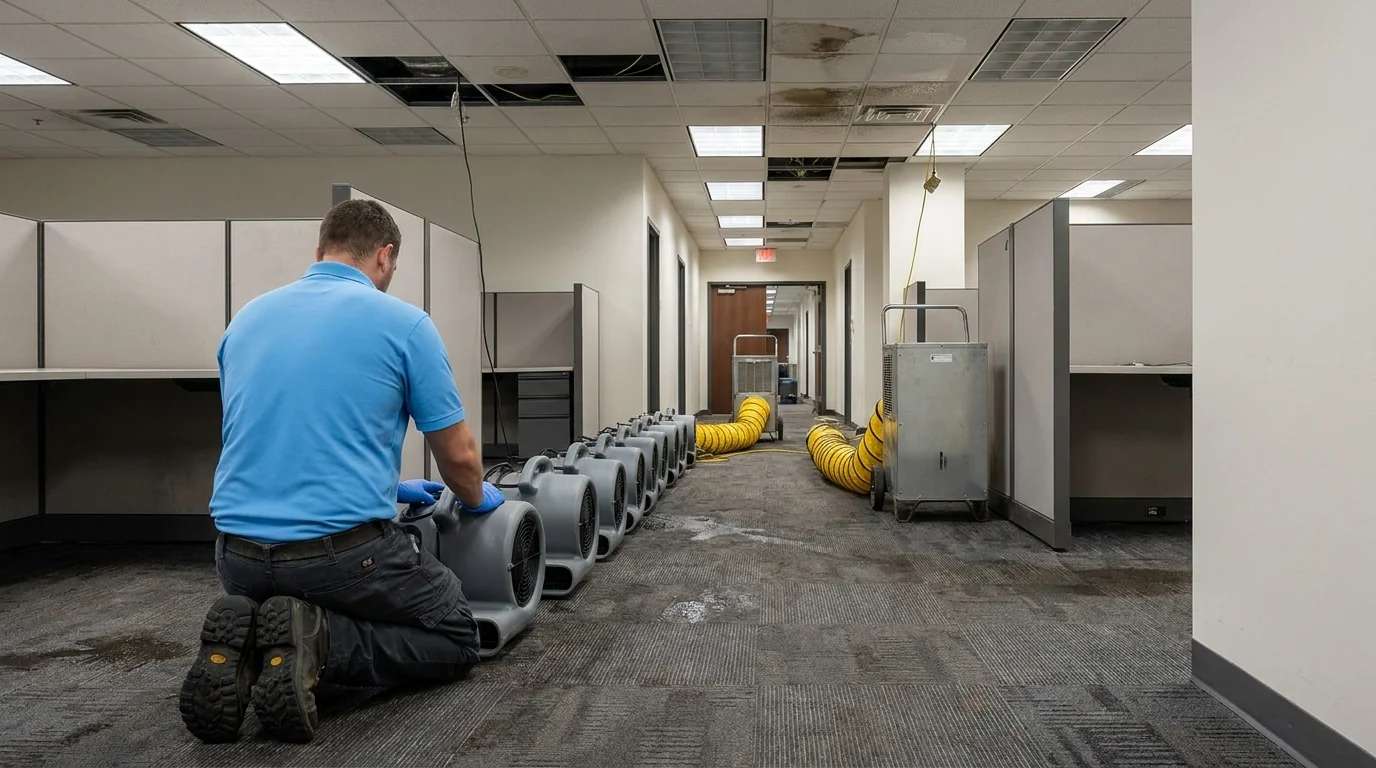
Commercial Restoration in Cranford
24/7 commercial restoration in Cranford, NJ. IICRC-certified, insurance billing accepted. Call (908) 970-8533.
Our IICRC-certified technicians are dispatched from our Fair Lawn, NJ headquarters and are typically on-site in Cranford within 60 minutes of your call.
Cranford’s nickname — the Venice of New Jersey — tells you everything a commercial property owner here already knows: the Rahway River is beautiful until it isn’t. Three named storms in twenty-two years (Floyd, Irene, Ida) have put storefronts, office suites, and mixed-use buildings underwater, and the damage doesn’t stop when the water recedes. For businesses in 07016, a fast, documented restoration response isn’t a luxury — it’s the difference between reopening in days and losing a lease. The Restoration Group operates around the clock from our Kenilworth headquarters, less than ten minutes from most of Cranford’s commercial corridors.
Why Cranford Commercial Properties Face Repeat Restoration Challenges
The flood history here is unusually concentrated for a Union County town this size. Riverside Drive-area businesses sit directly in the Rahway River’s path, which means they can take on water from the river channel itself during a heavy storm event. Properties farther inland — along the Downtown Cranford retail strip and near the Nomahegan Park corridor — flood differently: overwhelmed municipal storm sewers back up through floor drains and basement walls, often with no advance warning. Both patterns produce the same result inside a commercial building: standing water under flooring systems, saturated insulation inside partition walls, and a 24-to-48-hour window before mold colonization becomes a secondary problem.
Cranford’s commercial building stock adds another layer of complexity. Many of the town’s mixed-use and retail buildings date to the 1920s through 1940s — the same era as the surrounding residential colonials and capes. That means original terra-cotta block, balloon-frame construction, and masonry foundations that absorb and hold moisture in ways that modern poured-concrete structures don’t. Drying timelines in these older buildings run longer, and moisture mapping has to account for cavities that don’t show up on standard blueprints.
Our Commercial Restoration Process in Cranford
Every commercial job starts with a scope assessment before any equipment rolls in. For a Cranford property that has flooded, that means identifying the water category (clean supply line vs. storm-sewer backflow carries very different contamination risks), mapping affected materials with thermal imaging and moisture meters, and establishing a drying goal tied to the building’s baseline humidity — which in a river town runs higher than inland communities.
From there, the process moves in a defined sequence:
- Water extraction and containment — truck-mounted extractors pull standing water from hard and soft surfaces; containment barriers protect unaffected inventory or tenant spaces
- Structural drying — industrial desiccant dehumidifiers and high-velocity air movers are placed to IICRC S500 standard drying protocols, with daily moisture readings logged and dated
- Antimicrobial treatment — applied to any surface that contacted category 2 or 3 water before drying begins
- Controlled demolition if required — saturated drywall, flooring, or insulation is removed, documented with photographs, and itemized for your adjuster
- Reconstruction coordination — once the structure reads dry, we move into rebuild, keeping your timeline and your tenants’ needs in the same conversation
For fire or smoke damage in a commercial space, the process shifts toward odor neutralization and soot chemistry — both of which behave differently in older masonry buildings where smoke penetrates porous block and mortar joints deeply.
Reaching Cranford from Kenilworth
Our Kenilworth base puts us directly adjacent to Cranford’s western boundary. North Avenue and South Avenue connect the two towns without highway routing, which matters when a burst sprinkler line is soaking a server room at 2 a.m. Because we operate 24/7, a call to (908) 970-8533 reaches a live dispatcher at any hour — not an answering service. We stage equipment for Cranford commercial calls from the same facility we use for our Union County residential work, so there’s no transfer delay between residential and commercial dispatch.
For properties near Downtown Cranford or along the Lincoln Park East corridor, routing through Centennial Avenue typically avoids the intersection congestion that slows response along South Avenue during business hours.
Insurance Documentation for Cranford’s Flood-Prone Commercial Properties
Many Cranford business owners carry National Flood Insurance Program (NFIP) policies in addition to standard commercial property coverage — a practical reality when your building has flooded in three of the last twenty-five years. NFIP claims have stricter documentation requirements than standard carriers: itemized moisture logs, dated photographs of affected materials before removal, and written drying reports that show the structure returned to acceptable moisture levels.
We build that documentation into every job as a standard step, not an add-on. Our project files include daily moisture readings, pre- and post-remediation photographs, and a written scope of loss formatted for adjuster review. If your carrier or NFIP adjuster needs a site walk, we coordinate scheduling directly.
Local Note
One pattern we’ve seen repeatedly in Cranford’s older commercial buildings near the Rahway River Parkway: the original basement floor drains in these structures were sized for the storm-sewer capacity of the 1930s, not for the volume that backs up during a modern 100-year rain event. When those drains reverse-flow, water enters the basement faster than most sump systems can handle, and it carries sewer-category contamination even if the source looks like clean stormwater. Any commercial property owner in this part of Cranford should treat basement flood water as category 3 until testing says otherwise — and restoration crews who don’t know the local sewer history sometimes underestimate the contamination level and under-scope the remediation.
For a business that has been through this before, call (908) 970-8533. We know what Cranford’s flood events actually leave behind, and we document it in a way that holds up with your carrier.
Commercial Restoration in Cranford: Service Coverage
Frequently Asked Questions
How fast can you arrive for commercial restoration in Cranford?
How quickly can The Restoration Group reach a commercial property in Downtown Cranford after a flood call?
Cranford has flooded three times in 25 years — does your documentation hold up for NFIP claims specifically?
Are Riverside Drive-area commercial buildings treated differently than properties farther inland in Cranford?
How long does structural drying take in Cranford's older commercial buildings?
Can you handle both the emergency mitigation and the rebuild for a Cranford commercial space, or do we need separate contractors?
Will my homeowners insurance cover commercial restoration in Cranford?
Commercial Restoration response in Cranford
Most Cranford calls see a technician on-site within 60 minutes from our Fair Lawn headquarters.