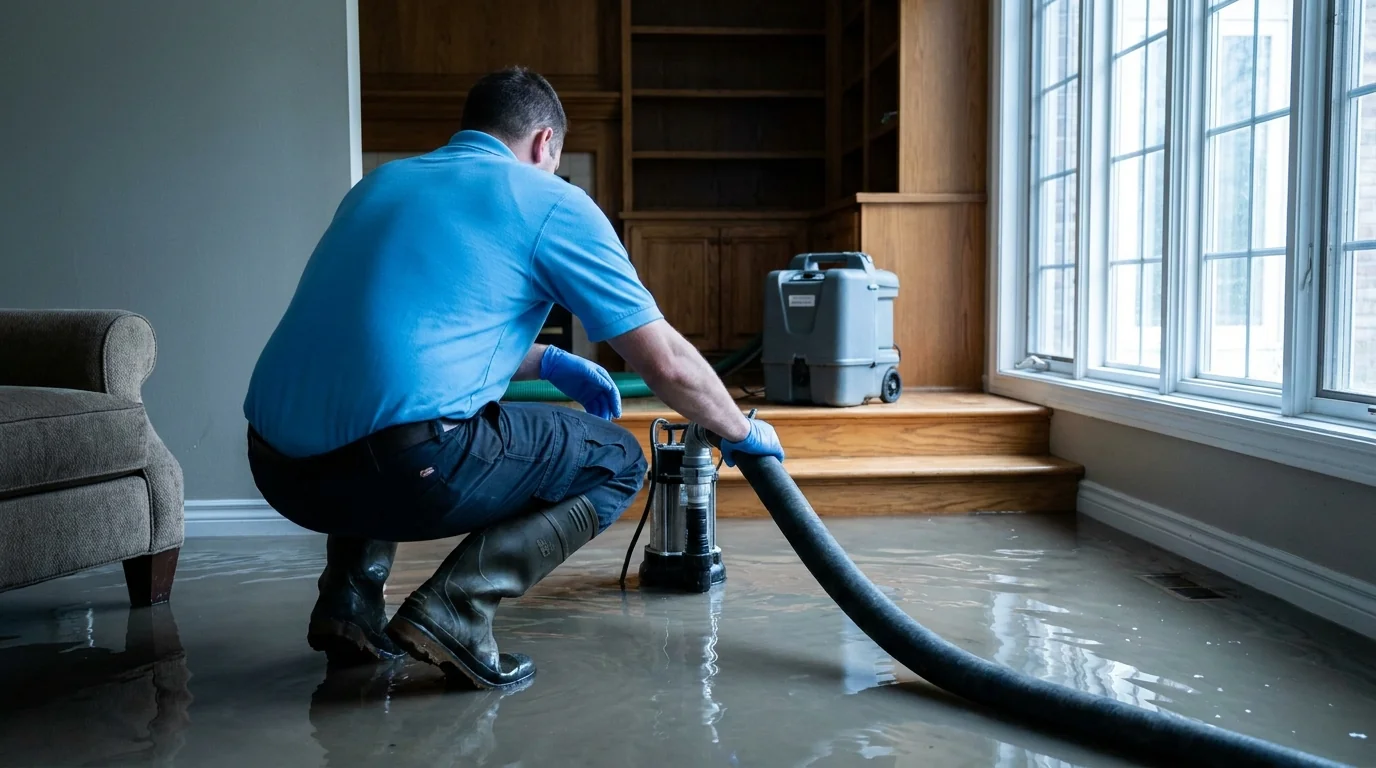
Flood Damage Restoration in Brooklyn
24/7 flood damage restoration in Brooklyn, NY. IICRC-certified, insurance billing accepted. Call (908) 970-8533.
Our IICRC-certified technicians are dispatched from our Fair Lawn, NJ headquarters and are typically on-site in Brooklyn within 60 minutes of your call.
Brooklyn’s basement flooding problem is not a weather anomaly — it’s a structural inevitability. The borough’s brownstone belt, stretching from Brooklyn Heights through Park Slope and into the Bed-Stuy fringe, is built on 1880s-to-1920s masonry rowhouses where garden-level and cellar apartments sit below grade, often with original clay-drain laterals that back up the moment a heavy storm overwhelms the combined sewer system. When Ida dropped more than three inches of rain on the city in a single hour, those basements filled in minutes. If you’re dealing with standing water right now, call (908) 970-8533 — the team is available around the clock.
Why Brooklyn Properties Flood Differently Than Most
Brooklyn’s housing stock creates a specific set of flood vulnerabilities that don’t show up in newer suburban construction. The masonry walls of a Park Slope brownstone wick moisture laterally through the mortar joints long after the visible water is gone — you can extract every drop from the floor and still have wet wall cavities weeks later. Original plaster-on-lath, common in pre-war buildings from Flatbush to Bay Ridge, absorbs water more slowly than modern drywall but releases it even more slowly, which means drying timelines are longer and moisture readings can be deceptive if you’re only checking the surface.
Coastal neighborhoods carry a different risk profile entirely. Canarsie and the low-lying areas near the Coney Island boardwalk sit in FEMA flood zones that saw real storm-surge inundation during Sandy, and the soil saturation in those areas means hydrostatic pressure can push water through foundation walls even without a direct plumbing failure. Red Hook’s industrial-to-residential conversions add another layer: older concrete slabs with no vapor barrier and drainage systems that were never designed for residential occupancy.
The city’s combined sewer system is also a factor most restoration companies from outside the metro don’t think about. During heavy rain, wastewater and stormwater share the same pipes, and when those pipes surcharge, the water backing up into a Brooklyn basement isn’t clean water — it’s Category 3 contaminated water that requires a different extraction and sanitization protocol than a simple pipe burst.
Our Flood Damage Restoration Process in Brooklyn
Every job starts with moisture mapping before a single piece of equipment is placed. In a rowhouse with a shared party wall — common throughout Williamsburg and Brooklyn Heights — water doesn’t respect property lines. We check adjacent wall cavities and document moisture readings on both sides so the neighbor’s management company or co-op board has the data they need, and so your insurer has a complete loss picture.
Extraction comes next, using truck-mounted and portable units calibrated to the job size. For cellar apartments with low clearance and narrow stair access, we stage portable high-CFM extractors that can be broken down and carried in — no waiting for a machine that won’t fit through a brownstone vestibule. After extraction, structural drying follows IICRC S500 standards: commercial-grade desiccant or refrigerant dehumidifiers, air movers positioned to create a directed airflow pattern through wall cavities, and daily moisture logging until readings return to baseline.
For contaminated-water events — sewer backups, storm surge — we apply EPA-registered antimicrobial agents to all affected surfaces after extraction and before drying begins. Affected porous materials (insulation, saturated plaster that can’t be dried in place, damaged subfloor sections) are removed, documented with photographs, and inventoried for your insurance claim before disposal.
Reaching Brooklyn from Kenilworth
The Restoration Group operates out of Kenilworth, NJ, and covers the full NY-metro area including all of Brooklyn’s ZIP codes — from 11201 in Brooklyn Heights to 11235 out near Sheepshead Bay. The team dispatches 24/7, which matters when a sewer backup hits a garden apartment at 2 a.m. Routes via the Goethals Bridge or the Staten Island Expressway to the Verrazzano connect to the borough quickly, and for jobs in northern Brooklyn — Williamsburg, Bushwick — the Lincoln Tunnel route is often faster. Scheduling and dispatch can be reached any hour at (908) 970-8533.
Insurance and Co-op Board Documentation in Brooklyn
Brooklyn’s ownership landscape is unusually complex. A single brownstone on a Park Slope block might have a ground-floor owner-occupant, a garden-level rental tenant, and a co-op on the upper floors — each with a different insurer and a different expectation for documentation. We produce itemized moisture logs, photo documentation organized by room and elevation, and written scope-of-work reports formatted to meet the documentation requirements most major carriers use for water loss claims. For co-op and condo boards, we can provide a separate summary report for the managing agent without disclosing individual unit owner information.
Local Note
In Brooklyn’s pre-war rowhouses, the gap between the finished floor and the original subfloor — sometimes filled with decades of compressed debris and sawdust — acts like a sponge during a flood event. We’ve pulled moisture readings from that void space in Flatbush and Bay Ridge homes that were still elevated two weeks after the visible water was gone, while the homeowner assumed the job was finished. Thermal imaging during the initial assessment catches this; skipping it means mold has a head start in a space nobody is watching.
If you’re in Brooklyn and dealing with flood damage — whether it’s a burst pipe in a brownstone cellar, a storm-surge event near the waterfront, or a sewer backup that turned a garden apartment into a contamination scene — call (908) 970-8533. The Restoration Group’s certified team is available 24/7 to assess the damage, begin extraction, and build the documentation trail your insurer needs from day one.
Flood Damage Restoration in Brooklyn: Service Coverage
Frequently Asked Questions
How fast can you arrive for flood damage restoration in Brooklyn?
How quickly can The Restoration Group reach a Brooklyn address after I call?
My Park Slope brownstone has original plaster walls. Does that change how long flood drying takes?
The water in my basement smells like sewage. Does that affect the restoration process?
My building has a co-op board and a managing agent. Can you provide documentation they'll accept alongside my insurance claim?
Are Canarsie and other low-lying Brooklyn neighborhoods at higher risk for recurring flood damage?
Flood Damage Restoration response in Brooklyn
Most Brooklyn calls see a technician on-site within 60 minutes from our Fair Lawn headquarters.