Flood Damage Restoration in Cranford
24/7 flood damage restoration in Cranford, NJ. IICRC-certified, insurance billing accepted. Call (908) 970-8533.
Our IICRC-certified technicians are dispatched from our Fair Lawn, NJ headquarters and are typically on-site in Cranford within 60 minutes of your call.
Cranford earns its nickname — the Rahway River doesn’t just pass through town, it defines it. For homeowners along Riverside Drive or near the Cranford Canoe Club, that means a recurring reality: when the Rahway rises, basements fill, first floors flood, and the clock starts ticking on structural damage and mold. Hurricanes Floyd, Irene, and Ida each put whole blocks of 07016 underwater, and the storm-sewer system that serves the rest of town has its own breaking point. The Restoration Group responds 24/7 to flood damage calls across Cranford, bringing the equipment and documentation process that repeat-flood homeowners here have come to depend on.
Why Cranford Properties Flood the Way They Do
Cranford sits in a natural bowl carved by the Rahway River, and the town’s two distinct flood mechanisms catch a lot of homeowners off guard. Properties closest to the river — particularly along the Riverside Drive corridor and near Rahway River Parkway — flood directly when the channel overtops its banks. But neighborhoods further inland, including parts of Sunny Acres and Lincoln Park East, flood from a different source: storm sewers that back up faster than the volume of a heavy rain event can drain. Both scenarios push water into basements hard and fast.
The housing stock compounds the problem. Most of Cranford’s residential blocks were built between 1900 and the 1940s — full-basement colonials and cape cods with original fieldstone or poured concrete foundations that weren’t designed to modern waterproofing standards. Older mortar joints and cold joints between the footing and the wall are common entry points. Once water is in, it saturates original hardwood subfloors, old-growth framing, and in many cases, original plaster walls — all of which hold moisture longer than modern building materials.
Our Flood Damage Restoration Process in Cranford
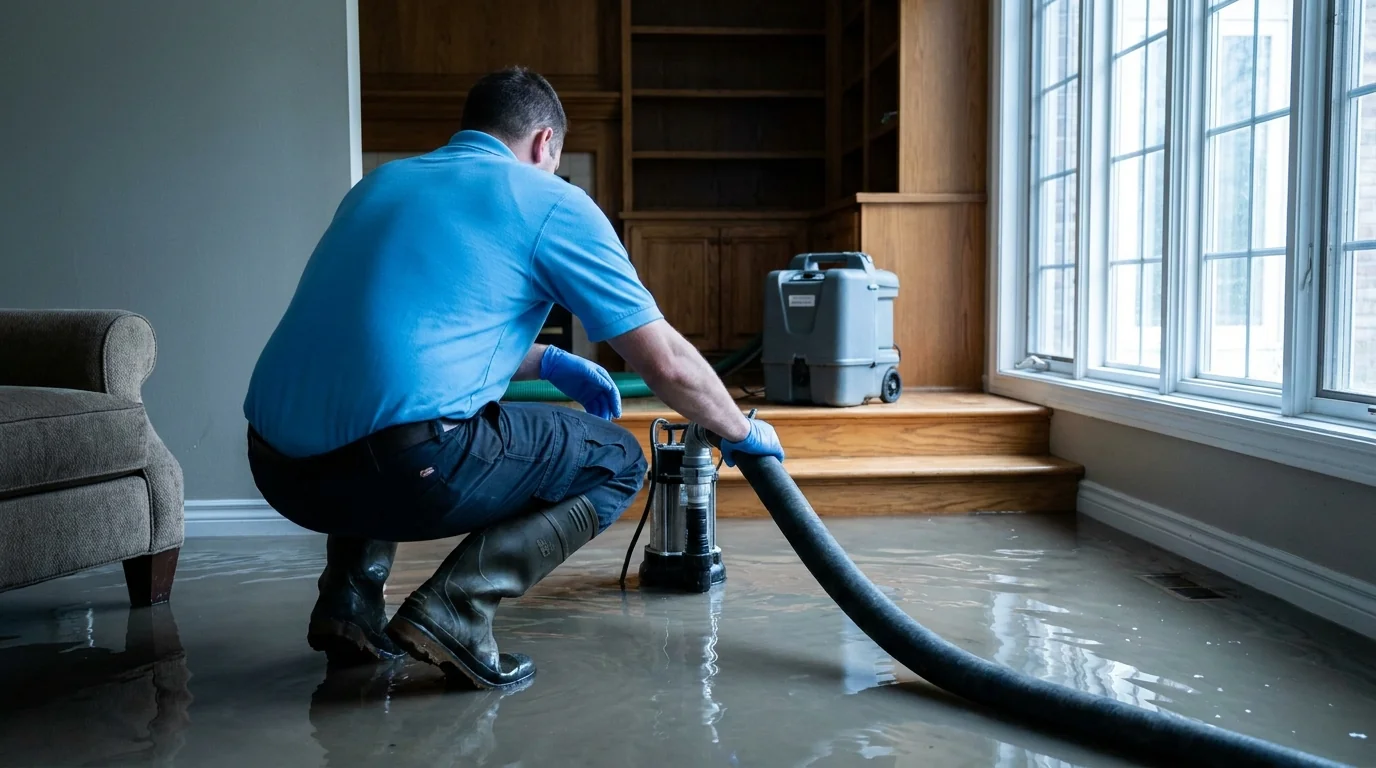
The first priority when we arrive is stopping the water source or confirming it has stopped, then getting standing water out before it migrates further into the structure. For a typical Cranford basement flood, that means truck-mounted extraction followed by targeted drying with industrial dehumidifiers and air movers calibrated to the actual cubic footage and material density of the space — not a generic setup.
From there, the process follows a documented sequence:
- Moisture mapping — thermal imaging and pin/pinless meters to trace exactly where water has wicked into framing, subfloor, and wall cavities, so nothing gets missed and everything gets recorded.
- Controlled demolition — removing saturated drywall, insulation, or flooring to the flood cut line, which also gives adjusters clear visual documentation.
- Structural drying — drying logs maintained daily, with readings tied to the IICRC S500 standard for Category 1, 2, or 3 water, depending on what came in (river water and sewer backflow are not the same job).
- Antimicrobial treatment — applied to framing and concrete before any rebuild begins, particularly important in Cranford’s older basements where mold can colonize within 48 to 72 hours of a flood event.
- Rebuild coordination — as an NJ Licensed Home Improvement Contractor, we can carry the job through repairs rather than handing off to a second crew.
Reaching Cranford from Kenilworth
Our headquarters in Kenilworth sits one town over from Cranford — a straight shot down North Avenue or a quick run via Route 28 depending on traffic. That proximity matters when a call comes in at 2 a.m. after a storm has pushed the Rahway over its banks. We’re dispatched 24/7, and the short drive means equipment is on the ground in Cranford fast, before standing water has time to wick further into subfloors and wall assemblies.
For properties near Nomahegan Park or in the Downtown Cranford area, we’re familiar with the street grid and the parking constraints that come with older, tighter residential blocks — we stage equipment to minimize disruption to neighbors while keeping hoses and power runs clear of sidewalks.
Insurance Documentation for Cranford’s Repeat-Flood Homeowners
A significant number of Cranford homeowners carry National Flood Insurance Program (NFIP) policies rather than — or in addition to — standard homeowner’s coverage. NFIP claims have specific documentation requirements that differ from a typical property insurance claim, and adjusters look for moisture readings, drying logs, and itemized scope of work tied to affected materials. We build that documentation into every job from the first hour on-site, not as an afterthought before closing out.
For homeowners who have filed before — after Irene, after Ida — the process is familiar, but each claim still needs its own complete file. We photograph every affected area before extraction begins, log daily drying progress, and provide a final moisture clearance report that satisfies both NFIP adjusters and most private carriers.
Local Note
One thing worth knowing about Cranford’s older colonials and capes: the original plaster walls common in homes built before 1950 behave very differently from modern drywall when they get wet. Plaster itself is dense and slow to release absorbed moisture — it can read dry on the surface while the wood lath behind it is still holding significant water content. We’ve learned to extend drying cycles on these homes and position equipment specifically to draw moisture out through the lath layer, rather than calling a job complete based on surface readings alone. It’s a detail that matters for mold prevention in the weeks after a flood.
If your home in Cranford has taken on water — whether from the Rahway, a backed-up drain, or a storm that overwhelmed the sewer system — call The Restoration Group at (908) 970-8533. We’re available around the clock, we know these streets, and we’ll document everything your insurer needs from the moment we walk in the door.
Flood Damage Restoration in Cranford: Service Coverage
Frequently Asked Questions
How fast can you arrive for flood damage restoration in Cranford?
How quickly can The Restoration Group reach the Riverside Drive area after a Rahway River flood event?
Does Cranford's NFIP flood insurance require different documentation than a standard homeowner's claim?
Are homes in Sunny Acres and Lincoln Park East at risk from a different type of flooding than riverfront properties?
How does the age of Cranford's housing stock affect the flood drying timeline?
What's the difference between flood cleanup after a river overflow versus a sewer backup in Cranford?
Flood Damage Restoration response in Cranford
Most Cranford calls see a technician on-site within 60 minutes from our Fair Lawn headquarters.