Fire Damage Restoration in Cranford
24/7 fire damage restoration in Cranford, NJ. IICRC-certified, insurance billing accepted. Call (908) 970-8533.
Our IICRC-certified technicians are dispatched from our Fair Lawn, NJ headquarters and are typically on-site in Cranford within 60 minutes of your call.
Cranford’s older housing stock and the Rahway River’s long shadow over the town’s flood history get most of the attention, but fire damage is its own quiet crisis here — and it hits differently in a neighborhood of 1920s and 1930s colonials and capes. When a kitchen fire chars the original fir framing above a full basement, or a faulty knob-and-tube circuit ignites insulation in an attic that hasn’t been touched since Eisenhower, the structural and smoke damage runs deeper than it would in a newer build. The Restoration Group responds 24/7 from our Kenilworth headquarters, just minutes from Cranford’s 07016 zip code, to start the recovery before secondary damage compounds the loss.
Why Cranford’s Older Homes Make Fire Damage More Complex
The same architectural character that draws buyers to Downtown Cranford and the streets near Nomahegan Park — original hardwood floors, plaster-and-lath walls, balloon-frame construction — creates specific challenges after a fire. Balloon framing, common in homes built before 1940, allows fire and smoke to travel vertically inside wall cavities from the basement sill plate to the attic ridge without any fire-stopping in between. By the time a fire is extinguished, smoke residue may have migrated two or three floors away from the visible burn area.
Plaster walls compound the problem differently than modern drywall: they are denser and hold smoke odor compounds — particularly soot proteins from cooking fires and synthetic-material fires — longer and deeper. Thermal fogging and ozone treatments that work quickly in a 2005 construction home may need extended dwell times in a 1930s Cranford colonial. Knob-and-tube wiring, still present in some unrenovated homes in the Riverside Drive area and Sunny Acres, also means that electrical inspections and permits are a mandatory step before restoration work can close out — not an optional add-on.
Our Fire Damage Restoration Process in Cranford
Every job starts with a structured assessment, not a quick walk-through. We document every affected surface with photos and moisture readings before anything is moved or removed — a record that matters when you’re filing with your carrier or, in the case of a total-loss event, dealing with the NJ Division of Consumer Affairs contractor licensing requirements that govern what we can and cannot do on a permitted scope.
From there, the process follows the IICRC S700 standard for smoke and fire restoration:
- Emergency board-up and tarping to secure the structure and prevent weather intrusion through fire-damaged rooflines or windows — critical in Cranford’s wet winters and the nor’easters that roll through Union County.
- Controlled demolition of unsalvageable materials, with careful separation of charred balloon-frame members that may require a structural engineer’s sign-off before replacement.
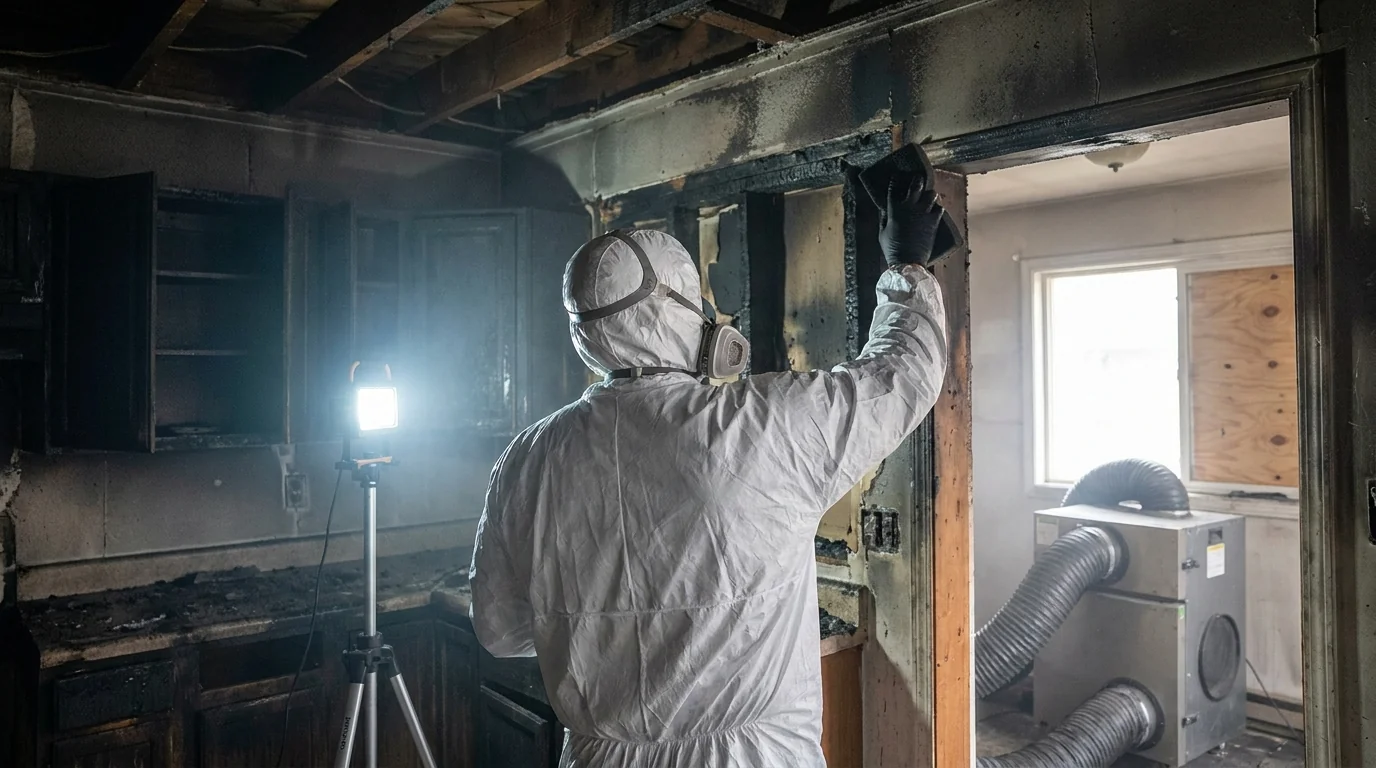
- Smoke and soot cleaning of all affected surfaces, including interior wall cavities where smoke has migrated, using dry-chemical sponges, HEPA vacuuming, and chemical sponge wiping calibrated to the surface type — plaster, original woodwork, masonry.
- Odor neutralization using thermal fogging and hydroxyl generators, with extended treatment cycles for plaster-walled rooms.
- Structural drying if firefighting water has saturated subfloors or framing — a step that often surprises homeowners but is standard after any suppression event.
- Rebuild coordination under our NJ Licensed Home Improvement Contractor license, so you work with one point of contact from emergency response through finished restoration.
Reaching Cranford from Kenilworth
Our Kenilworth headquarters sits one town over, and we reach most Cranford addresses — including the Rahway River Parkway corridor and the neighborhoods near Union College of Union County — quickly via Route 28 or North Avenue. Because we operate 24/7, a call at 2 a.m. after a kitchen fire gets the same dispatch as a call at noon. We do not subcontract emergency response to a third-party crew; the technicians who arrive first are The Restoration Group employees who carry the job through to completion.
Cranford Insurance Coordination
Cranford homeowners tend to be experienced insurance claimants — the town’s repeat flood history means many households have navigated NFIP claims after Floyd, Irene, or Ida, and they know the difference between a contractor who documents properly and one who doesn’t. Fire claims run through standard homeowners’ policies rather than flood policies, but the documentation discipline is the same. We photograph and itemize every affected material before removal, produce a line-item scope in the format most major carriers accept, and communicate directly with adjusters to reduce back-and-forth delays. You should not have to serve as the translator between your contractor and your insurance company.
Local Note
One thing that catches homeowners off guard in Cranford’s pre-war neighborhoods: after a fire, the township’s building department requires a fire-damage inspection and permit before structural repairs begin — and in older homes with balloon framing, that inspection often triggers a requirement to install fire-blocking in the wall cavities as part of the permitted scope. It’s not a surprise we spring on you mid-job; we flag it in the initial assessment and build it into the project timeline so the permit process doesn’t stall your rebuild.
If your home in Cranford has been through a fire — whether a contained kitchen event or a more extensive structural fire — call (908) 970-8533 now. We’ll assess the damage, secure the structure, and walk you through exactly what recovery looks like for your specific home and your specific policy.
Fire Damage Restoration in Cranford: Service Coverage
Frequently Asked Questions
How fast can you arrive for fire damage restoration in Cranford?
How quickly can The Restoration Group reach a fire damage emergency in the Riverside Drive area or Downtown Cranford?
Cranford has a lot of pre-1940 homes with plaster walls and older wiring — does that change how fire and smoke restoration is done?
Will Cranford's building department require permits for fire damage repairs, and does The Restoration Group handle that process?
How does smoke damage get into parts of a Cranford home that didn't actually burn?
Cranford homeowners are used to insurance claims from flood events — is a fire damage claim handled the same way?
Fire Damage Restoration response in Cranford
Most Cranford calls see a technician on-site within 60 minutes from our Fair Lawn headquarters.