Mold Inspection and Testing in Elizabeth
24/7 mold inspection and testing in Elizabeth, NJ. IICRC-certified, insurance billing accepted. Call (908) 970-8533.
Our IICRC-certified technicians are dispatched from our Fair Lawn, NJ headquarters and are typically on-site in Elizabeth within 60 minutes of your call.
The Elizabeth River hasn’t forgotten Hurricane Ida. Low-lying Elizabethport and Bayway took on water that lingered for days inside crawl spaces and basement units, and in the early-1900s two- and three-family frame homes that define so much of this city, that kind of prolonged moisture is exactly what mold needs to colonize wall cavities, floor joists, and shared mechanical chases within 48 to 72 hours. If you’re smelling something musty in a 07206 rental or noticing discoloration behind a bathroom vanity in Elmora, a professional mold inspection and testing visit is the first step toward knowing what you’re actually dealing with — and what it will take to fix it.
Why Elizabeth Properties See Elevated Mold Risk
Elizabeth’s housing stock is one of the oldest in Union County. The majority of residential buildings in neighborhoods like Peterstown, Midtown, and Elizabethport were constructed before 1950, which means original balloon-frame construction, minimal vapor barriers, and plaster-over-lath walls that absorb and hold moisture in ways modern drywall simply doesn’t. When a supply line drips inside one of these walls for even a week, the plaster wicks water upward and outward — spreading the wet zone well beyond the visible stain.
The city’s combined sewer system compounds the problem. During heavy rain events, sewage backups push contaminated water into basement apartments and first-floor units, introducing not just moisture but organic material that accelerates mold growth. Add the marine-influenced humidity that drifts inland from Port Newark-Elizabeth Marine Terminal and the tidal flats along the Arthur Kill, and Elizabeth sees sustained indoor relative humidity levels that keep building assemblies perpetually close to the threshold where mold thrives.
For landlords managing two- and three-family properties — which make up a large share of Elizabeth’s residential rental stock — one affected unit rarely stays isolated. Shared floor systems, common stairwells, and connected mechanical chases mean mold spores can migrate between households before anyone notices a problem.
Our Mold Inspection and Testing Process in Elizabeth
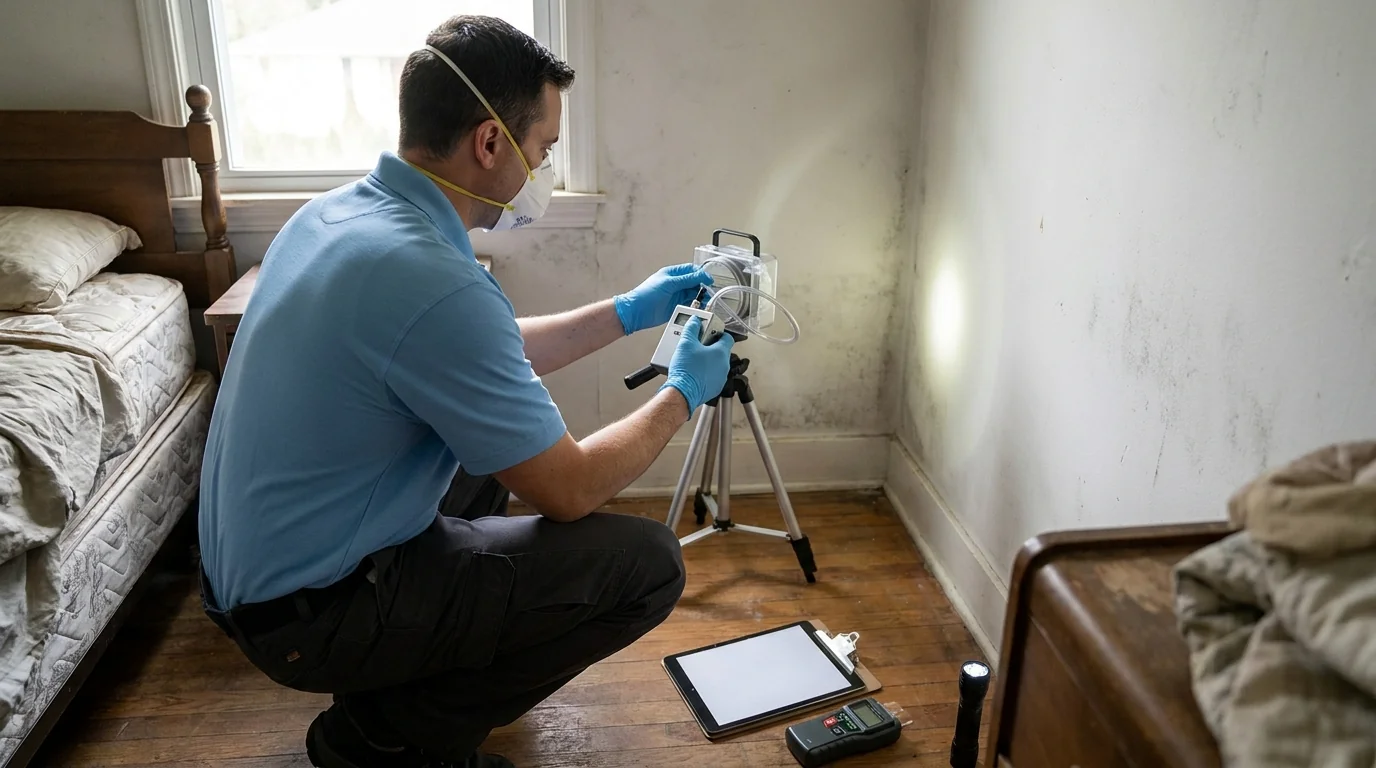
A mold inspection is not a visual walk-through with a flashlight. Our process starts with a moisture mapping survey using a combination of non-invasive pin-type meters and thermal imaging, which lets us trace hidden wet areas inside wall cavities and under flooring without opening walls unnecessarily — important in occupied multifamily buildings where minimizing disruption matters.
Once we’ve identified areas of concern, we collect air samples and, where surface growth is visible or suspected, tape-lift or swab samples. Those samples go to an accredited third-party laboratory. Lab results typically return within 24 to 48 hours and tell us the genus and concentration of spores present, giving you documented data rather than a guess. That documentation matters whether you’re a homeowner negotiating with an insurer, a landlord responding to a tenant complaint, or a property manager preparing a building for sale.
We calibrate our sampling strategy to the building type. In Elizabeth’s older multifamily stock, we routinely pull air samples from multiple floors and from shared spaces like basement utility rooms, because spore counts in a second-floor unit often reflect what’s growing in the basement two stories below.
Reaching Elizabeth from Kenilworth
Our shop is in Kenilworth, roughly ten minutes from most Elizabeth addresses under normal traffic. We run 24/7, so whether a landlord calls at 7 a.m. after discovering a flooded basement apartment or a property manager reaches out on a Sunday afternoon about an indoor air quality concern flagged by a tenant, we can schedule an inspection and get eyes on the property quickly. Neighborhoods in North Elizabeth near Newark Liberty International Airport and commercial corridors near The Mills at Jersey Gardens are equally accessible — the Garden State Parkway and Routes 1 and 9 keep travel times short from our end.
Local Note: What Elizabeth’s Plaster Walls Mean for Sampling
One thing that catches inspectors off guard in Elizabeth’s pre-war housing is how plaster walls mask active mold growth. Because plaster is denser than drywall, surface staining often appears only after a colony has been growing for weeks inside the wall cavity. We’ve learned to treat any plaster wall with a moisture reading above 17% as a priority sampling location, even when the surface looks clean. In multifamily buildings where a burst riser in one unit shares a wall with a neighboring unit, that hidden-growth pattern can mean two households are affected before either tenant reports a smell. If you’re in a Peterstown or Elmora two-family and one unit had a recent leak, it’s worth testing the adjacent unit as well — not just the one that flooded.
Elizabeth Insurance and Documentation
Mold claims in New Jersey are handled inconsistently across carriers, and Elizabeth landlords with multiple-unit properties sometimes find that insurers require documented air quality testing before approving remediation coverage. Our lab-backed reports — which include spore species, concentration levels, and affected area mapping — are formatted to meet the documentation standards most major carriers expect. We can also provide pre- and post-remediation testing if your policy or a court proceeding requires clearance verification. If you’re in a dispute with a tenant or a prior owner over undisclosed mold, that chain of documented evidence is often what resolves the matter.
If you’re dealing with a musty smell, a recent flood, or a tenant complaint in Elizabeth — ZIP codes 07201, 07202, 07206, or 07208 — call The Restoration Group at (908) 970-8533. We’ll schedule an inspection, give you real data from an accredited lab, and walk you through what the results mean before you spend a dollar on remediation.
Mold Inspection and Testing in Elizabeth: Service Coverage
Frequently Asked Questions
How fast can you arrive for mold inspection and testing in Elizabeth?
Are Elizabethport and Bayway homes at higher risk for mold after storms?
How does Elizabeth's older housing stock affect the mold testing process?
Can mold in one unit of an Elizabeth two-family home spread to the adjacent unit?
What do the lab results from a mold test actually tell me?
Do Elizabeth landlords need post-remediation testing before a tenant can return?
Will my homeowners insurance cover mold inspection and testing in Elizabeth?
Mold Inspection and Testing response in Elizabeth
Most Elizabeth calls see a technician on-site within 60 minutes from our Fair Lawn headquarters.