Mold Inspection and Testing in Cranford
24/7 mold inspection and testing in Cranford, NJ. IICRC-certified, insurance billing accepted. Call (908) 970-8533.
Our IICRC-certified technicians are dispatched from our Fair Lawn, NJ headquarters and are typically on-site in Cranford within 60 minutes of your call.
Cranford’s nickname — the Venice of New Jersey — captures the beauty of the Rahway River winding through town, but it also captures the reality that homeowners here know better than most: standing water finds its way into basements, crawlspaces, and wall cavities, and within 24 to 48 hours mold colonization can begin. After three named storms in roughly two decades (Floyd, Irene, and Ida), many properties in the 07016 ZIP code have experienced repeated wetting cycles. Each one leaves behind a slightly higher baseline of spores embedded in old framing, plaster, and insulation — which is exactly why a professional mold inspection and testing assessment is worth doing even when you can’t see anything visibly wrong.
Why Cranford Properties Face Elevated Mold Risk
The housing stock tells most of the story. The colonials and cape cods that line the blocks between Downtown Cranford and the Riverside Drive area were built predominantly between 1900 and the 1940s. That era predates modern vapor barriers, pressure-treated sill plates, and the drainage membranes now standard in new construction. Full basements — common across Cranford — sit close to a water table that rises quickly when the Rahway River overtops its banks or when the town’s storm sewers back up under heavy rainfall.
Older balloon-frame construction, still present in many of these homes, creates continuous stud cavities that run from the basement sill all the way to the attic. When a basement floods, moisture wicks upward through those cavities long after the visible water is gone. Mold can establish itself inside wall assemblies that look and feel dry from the living space side — which is why surface observation alone is not a reliable assessment method in Cranford’s older building stock.
Our Mold Inspection and Testing Process in Cranford
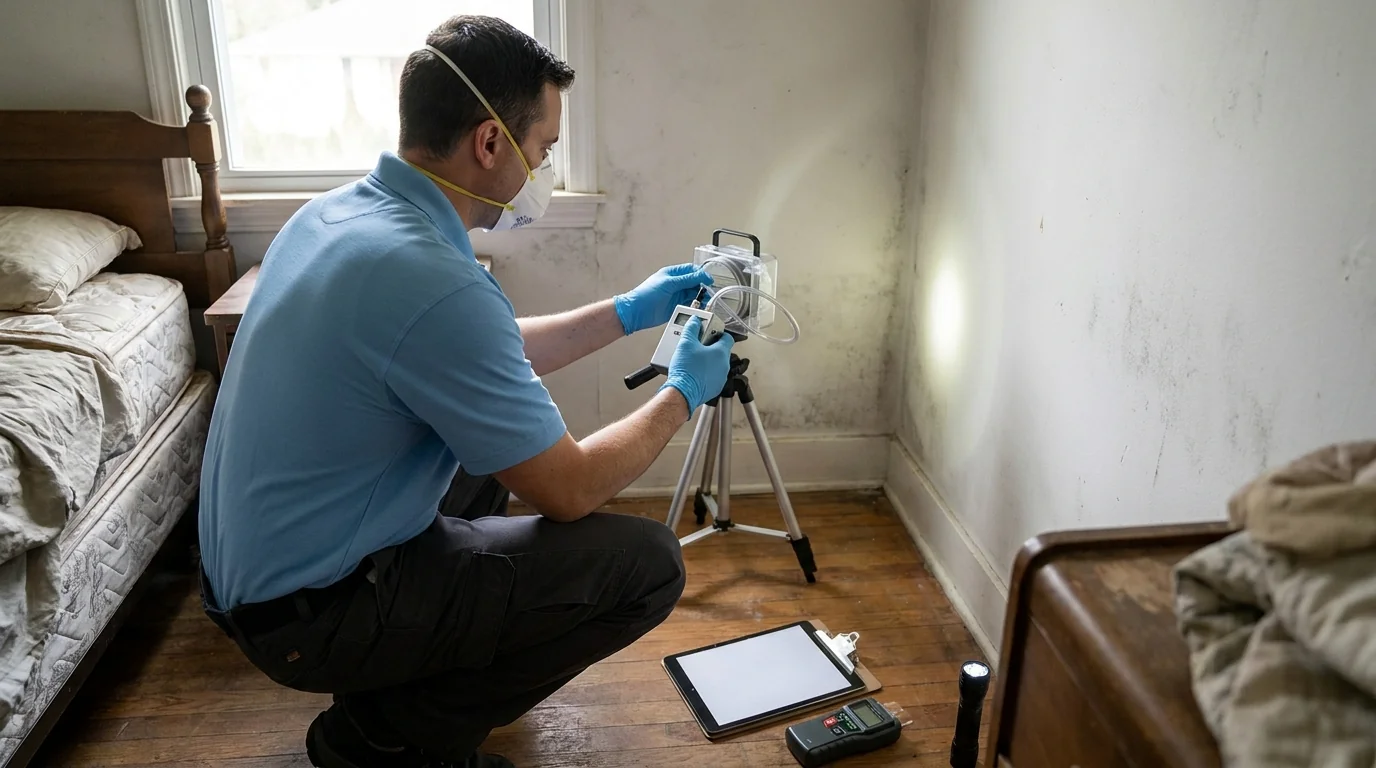
A thorough assessment here goes beyond a visual walkthrough. The process starts with a moisture mapping phase: we use thermal imaging cameras and calibrated moisture meters to trace hidden damp zones through finished walls, subfloors, and ceiling assemblies — areas that frequently retain moisture in post-flood Cranford homes long after drywall surfaces appear normal.
From there, air sampling is collected from multiple locations — typically a basement or crawlspace sample, a main living area sample, and an outdoor baseline control. Samples are sent to an accredited third-party laboratory for spore identification and count. If surface growth is visible or suspected inside a wall cavity, we also collect tape-lift or swab samples to identify the specific genus and concentration of mold present. The lab results, combined with the moisture map, give you a clear picture of what’s actually happening inside the structure — not just what’s visible — and produce documentation that holds up with your insurance carrier or with NFIP claims adjusters.
As an IICRC Certified Firm (#210213), our inspection protocol follows industry standards for sampling methodology, chain of custody, and reporting, so the findings are defensible if you need them for a real estate transaction, a remediation permit, or a dispute with an insurer.
Reaching Cranford from Our Kenilworth Headquarters
The Restoration Group operates out of Kenilworth, one town over from Cranford’s western border. That proximity matters when you’re trying to schedule an inspection quickly after discovering a water issue. We’re available around the clock, and our team can reach most Cranford addresses — including properties near Nomahegan Park and the Sunny Acres neighborhood — without navigating through major interchange congestion that would add time from a more distant service area. If you’re calling from the Lincoln Park East side of town, routing through North Avenue keeps travel time short regardless of the hour.
Cranford Insurance and Documentation Coordination
Cranford homeowners who have filed NFIP or homeowners’ insurance claims after past flood events are often already familiar with how important documentation quality is. Adjusters want to see moisture readings, sample chain-of-custody forms, and lab-certified spore counts — not just a contractor’s verbal assessment. We structure our inspection reports specifically to meet that standard: timestamped photos, moisture meter readings logged by location, and a written narrative that maps findings to the affected areas of the home.
If remediation follows the inspection, we can also coordinate post-remediation clearance testing with an independent industrial hygienist, which some carriers and real estate transactions require before a property is considered resolved.
Local Note
One pattern we see specifically in Cranford homes that back up to or near the Rahway River Parkway corridor: the combination of high ambient humidity during summer months and the clay-heavy soil common along the river’s floodplain means that even homes that did not flood can develop elevated indoor mold counts. Moisture migrates through foundation walls from saturated soil, and without a dehumidification system running consistently, basements in this zone routinely read above 60% relative humidity — the threshold above which mold growth accelerates. If your home is in this corridor and you haven’t had an indoor air quality test done since the last major storm event, that’s the single most useful thing you can do before the next rainy season arrives.
If you’re seeing discoloration on basement walls, catching an earthy or musty smell after wet weather, or simply want a documented baseline before listing a Cranford property for sale, call (908) 970-8533. We’ll schedule an inspection, walk you through the results in plain language, and give you a clear picture of what — if anything — needs to be addressed.
Mold Inspection and Testing in Cranford: Service Coverage
Frequently Asked Questions
How fast can you arrive for mold inspection and testing in Cranford?
Are homes near the Riverside Drive area more likely to test positive for elevated mold spore counts?
How does Cranford's older housing stock affect the mold inspection process?
Can your mold inspection report be used for an NFIP or homeowners' insurance claim in Cranford?
What does indoor air quality testing actually measure, and how long does it take in a typical Cranford home?
If mold is found during the inspection, does The Restoration Group also handle remediation for Cranford properties?
Mold Inspection and Testing response in Cranford
Most Cranford calls see a technician on-site within 60 minutes from our Fair Lawn headquarters.