Mold Inspection and Testing in Brooklyn
24/7 mold inspection and testing in Brooklyn, NY. IICRC-certified, insurance billing accepted. Call (908) 970-8533.
Our IICRC-certified technicians are dispatched from our Fair Lawn, NJ headquarters and are typically on-site in Brooklyn within 60 minutes of your call.
Brooklyn’s brownstone belt sits on some of the most mold-hospitable real estate in the Northeast. Garden-level and cellar apartments in Park Slope and Brooklyn Heights routinely see standing water after heavy rain events — the kind of flooding that became citywide news when Hurricane Ida dropped more than three inches in a single hour. In masonry rowhouses built between 1880 and 1920, that moisture doesn’t evaporate the way it does in modern construction; it wicks into brick, lath, and plaster, then feeds hidden mold colonies for weeks before anyone notices a smell. If you’re searching for mold inspection and testing in Brooklyn, the building you’re in probably has a story worth uncovering.
Why Brooklyn Properties Are Unusually Prone to Mold
The combination of age, density, and geography creates conditions that don’t exist in most American cities. Coastal neighborhoods from Canarsie to Coney Island still carry residual moisture intrusion patterns traceable to Hurricane Sandy’s storm surge — crawl spaces and slab edges that were saturated in 2012 and never fully remediated. Further inland, the brownstone belt’s party-wall construction means a water event in one unit can migrate laterally into adjacent units without anyone realizing it. Flat roofs common on pre-war rowhouses pond water and develop slow membrane failures that drip into top-floor ceiling cavities for months. Add New York City’s humid summers — July dew points regularly climb above 70°F — and you have a building stock that is under near-constant biological pressure.
Co-op and condo boards add another layer of complexity. In a Brooklyn Heights co-op, the board may own the walls while the shareholder owns the air rights inside them, which means a mold assessment needs to document exactly where contamination starts and stops — not just for health reasons, but to establish who is financially responsible for remediation.
Our Mold Inspection and Testing Process in Brooklyn
A mold assessment in a century-old Brooklyn rowhouse is not the same job as one in a 1990s suburban split-level. Our process is calibrated to what we actually find here.
Visual inspection first. We start at the lowest point — the cellar or garden level — and work upward, checking behind mechanicals, inside closets that share exterior masonry walls, and around any cast-iron plumbing that may have sweated or leaked. In Flatbush and Bushwick, we commonly find mold behind original horsehair plaster that has absorbed decades of condensation from uninsulated exterior walls.
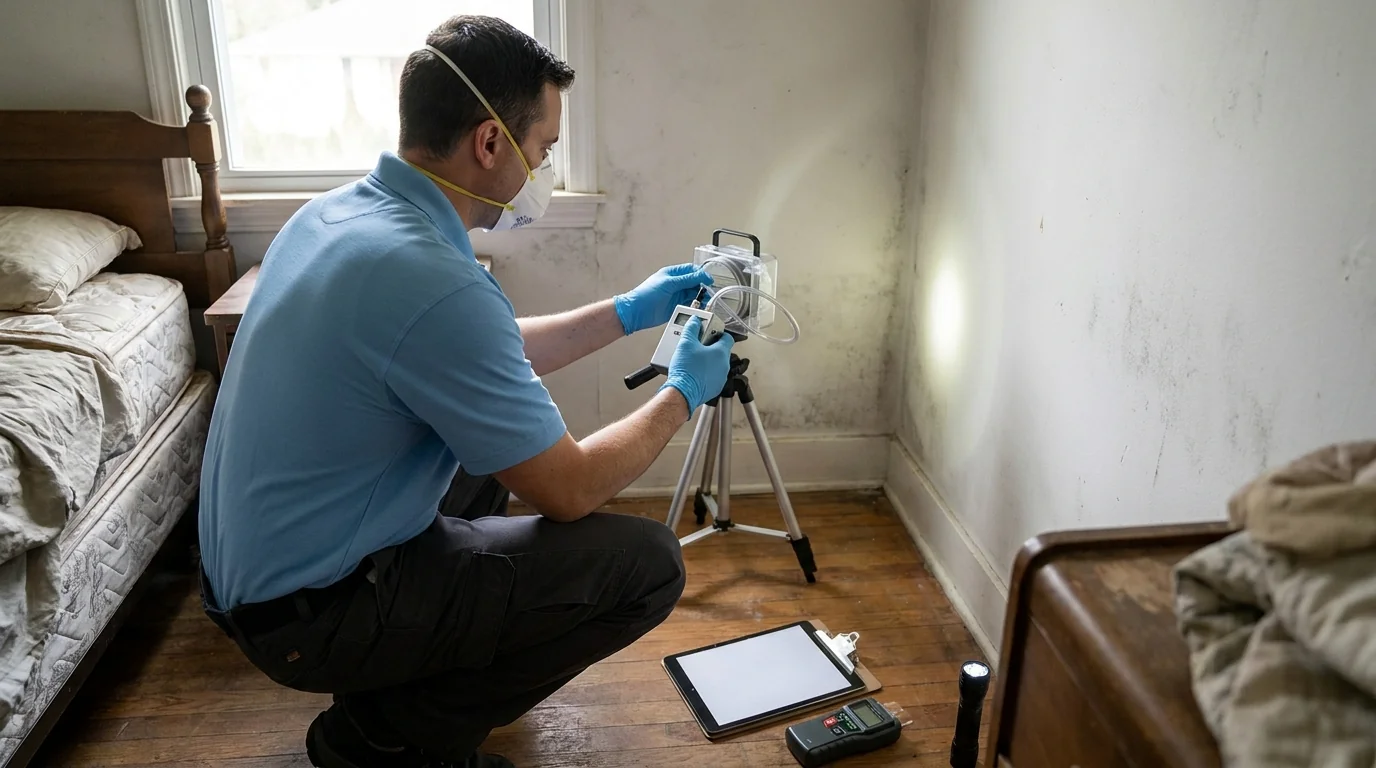
Moisture mapping. Before any samples are pulled, we use thermal imaging cameras and calibrated moisture meters to map wet zones. This step is critical in masonry construction because the visible surface can read dry while the substrate behind it is still saturated.
Air and surface sampling. We collect indoor air quality samples using calibrated spore trap cassettes and compare them against outdoor baseline samples taken at the same time. Surface swabs or tape lifts are taken from any visually suspect areas. All samples are sent to an accredited third-party laboratory — results typically return within 24 to 72 hours.
Written assessment report. The lab data, moisture readings, and photo documentation are compiled into a report formatted to meet the documentation requirements of major insurance carriers and New York City co-op and condo management companies. If remediation is needed, the report includes a scope of work that a licensed contractor can bid against.
Reaching Brooklyn from Kenilworth
The Restoration Group operates 24/7 out of Kenilworth, NJ, which puts us roughly 45 minutes from most Brooklyn ZIP codes via the Goethals Bridge and the BQE under normal traffic — closer to neighborhoods like Bay Ridge (ZIP 11209) than many Manhattan-based firms. For neighborhoods deeper into the borough, like Canarsie or Flatbush (ZIP 11226), we route through the Staten Island Expressway to avoid midday BQE congestion. We schedule Brooklyn inspections with a confirmed arrival window so building supers and property managers aren’t waiting in the lobby.
Local Note: What Brooklyn’s Building Age Means for Air Sampling
Inspectors who primarily work in newer construction sometimes under-sample Brooklyn properties. In a pre-war rowhouse, a single air sample in the living room can miss a thriving mold colony two feet away inside a sealed plaster wall cavity. We’ve found active growth behind original wainscoting in Park Slope parlor floors that showed zero visible signs from the room side — the only indication was a slightly elevated spore count and a faint earthy odor that the homeowner had attributed to the building’s age. In Brooklyn’s older housing stock, we treat the building’s construction type as a variable that shapes where we sample, not just how many samples we pull.
Brooklyn Insurance and Co-op Board Documentation
New York City insurers and co-op boards have specific documentation expectations that differ from suburban New Jersey claims. A mold assessment report submitted to a Brooklyn co-op board typically needs to identify affected materials by unit boundary, include chain-of-custody lab documentation, and specify whether the source of moisture has been corrected — because boards will not approve remediation work until the water intrusion is resolved. We structure our reports to answer those questions directly, which shortens the approval cycle and gets remediation started faster. Our status as an IICRC Certified Firm (#210213) is recognized by most major carriers operating in the New York metro market.
If you’re dealing with a musty smell in a Williamsburg loft, visible discoloration in a Bay Ridge basement, or a co-op board demanding documentation before authorizing repairs, call The Restoration Group at (908) 970-8533. We’ll schedule a mold inspection and testing appointment in Brooklyn and give you a report you can actually use.
Mold Inspection and Testing in Brooklyn: Service Coverage
Frequently Asked Questions
How fast can you arrive for mold inspection and testing in Brooklyn?
Are garden-level and cellar apartments in Park Slope and Brooklyn Heights at higher risk for mold than upper-floor units?
How does mold testing work in a Brooklyn co-op where the board owns the walls?
Can Brooklyn's coastal neighborhoods still have Sandy-related mold problems in buildings that were "cleaned up" after 2012?
What's the difference between air sampling and surface swab testing, and which does my Brooklyn property need?
How long does a mold inspection take in a typical Flatbush or Bushwick rowhouse, and when do I get results?
Will my homeowners insurance cover mold inspection and testing in Brooklyn?
Mold Inspection and Testing response in Brooklyn
Most Brooklyn calls see a technician on-site within 60 minutes from our Fair Lawn headquarters.