Fire Damage Restoration in Jersey City
24/7 fire damage restoration in Jersey City, NJ. IICRC-certified, insurance billing accepted. Call (908) 970-8533.
Our IICRC-certified technicians are dispatched from our Fair Lawn, NJ headquarters and are typically on-site in Jersey City within 60 minutes of your call.
A kitchen fire in a Bergen-Lafayette rowhouse and a high-rise unit fire near the Exchange Place waterfront are both fire damage jobs — but they couldn’t be more different to restore. Jersey City’s split building personality, century-old wood-frame construction in some blocks and glass-tower condos in others, shapes every decision from the first hour on site. When smoke has moved through a building, the clock matters: soot becomes chemically bonded to surfaces within days, and the dense multifamily fabric of neighborhoods like The Heights means a single unit fire can affect shared hallways, adjacent units, and a landlord’s entire rental income stream simultaneously.
Why Jersey City Properties See Distinct Fire Damage Challenges
The brownstones and frame rowhouses built between the 1890s and 1920s in Bergen-Lafayette, Greenville, and The Heights share a construction detail that complicates fire cleanup: balloon-frame or platform-frame walls with minimal fire blocking. Smoke and heat travel vertically inside wall cavities faster than in modern construction, depositing soot in spaces that aren’t visible until walls are opened. Older plaster-and-lath interiors also hold odor differently than drywall — the porous plaster absorbs smoke particulates deeply, and surface cleaning alone rarely resolves the smell.
On the waterfront side, Newport and Exchange Place towers present a different set of complications. High-rise buildings with stacked units mean a fire on one floor can push smoke through HVAC risers and elevator shafts into units above and below. Building management in these properties typically requires unit-by-unit documentation for the condo association’s insurer before any remediation scope is approved — a paperwork-heavy process that has to move in parallel with physical work, not after it.
Our Fire Damage Restoration Process in Jersey City
The first step on any fire job is a structured assessment that separates what can be restored from what needs to be replaced. Soot type matters here: protein-based soot from a kitchen fire is nearly invisible but extremely pungent and bonds tightly to painted surfaces, while wet smoke from smoldering fires leaves a sticky, streaky residue that requires different chemical agents. We identify the soot profile before any cleaning begins.
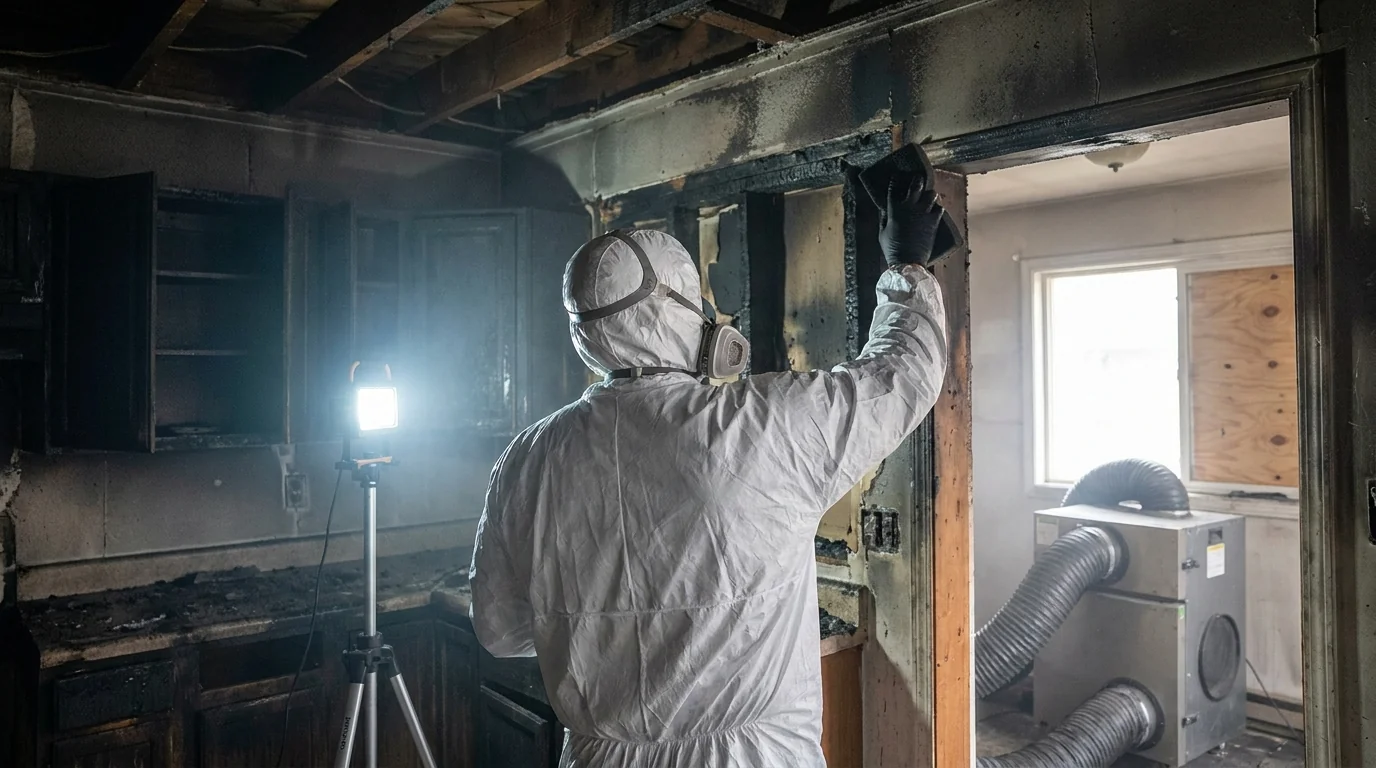
Once the scope is set, the process moves through emergency board-up and structural stabilization, content pack-out and inventory (critical for insurance documentation), structural cleaning using HEPA-filtered equipment and appropriate chemical sponges or wet-cleaning agents, odor neutralization through thermal fogging or hydroxyl generation depending on occupancy status, and final air quality verification. In occupied multifamily buildings — common in the 07304 and 07306 ZIP codes — we sequence work to minimize disruption to unaffected units while maintaining containment.
Where structural fire damage requires reconstruction — burned joists, compromised load-bearing walls, damaged rooflines — we carry the scope through rebuild under our NJ Licensed Home Improvement Contractor license, so property owners aren’t managing two separate contractors during an already stressful period.
Jersey City Insurance and HOA Coordination
Fire claims in Jersey City’s condo and multifamily market involve layers of insurance that don’t always talk to each other cleanly. A unit owner’s HO-6 policy covers their personal property and interior finishes; the building’s master policy covers structure and common areas; and when a fire originates in one unit and damages another, subrogation questions can stall remediation if documentation isn’t airtight from day one.
We produce photo-documented scope reports, moisture and air quality readings, and line-item estimates formatted to carrier standards — the kind of paperwork condo boards and property managers in the Newport and Journal Square corridor need before they can authorize work across multiple units. Our IICRC Certified Firm status (Firm #210213) gives adjusters a recognized quality benchmark when reviewing our scope.
Local Note
In Jersey City’s older rowhouse blocks — particularly in the Heights and Bergen-Lafayette — party walls between attached homes are often unreinforced brick with gaps and voids that channel smoke laterally into neighboring units. We’ve found smoke odor and light soot in an adjacent property that had no visible fire damage at all. On attached-home fire jobs in these neighborhoods, we recommend a walkthrough of the neighboring unit early in the assessment, with the property owner’s cooperation, before assuming the damage footprint is contained to a single address. It’s a step that prevents a neighbor’s complaint three weeks later and protects everyone’s insurance claim.
If you’re dealing with fire or smoke damage anywhere in Jersey City — from a rowhouse in Greenville to a high-rise near Liberty State Park — call The Restoration Group at (908) 970-8533. We respond 24/7, and we’ll give you a clear picture of the damage scope and next steps before any work begins.
Fire Damage Restoration in Jersey City: Service Coverage
Frequently Asked Questions
How fast can you arrive for fire damage restoration in Jersey City?
How quickly can The Restoration Group reach a fire damage emergency in The Heights or Bergen-Lafayette?
Does Jersey City's older housing stock — brownstones, balloon-frame rowhouses — change how fire and smoke restoration is done?
Our condo building near Exchange Place has a master insurance policy and individual unit policies — how do you handle documentation across both?
What's the difference between smoke odor treatment options, and which is used in occupied Jersey City multifamily buildings?
Can you handle both the fire cleanup and the structural repairs in a Jersey City home, or do we need to hire a separate contractor for reconstruction?
Fire Damage Restoration response in Jersey City
Most Jersey City calls see a technician on-site within 60 minutes from our Fair Lawn headquarters.