Water Damage Restoration in Jersey City
24/7 water damage restoration in Jersey City, NJ. IICRC-certified, insurance billing accepted. Call (908) 970-8533.
Our IICRC-certified technicians are dispatched from our Fair Lawn, NJ headquarters and are typically on-site in Jersey City within 60 minutes of your call.
Jersey City sits at the edge of Newark Bay and the Hudson River, and that geography is not just scenic — it’s a liability when pipes burst, storm drains back up, or a riser line fails on the fourteenth floor of a Newport high-rise. Water moves fast here, through century-old clay tile drains in the Heights, through shared wall cavities in Bergen-Lafayette rowhouses, and through stacked mechanical chases in Exchange Place condos where a single leak can soak a dozen units before anyone calls the super. The Restoration Group responds 24/7 to water damage emergencies across Jersey City, bringing drying equipment and documentation that holds up with insurers and condo associations alike.
Why Jersey City Properties See Water Damage Differently
Jersey City’s building stock splits into two very different worlds, and each one fails in its own way.
Along the waterfront — Newport, Exchange Place, and the high-rises clustered around Grove Street PATH plaza — the construction is modern but the plumbing is under constant pressure. Supply-line failures and riser breaks in stacked residential towers don’t stay contained to one unit. Water follows the path of least resistance through concrete penetrations, elevator shafts, and shared HVAC chases. By the time a resident on the eighth floor notices a wet ceiling, the unit below and the unit below that may already have elevated moisture in their walls. Building management needs unit-by-unit psychrometric readings and written moisture logs before the association’s insurer will close a claim — not just a verbal assurance that things are dry.
In the Heights, Bergen-Lafayette, and Greenville, the challenge is different. Brownstones and frame rowhouses built between 1890 and the 1920s have rubble-stone foundations, brick party walls, and cellars that were never designed for modern drainage loads. Jersey City’s combined sewer system — which carries both stormwater and sewage in the same pipe — backs up during heavy rain events, and those backups push directly into basements. Hurricane Ida made that visible citywide in 2021, flooding cellars from Greenville to Journal Square. Sandy’s surge a decade earlier showed how exposed the low-lying blocks between Liberty State Park and the waterfront truly are. For these older homes, the concern isn’t just standing water — it’s what that water carries, and what it leaves behind inside masonry walls that can hold moisture for weeks.
Our Water Damage Restoration Process in Jersey City
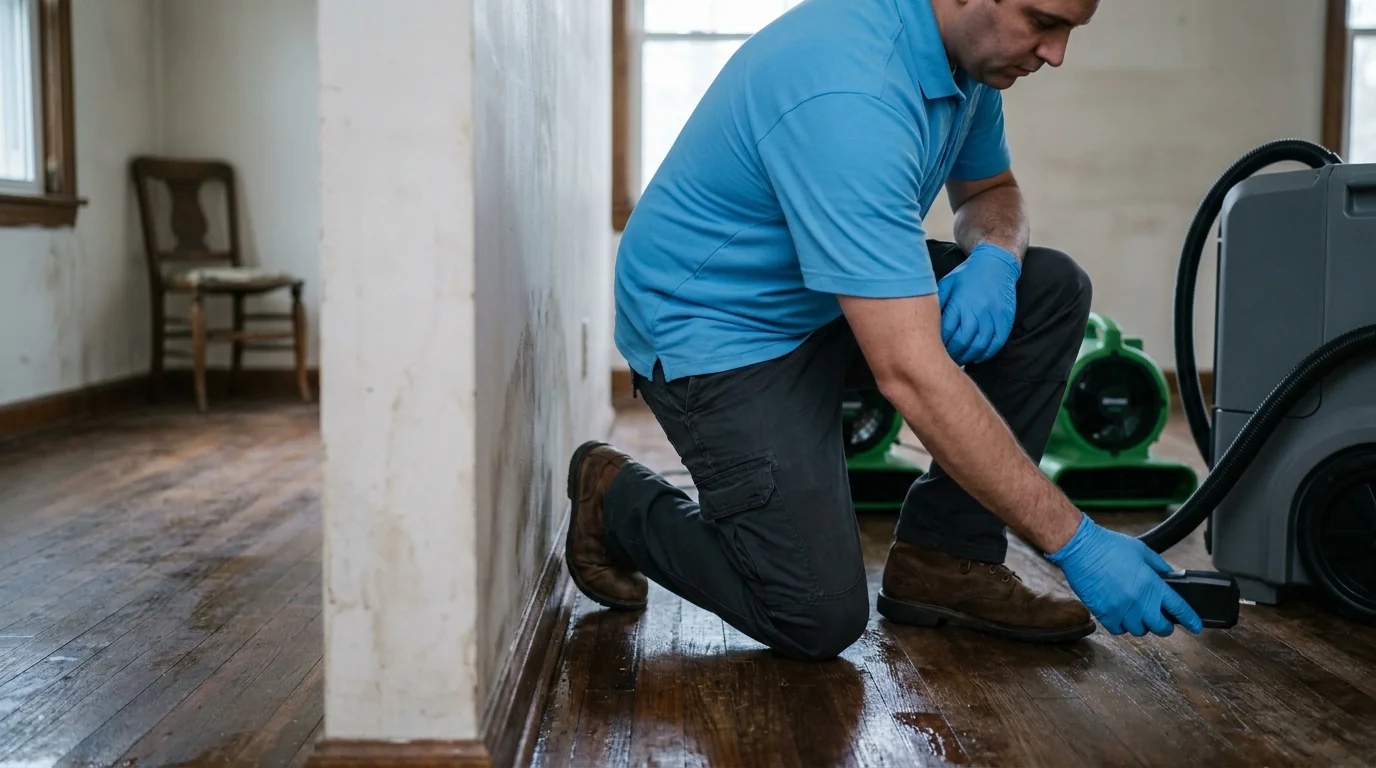
Every job starts with a moisture assessment before any equipment is placed. Technicians use thermal imaging cameras and pin-type moisture meters to map where water has traveled — not just where it’s visible. In a Newport high-rise, that means checking adjacent units and the unit directly below. In a Heights rowhouse, it means probing the rubble foundation wall and the wood framing that sits against it.
Once the scope is confirmed, extraction comes first. Truck-mounted and portable extraction units pull standing water from flooring, subfloor assemblies, and carpet padding. In below-grade spaces — the basements that flood repeatedly in ZIP code 07307 and 07304 — we address any sewage-contaminated water as a Category 3 loss, which requires containment, appropriate PPE, and antimicrobial treatment before drying begins.
Structural drying follows a calculated plan, not a timer. Refrigerant and desiccant dehumidifiers, air movers, and negative-air equipment are positioned based on the moisture map, not placed at random. Daily monitoring readings track the drying curve and confirm that materials are reaching equilibrium moisture content. In older plaster-and-lath construction common throughout the Heights, drying timelines run longer than in modern drywall — plaster releases absorbed moisture slowly, and rushing the process leads to secondary mold growth inside the wall cavity.
Documentation is produced throughout: photos, moisture logs, equipment placement records, and a final drying report. That paperwork matters when a landlord in Bergen-Lafayette needs to satisfy a tenant’s insurer, or when a condo board at Exchange Place needs to show the association’s carrier that every affected unit was properly dried and cleared.
Jersey City Insurance and HOA Coordination
Dense multifamily ownership in Jersey City means water damage claims almost always involve more than one party. A riser failure in a condo building touches the unit owner’s policy, the building’s master policy, and sometimes a neighbor’s renters policy — all at once. Landlords with multi-unit rowhouses in Greenville or Journal Square face similar complexity when a single pipe failure affects two or three tenants.
The Restoration Group, as an IICRC Certified Firm (#210213), produces the moisture documentation and drying logs that adjusters and HOA property managers need to process claims cleanly. We work directly with most major carriers and can communicate scope and progress with building management so the property owner isn’t caught in the middle translating between a contractor and an adjuster.
Local Note
One thing that catches property owners off guard in Jersey City’s older neighborhoods: the rubble-stone and brick foundations common in Heights and Bergen-Lafayette rowhouses don’t dry the same way a poured-concrete basement does. Stone foundation walls can wick groundwater laterally for weeks after a flood event, keeping adjacent wood framing above safe moisture thresholds even after the visible water is gone. We account for this by extending monitoring periods on below-grade losses in pre-1940 construction — pulling equipment too early is one of the most common reasons a mold problem shows up sixty days after a “completed” water job in these buildings.
If you’re dealing with water damage anywhere in Jersey City — a flooded cellar in the Heights, a burst supply line in a Newport high-rise, or a sewer backup after a storm — call (908) 970-8533 any time. The Restoration Group is available around the clock, and we carry the documentation standards that Jersey City’s landlords, condo boards, and insurers expect.
Water Damage Restoration in Jersey City: Service Coverage
Frequently Asked Questions
How fast can you arrive for water damage restoration in Jersey City?
How quickly can The Restoration Group reach a water damage emergency in Downtown Jersey City or the Exchange Place waterfront?
Our Heights rowhouse basement flooded from a combined-sewer backup — is that handled differently than a clean-water pipe burst?
A riser line failed in our Newport condo building and water entered multiple units — can you document each unit separately for the HOA's insurer?
How long does structural drying typically take in Jersey City's older brownstones and frame rowhouses?
What ZIP codes in Jersey City do you serve, and does location within the city affect response?
Will my homeowners insurance cover water damage restoration in Jersey City?
Water Damage Restoration response in Jersey City
Most Jersey City calls see a technician on-site within 60 minutes from our Fair Lawn headquarters.