Commercial Restoration in Kenilworth
24/7 commercial restoration in Kenilworth, NJ. IICRC-certified, insurance billing accepted. Call (908) 970-8533.
Our IICRC-certified technicians are dispatched from our Fair Lawn, NJ headquarters and are typically on-site in Kenilworth within 60 minutes of your call.
When a burst supply line floods a retail space on The Boulevard or a kitchen fire shuts down a Monroe Avenue industrial tenant, the clock starts immediately — every hour of downtime is revenue walking out the door. Kenilworth’s commercial stock ranges from mid-century storefronts and warehouse conversions to the redeveloping former Merck campus at The Park, and each building type brings its own restoration challenges. Because our headquarters sits on S 31st Street, we can have a crew staged and moving toward any 07033 address faster than we can reach almost anywhere else in Union County.
Why Kenilworth Commercial Properties Face Distinct Restoration Risks
The borough’s business corridors sit on top of infrastructure that was largely built before 1960. Cast-iron mains, clay sewer laterals, and aging sprinkler risers in older commercial buildings are reliable until they’re not — and when they fail, they fail completely. The Monroe Avenue and Market Street industrial corridor sees a particular pattern: a single supply-line failure in a multi-tenant building can push water into shared mechanical rooms and adjacent suites before anyone on staff notices the drop in pressure.
Storm events compound the risk. Black Brook and its network of storm drains run close to grade through much of the borough, and when a fast-moving system drops two inches in an hour — the way Ida did in September 2021 — those drains back up before the municipal system can clear the volume. Ground-floor commercial spaces along the lower-lying sections of the borough are especially exposed to that combination of surface flooding and sewer surcharge. Businesses that experienced Ida losses and didn’t address the underlying drainage vulnerabilities have seen repeat events since.
Fire risk in the commercial sector skews toward the older building stock as well. Balloon-frame construction in some of the pre-war mixed-use buildings means fire can travel inside wall cavities faster than suppression systems can respond, and smoke and soot spread well beyond the room of origin. That matters for restoration scope — what looks like a contained kitchen fire often means smoke odor and residue in adjacent tenant spaces that need to be documented and treated before any occupant returns.
Our Commercial Restoration Process in Kenilworth
The first thing we do on any commercial loss is a documented scope assessment — not a rough estimate, but a room-by-room inventory of affected materials, moisture readings at every structural assembly, and photographs that match the carrier’s line-item format. For commercial claims, that documentation is the difference between a smooth adjuster review and a protracted dispute.
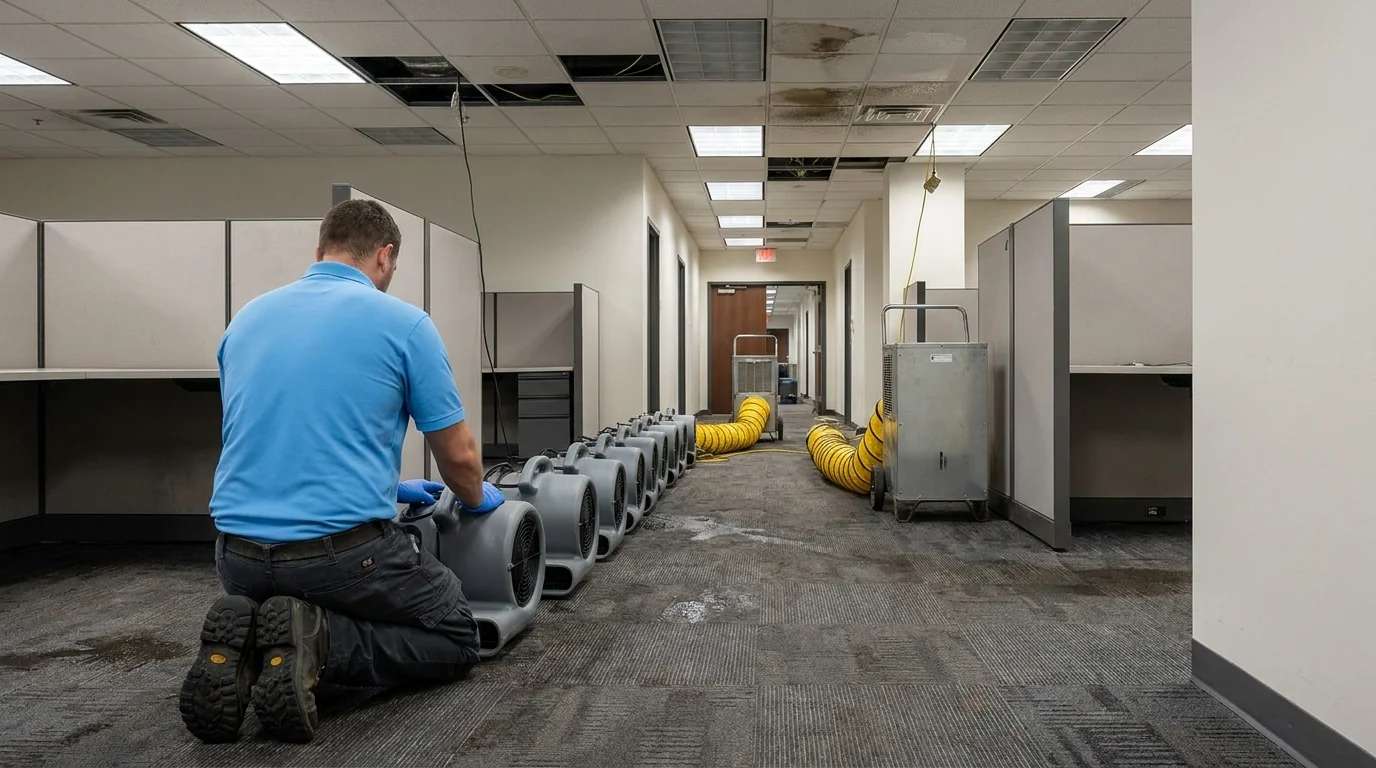
For water losses, we follow the IICRC S500 standard for drying, which means we don’t pull equipment early because a surface feels dry to the touch. Concrete subfloors under tile, the CMU block walls common in Monroe Avenue warehouse spaces, and the plaster-and-lath partitions still found in older mixed-use buildings all hold moisture longer than modern assemblies. We use thermal imaging and calibrated moisture meters at every check-in to confirm actual drying progress, not estimated drying progress.
For fire and smoke losses, the sequence matters: emergency board-up and tarping first to secure the structure and prevent secondary weather damage, then controlled demolition of char and compromised materials, then HEPA vacuuming and chemical sponge treatment of smoke-affected surfaces before any encapsulant or primer goes on. Skipping steps to accelerate a reopening timeline creates odor callbacks — we’ve remediated other contractors’ callbacks and it’s always more expensive than doing it right the first time.
Throughout the project, we maintain a single point of contact for the property owner or manager, the insurance adjuster, and any tenants who need status updates. Commercial losses involve more stakeholders than residential, and communication gaps are where projects stall.
Insurance Coordination for Kenilworth Commercial Claims
Most commercial property policies in New Jersey require prompt notice and documented mitigation to preserve coverage — waiting to call your carrier until you’ve assessed the damage yourself can create a coverage dispute over whether the loss was mitigated in time. We can initiate emergency services, document the loss simultaneously, and provide the adjuster with a scope that aligns with Xactimate line items, which is the estimating platform most commercial carriers use.
For multi-tenant properties along The Boulevard business district, we also help property managers communicate the scope to individual tenants whose business-interruption coverage may be triggered. That coordination isn’t something every restoration contractor offers, but it’s often what keeps a commercial relationship intact after a loss event.
As an IICRC Certified Firm (#210213) and NJ Licensed Home Improvement Contractor, our documentation meets the standards most adjusters require without back-and-forth over methodology.
Local Note
One thing specific to Kenilworth’s older commercial buildings: many of the mixed-use properties along The Boulevard were originally built with uninsulated, unlined clay flue systems that were later converted to gas heat. When a fire or significant smoke event occurs, those flue cavities can carry soot and combustion byproducts into wall assemblies on upper floors — sometimes into residential units above a ground-floor commercial space. We probe those cavities as a standard step on any fire loss in pre-1960 Kenilworth buildings, because missing that pathway means the odor complaint comes back six weeks after the job closes.
If your business or property has experienced a water, fire, or smoke event, call (908) 970-8533. We’re available around the clock, and for any address in Kenilworth, we’re already close.
Commercial Restoration in Kenilworth: Service Coverage
Frequently Asked Questions
How fast can you arrive for commercial restoration in Kenilworth?
How quickly can you reach a commercial property in the Monroe Avenue industrial corridor?
Our Boulevard business district property has multiple tenants — how do you handle a water loss that affects more than one suite?
Kenilworth saw significant basement flooding during Ida — does prior flood intrusion affect how you approach a new commercial water loss in the same building?
What's different about restoring a fire loss in one of Kenilworth's older mixed-use commercial buildings compared to a newer construction?
Does a commercial restoration project at The Park (former Merck campus) require any special permitting or coordination in Kenilworth?
Will my homeowners insurance cover commercial restoration in Kenilworth?
Commercial Restoration response in Kenilworth
Most Kenilworth calls see a technician on-site within 60 minutes from our Fair Lawn headquarters.