Reconstruction Services in Manhattan
24/7 reconstruction services in Manhattan, NY. IICRC-certified, insurance billing accepted. Call (908) 970-8533.
Our IICRC-certified technicians are dispatched from our Fair Lawn, NJ headquarters and are typically on-site in Manhattan within 60 minutes of your call.
When a burst riser soaks thirteen floors of a pre-war co-op on the Upper East Side, or a kitchen fire guts a Chelsea restaurant that was booked solid through the weekend, the mitigation is only half the story. Getting the structure back — walls, ceilings, framing, finishes — is where the real complexity begins in Manhattan. Vertical buildings, landmark-district restrictions, DOB permit timelines, and the logistical puzzle of freight elevators and noise ordinances make reconstruction in New York City a different discipline than anywhere else.
Why Manhattan Properties Face Distinct Reconstruction Challenges
Manhattan’s building stock spans more than a century of construction methods layered on top of each other. Pre-war co-ops in the 70s and 80s blocks of the Upper West Side were built with hollow-tile terra cotta partitions and horsehair plaster — materials that perform nothing like modern gypsum board when they absorb water or char from fire. Replacing them to match the original profile often requires sourcing specialty materials and working within the co-op board’s approved contractor list.
Beyond the building fabric itself, the city’s regulatory environment adds real time to any reconstruction scope. The New York City Department of Buildings requires permits for structural work, and depending on the building’s age and location, Landmarks Preservation Commission review may apply — even for interior work in certain designated districts. Flood events compound this: Hurricane Sandy’s storm surge left the Financial District and Lower East Side dealing with saltwater intrusion that corroded structural steel and wicked into concrete slabs for months. More recently, the remnants of Ida overwhelmed street drains from Harlem down through Chelsea, sending water into basement mechanical rooms and ground-floor retail spaces that had never flooded before. Each of those events created reconstruction scopes that required navigating both insurance adjusters and city agencies simultaneously.
Our Reconstruction Process in Manhattan
Every project starts with a documented scope — room-by-room, floor-by-floor — that a resident manager, managing agent, or commercial property owner can hand directly to their insurance carrier or board. We photograph affected assemblies before demolition, catalog removed materials by unit, and maintain a moisture log that tracks readings from initial assessment through final clearance. That paper trail matters in a city where co-op boards and condo associations routinely require it before releasing escrow or approving contractor access.
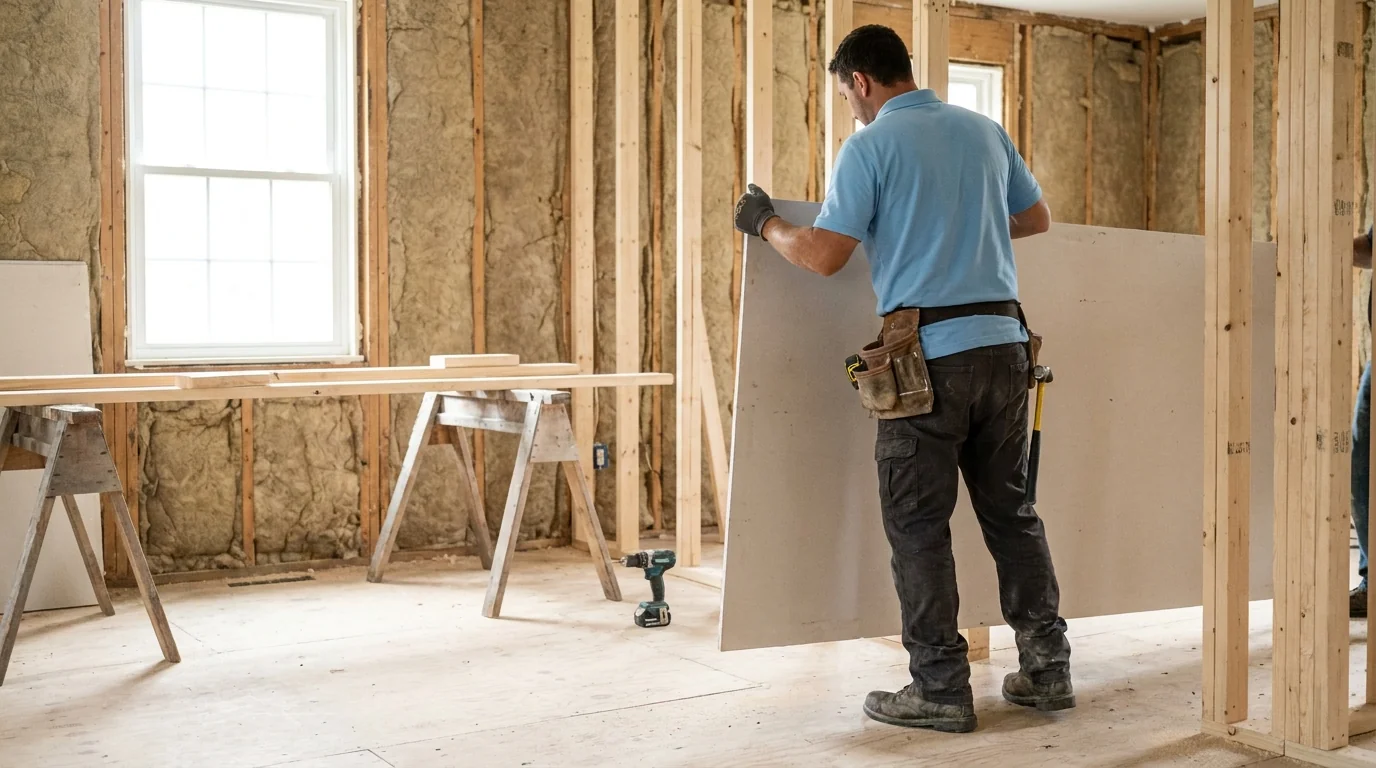
Demolition and framing proceed once permits are pulled and the building’s scheduling rules are confirmed. Most Manhattan residential buildings restrict noisy work to specific weekday hours — typically 8 a.m. to 5 p.m. — and require freight elevator reservations that can be booked out days in advance. We build that lead time into the project schedule from day one rather than discovering it mid-job. For commercial clients in Midtown or the Financial District, where every closed day is measurable lost revenue, we sequence work to restore operational areas first and isolate active reconstruction behind temporary barriers.
Finishes are matched to the existing building standard — whether that means custom millwork profiles for a landmarked lobby, tile sourced to match a discontinued pattern, or paint colors pulled from a co-op’s approved palette. The reconstruction is complete when the repaired space is indistinguishable from what surrounded it before the loss.
Coordinating with Manhattan Buildings, Boards, and Carriers
Residential buildings in Manhattan run on process. Boards want certificates of insurance naming the building as an additional insured before any contractor sets foot in a unit. Managing agents want daily progress updates. Resident managers want to know which freight elevator is being used and when. We operate inside those systems because ignoring them creates delays that cost everyone — the property owner, the carrier, and the building community sharing walls and ceilings with an active job site.
On the insurance side, we document the loss in the format adjusters expect: Xactimate line items, photo documentation keyed to the estimate, and a clear separation between mitigation costs and reconstruction costs. For multi-unit losses — a single failed pipe affecting units on ZIP code 10021’s Upper East Side corridor, for example — we can produce unit-by-unit breakdowns that make the subrogation process cleaner for the carrier.
Local Note
One thing that surprises property owners new to Manhattan reconstruction: the DOB permit clock doesn’t stop for your insurance timeline. We’ve seen jobs where the adjuster approved the scope in week two, but the permit wasn’t issued until week six because the building’s existing Certificate of Occupancy had an open violation that needed to be resolved first. If you’re managing a loss in a pre-war building — particularly in Harlem or the Lower East Side, where deferred maintenance violations are more common — it’s worth pulling the building’s DOB record early. We flag this during our initial scope review so the property owner isn’t blindsided mid-project.
If your Manhattan property has been damaged by water, fire, or a weather event, the reconstruction phase deserves the same level of coordination and documentation as the emergency response that preceded it. Call The Restoration Group at (908) 970-8533 — we’re available around the clock and ready to walk through your scope, your building’s requirements, and a realistic timeline for getting the space back to pre-loss condition.
Reconstruction Services in Manhattan: Service Coverage
Frequently Asked Questions
How fast can you arrive for reconstruction services in Manhattan?
How do Manhattan co-op board requirements affect the reconstruction timeline?
Does the NYC Department of Buildings permitting process slow down reconstruction in neighborhoods like the Financial District or Harlem?
Can you handle reconstruction across multiple units when a single pipe failure affects several floors?
What's involved in matching original finishes in a pre-war Manhattan building?
How do you handle reconstruction for a commercial tenant in Midtown where every closed day affects revenue?
Will my homeowners insurance cover reconstruction services in Manhattan?
Reconstruction Services response in Manhattan
Most Manhattan calls see a technician on-site within 60 minutes from our Fair Lawn headquarters.