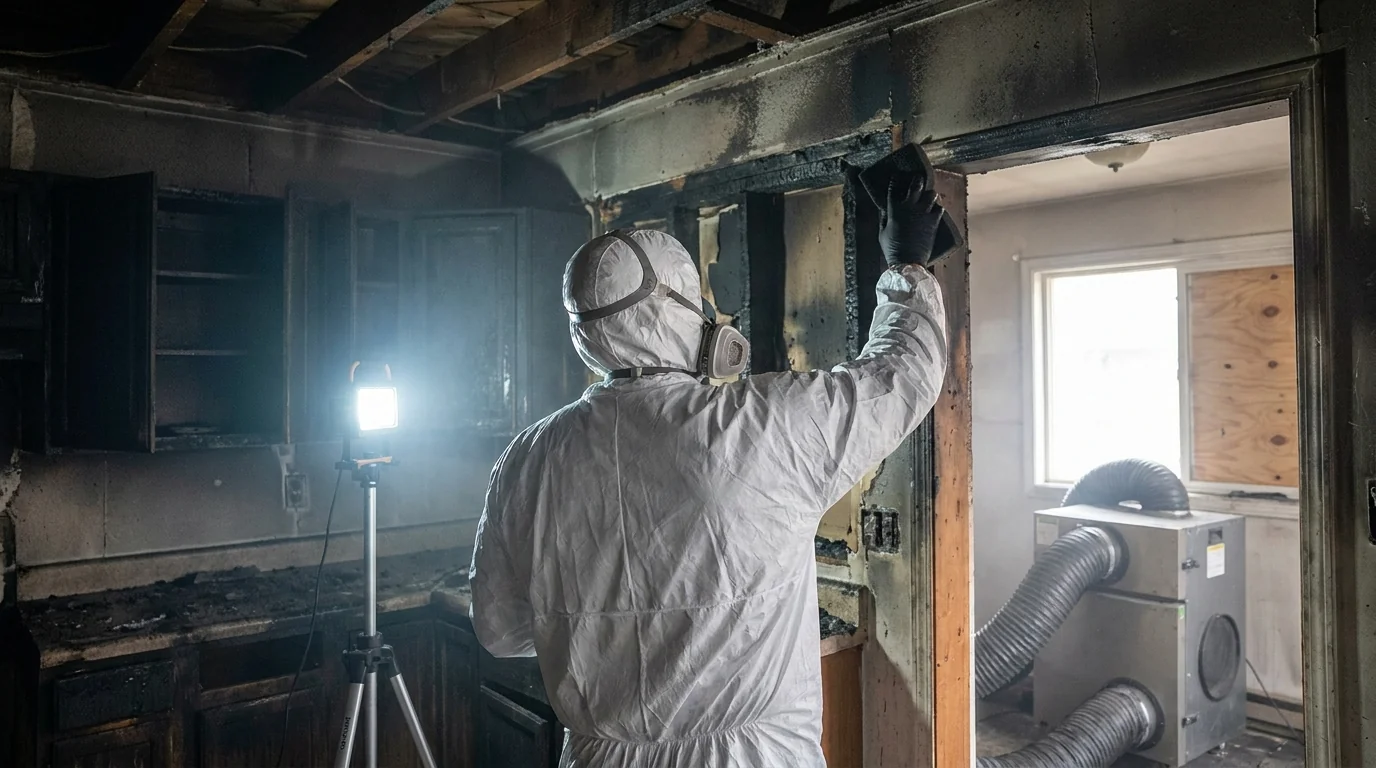
Fire Damage Restoration in Manhattan
24/7 fire damage restoration in Manhattan, NY. IICRC-certified, insurance billing accepted. Call (908) 970-8533.
Our IICRC-certified technicians are dispatched from our Fair Lawn, NJ headquarters and are typically on-site in Manhattan within 60 minutes of your call.
A kitchen fire in a Chelsea walk-up or a stove flare-up in a Midtown high-rise doesn’t just damage one unit — in Manhattan’s dense vertical stack, smoke travels through shared ductwork, char odor seeps into neighboring floors through elevator shafts, and soot settles on surfaces three stories below the flame. The Restoration Group responds 24/7 to fire damage across Manhattan, bringing IICRC-certified technicians (Firm #210213) and commercial-grade equipment to a borough where every hour of displacement costs real money and building management expects documentation before the freight elevator is even unlocked.
Why Manhattan Buildings Face Distinct Fire Damage Challenges
Manhattan’s housing stock is unlike almost anywhere else in the country. Pre-war co-ops on the Upper East Side and Upper West Side were built with plaster-and-lathe walls, original oak flooring, and ornate millwork that absorbs smoke differently than modern drywall — and that your board’s managing agent will expect to be matched, not simply replaced with builder-grade materials. In newer condo towers closer to the Financial District or around 10038, fire suppression systems can release hundreds of gallons of water alongside the fire damage itself, meaning restoration crews are often managing simultaneous char, soot, and water intrusion from the sprinkler discharge.
Older buildings also carry decades of accumulated paint layers — some pre-dating lead-safe regulations — which means any surface disturbed during debris removal or structural repair triggers additional handling protocols. Add in the density of shared mechanical chases, and smoke odor that reads as a minor inconvenience in a suburban ranch house becomes a building-wide complaint in a 30-story tower.
Our Fire Damage Restoration Process in Manhattan
When we arrive on site, the first priority is containment: sealing HVAC registers and shared duct openings to stop soot migration into adjacent units. We document every affected surface with photos and moisture readings before touching anything — resident managers and co-op boards require unit-by-unit logs, and insurers need that same paper trail to process the claim cleanly.
From there, the process moves in a defined sequence:
- Structural assessment — identifying load-bearing elements compromised by heat or char, coordinating with the building’s engineer of record when required by the building’s own rules
- Debris removal and controlled demolition — removing unsalvageable materials while protecting finishes the board or owner wants to retain
- Dry-ice or soda blasting for soot — particularly effective on exposed brick, cast-iron radiators, and the ornate plaster crown molding common in pre-war units
- Thermal fogging and hydroxyl treatment — penetrating smoke odor in wall cavities and shared spaces without displacing residents in adjacent units for extended periods
- Reconstruction — matching existing finishes, sourcing period-appropriate materials when the building requires it, and scheduling work around freight-elevator windows and building quiet hours
Reaching Manhattan from Kenilworth
The Restoration Group is based in Kenilworth, NJ, and reaches Manhattan via the Lincoln Tunnel or the George Washington Bridge depending on the borough entry point — Midtown and Upper West Side calls typically route through the Lincoln; Harlem and upper Manhattan through the GWB. Because we operate around the clock, we can dispatch at times when tunnel and bridge traffic is lighter, which matters when equipment trucks need to reach a building before business hours so work can begin at first light. Once on site, we coordinate directly with the building’s superintendent or managing agent on freight access, COI requirements, and any board-mandated work-hour restrictions.
Manhattan Insurance and Building Coordination
Fire losses in Manhattan almost always involve at least two insurance policies: the unit owner’s HO-6 and the building’s master policy, and sometimes a commercial policy if the fire originated in a ground-floor retail or restaurant space. We photograph and document the loss in a format that satisfies both carriers, itemize affected materials by unit, and provide the certificates of insurance that co-op and condo boards require before any contractor sets foot in a common area.
For commercial losses — restaurants near Times Square, office suites around Grand Central Terminal, or retail in the Financial District — we understand that every closed day is measurable lost revenue. We build a phased scope that reopens usable portions of the space as quickly as the work sequence allows, rather than treating the whole property as a single shut-down zone.
Local Note
In pre-war Manhattan buildings, the original tin ceilings and decorative plaster medallions that survived a century of steam heat are often the first things an owner asks about after a fire. Standard restoration practice would call them a write-off, but experienced crews working in ZIP codes like 10021 or 10025 know to assess them individually — a medallion with surface soot and minor heat blistering can often be cleaned and stabilized in place for a fraction of the cost of a custom reproduction. It’s the kind of call that only gets made when the technician has seen enough pre-war Manhattan interiors to know what’s worth saving.
If your property has sustained fire or smoke damage anywhere in Manhattan, call The Restoration Group at (908) 970-8533. We’ll have a certified crew on site, documentation started, and a scope of work in your hands before your building management asks for it.
Fire Damage Restoration in Manhattan: Service Coverage
Frequently Asked Questions
How fast can you arrive for fire damage restoration in Manhattan?
How quickly can The Restoration Group reach a fire damage emergency in Midtown or the Upper East Side?
A fire started in a ground-floor restaurant in our Financial District building and smoke reached upper residential floors. Who handles the multi-policy insurance complexity?
Our Upper West Side co-op board requires a certificate of insurance and board approval before any contractor begins work. Can you meet those requirements?
How do you handle smoke odor that has spread into neighboring units through shared ductwork in a Manhattan high-rise?
What's involved in restoring original plaster and millwork in a pre-war Manhattan apartment after fire damage?
Fire Damage Restoration response in Manhattan
Most Manhattan calls see a technician on-site within 60 minutes from our Fair Lawn headquarters.