Mold Remediation in Manhattan
24/7 mold remediation in Manhattan, NY. IICRC-certified, insurance billing accepted. Call (908) 970-8533.
Our IICRC-certified technicians are dispatched from our Fair Lawn, NJ headquarters and are typically on-site in Manhattan within 60 minutes of your call.
Manhattan’s vertical density creates a mold dynamic you won’t find in a suburban split-level. When a radiator valve fails on the 22nd floor of a pre-war co-op on the Upper West Side, the water doesn’t spread outward — it travels down through plaster ceilings, behind terracotta tile, and into the unit below before anyone smells the musty signature that means mold has already begun colonizing. Spores can establish a foothold within 24 to 48 hours of a moisture event, and in buildings where the air handling is shared and the walls are thick, the problem is rarely confined to one apartment.
Why Manhattan Properties See Mold Issues
The borough’s housing stock is its own ecosystem. Pre-war buildings — the kind that line West End Avenue and populate the blocks between Lexington and Fifth on the Upper East Side — were built with materials that behave nothing like modern construction. Horsehair plaster, brick cavity walls, and original cast-iron pipe risers create moisture pathways that standard inspection misses. When those risers fail, water migrates laterally through structural cavities before it ever appears on a surface.
Climate compounds the problem. New York City’s humid summers push outdoor dew points into the mid-70s, and the gap between an air-conditioned interior and a warm exterior wall creates condensation inside wall assemblies for months at a stretch. Buildings that took on storm surge during Sandy — particularly in the Financial District and the Lower East Side — often dealt with mold remediation in the months that followed, not just from the floodwater itself but from the residual moisture trapped in concrete slabs and behind wall finishes that dried unevenly. Ida’s 2021 flooding repeated the pattern, overwhelming drains from Harlem south through Chelsea and leaving basement mechanical rooms with moisture readings that persisted well into winter.
Our Mold Remediation Process in Manhattan
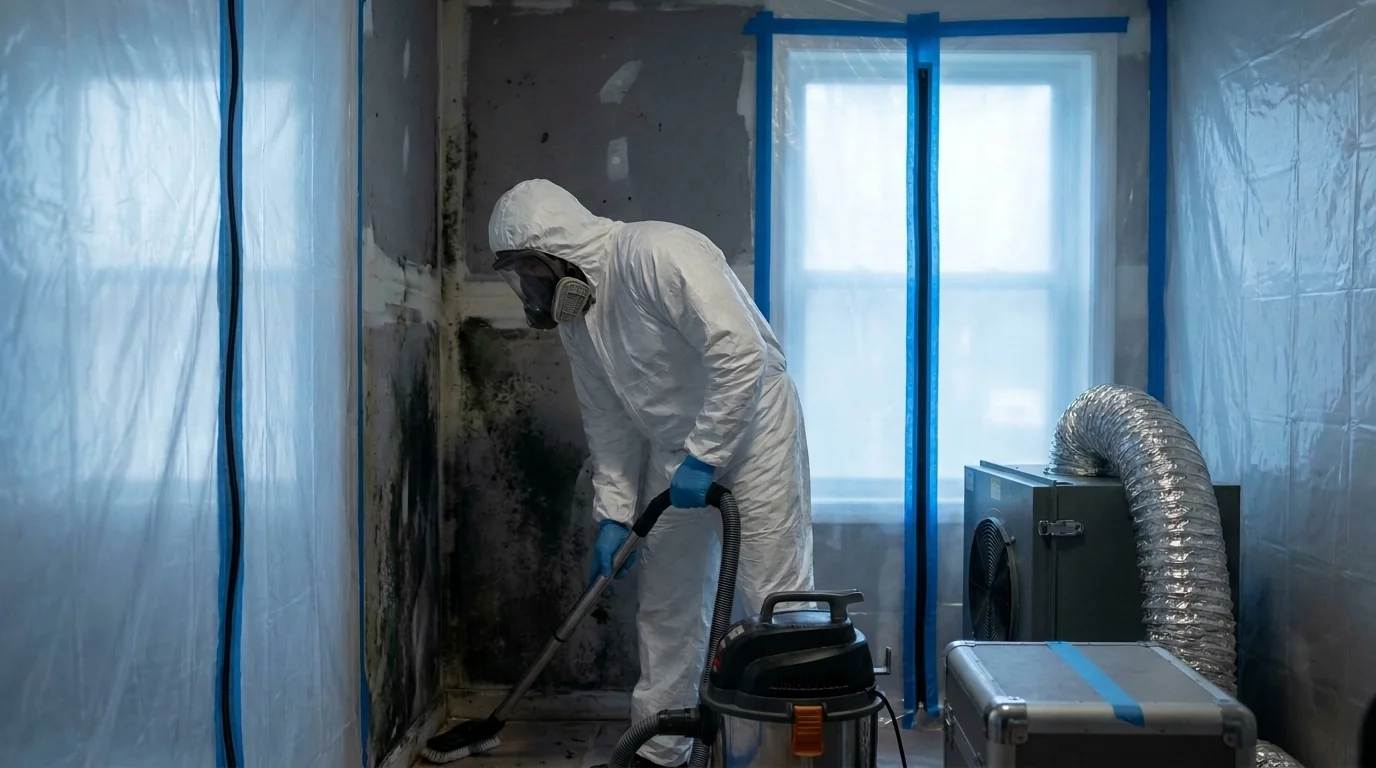
Every job starts with a thorough moisture mapping inspection — thermal imaging and calibrated moisture meters across all affected surfaces, not just the visible staining. That data drives the containment plan. In a multi-unit building, containment matters more than almost anywhere else: negative air pressure chambers using HEPA-filtered air scrubbers prevent cross-contamination to adjacent units, hallways, and HVAC return ducts.
Once containment is established, affected materials are removed following IICRC S520 protocol. Porous materials — drywall, insulation, carpet backing — that test above remediation thresholds are bagged, sealed, and removed through the freight elevator, not the passenger lobby. That last detail matters in a co-op or condo: resident managers and building boards expect the work to be invisible to neighbors, and we coordinate freight-elevator scheduling and hallway protection accordingly.
Drying and treatment follow removal. Antimicrobial application covers structural surfaces, and drying equipment runs until moisture readings return to baseline — typically verified across multiple consecutive days of readings, not a single passing measurement. We provide unit-by-unit moisture logs that managing agents and boards can file with the building’s records, which is often a condition of closing out the work order in larger residential towers.
Reaching Manhattan from Kenilworth
The Restoration Group operates 24/7 and dispatches from Kenilworth, NJ, with access to Manhattan via the Lincoln Tunnel into Midtown or the Holland Tunnel into lower Manhattan — useful when a call comes in for a building near One World Trade Center or in the ZIP codes around 10038. For jobs in Harlem or the northern reaches of the island, the George Washington Bridge keeps routing straightforward. We work within building access rules, which means coordinating with doormen, resident managers, and after-hours security rather than assuming street-level access.
Manhattan Insurance and Building Coordination
Most mold losses in Manhattan trace back to a covered water event — a burst pipe, a failed appliance line, an HVAC condensate overflow. We document the origin, photograph affected materials, and produce the moisture logs and scope of work that carriers and public adjusters need to process the claim. In co-op and condo buildings, that documentation also satisfies the board’s requirement that the remediating contractor carry adequate insurance and provide a certificate before work begins. We carry the certificates of insurance that resident managers request, and we’re accustomed to submitting them before a start date is confirmed.
For commercial spaces — the restaurants, retail storefronts, and office suites that occupy ground floors and lower levels across Midtown and Chelsea — we schedule work to minimize closed hours, often running the heaviest phases overnight so the business can open the next morning.
Local Note
One thing that catches out-of-market contractors in Manhattan: many pre-war buildings have transom windows above unit doors that open into shared corridors. During mold remediation, those transoms are a direct pathway for spores to migrate from a contained work area into a common hallway — and from there into adjacent units through their own door gaps. We seal transoms as part of initial containment setup, a step that’s easy to overlook if your crew is used to working in detached single-family homes where corridor contamination isn’t a variable.
If you’re dealing with visible mold growth, a persistent musty odor, or a recent water event in a Manhattan building, call The Restoration Group at (908) 970-8533. We’ll assess the scope, work within your building’s protocols, and get the documentation your board or carrier needs — without turning the job into a disruption for the rest of the building.
Mold Remediation in Manhattan: Service Coverage
Frequently Asked Questions
How fast can you arrive for mold remediation in Manhattan?
How does mold remediation work differently in a Manhattan co-op or condo versus a standalone house?
Can mold from a water event during a storm like Ida or Sandy still be a problem years later in Lower East Side or Financial District buildings?
Does mold remediation in a building near ZIP code 10001 or 10025 require any city permits or notifications?
What equipment do you use, and how do you manage noise and dust in a densely occupied Manhattan building?
How does a mold insurance claim typically work for a Manhattan apartment where the source was a pipe in a unit above?
Mold Remediation response in Manhattan
Most Manhattan calls see a technician on-site within 60 minutes from our Fair Lawn headquarters.