Smoke Damage Restoration in Newark
24/7 smoke damage restoration in Newark, NJ. IICRC-certified, insurance billing accepted. Call (908) 970-8533.
Our IICRC-certified technicians are dispatched from our Fair Lawn, NJ headquarters and are typically on-site in Newark within 60 minutes of your call.
When a fire tears through one of Newark’s dense brick multifamilies or a pre-war frame three-family, the flames are only half the story. Smoke travels fast through shared stairwells, open risers, and the gaps between century-old balloon framing — and within hours it deposits a fine, acidic residue on every surface it touches. That residue keeps working long after the fire trucks leave: etching chrome fixtures, yellowing plaster ceilings, and embedding a persistent odor into porous brick that no amount of airing out will fix. The Restoration Group responds 24/7 to smoke damage calls across Newark, from the Ironbound to Forest Hill, and we carry the documentation your insurance adjuster needs from the first hour on site.
Why Newark Properties See Smoke Damage Spread Differently
Newark’s housing stock is overwhelmingly pre-1950 — brick multifamily rowhouses, frame two- and three-families built shoulder-to-shoulder, and the grand colonials of Forest Hill sitting on lots that would look spacious anywhere else in Essex County. That density creates a specific smoke problem: a kitchen fire on the second floor of a six-unit building on Bloomfield Avenue doesn’t stay on the second floor. Smoke migrates through shared walls, travels up uninsulated pipe chases, and settles into units that never saw a flame. Balloon-frame construction — common in Newark’s older residential stock — has continuous wall cavities from the basement sill plate to the roof, giving smoke an invisible highway through the entire structure.
The Ironbound’s position along the Passaic River adds another layer. The neighborhood’s older buildings tend to have higher ambient humidity, especially in basements and ground-floor units, which means smoke particles bond more aggressively to surfaces and odor compounds penetrate deeper into porous masonry. Landlords and property managers operating in ZIP codes like 07105 and 07102 know that a fire in one unit can render adjacent units uninhabitable — and that insurance carriers expect a detailed scope of damage across every affected space, not just the room of origin.
Our Smoke Damage Restoration Process in Newark
The first thing we do on arrival is a full structural survey — not just the fire room, but every connected space. In a Newark multifamily, that means checking adjacent units, the basement utility area, and the attic if accessible. Smoke residue is categorized before any cleaning begins: dry soot from fast-burning fires behaves differently from the wet, oily smoke left by synthetic materials or a smoldering electrical fire, and using the wrong cleaning chemistry makes the staining permanent.
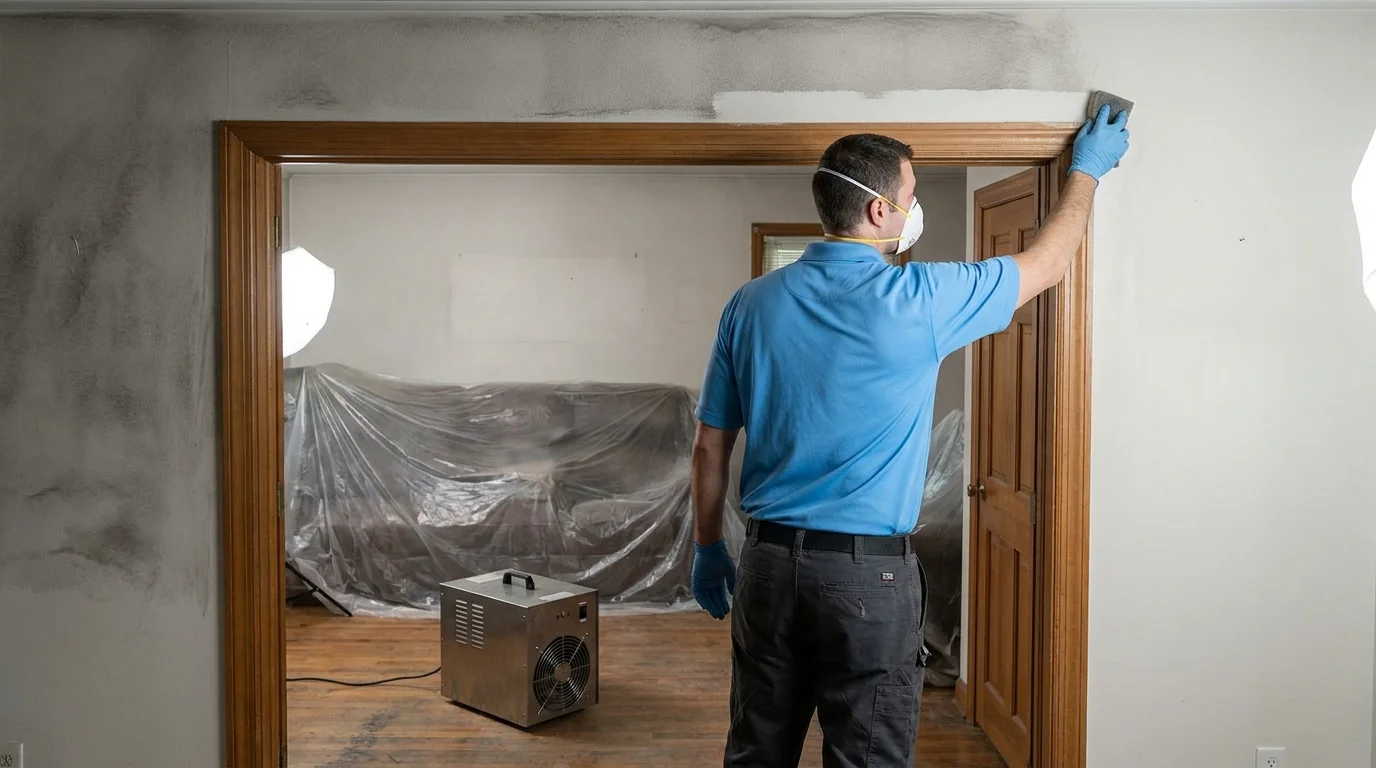
Once the scope is mapped, we seal HVAC returns and shared ductwork to stop cross-contamination, then work through a structured cleaning sequence — dry chemical sponges on loose soot first, followed by wet cleaning with pH-adjusted solutions matched to the surface type. Newark’s plaster walls and ceilings require particular care: plaster is more alkaline than drywall and can react badly to aggressive cleaners, leaving ghost stains that reappear months later. Odor neutralization runs concurrently, using thermal fogging and hydroxyl generation to reach the same pathways the smoke used. We document every step with timestamped photos and moisture readings — the format insurance carriers and the NJ Division of Consumer Affairs expect for licensed home improvement work.
Reaching Newark from Kenilworth
Our shop in Kenilworth sits roughly fifteen minutes from Newark via the Garden State Parkway or Route 22 to McCarter Highway, depending on traffic. Because we operate around the clock, we can stage a crew and equipment for any neighborhood in the city — Weequahic and Vailsburg to the southwest, University Heights near the medical district, or the blocks immediately around Prudential Center and Newark Penn Station where commercial and mixed-use properties are densest. For large-scale losses involving multiple units or institutional properties, we can coordinate simultaneous crews to keep the project timeline tight and minimize displacement for tenants.
Newark Insurance & Documentation
Most fire losses in Newark run through standard homeowners or landlord policies, but the documentation requirements are specific. Carriers want a line-item scope, not a summary — affected square footage by room, surface category, cleaning method, and materials requiring replacement. For multifamily properties, that means separate documentation for each affected unit. We produce an insurance-ready report from the first site visit and communicate directly with adjusters to answer technical questions about scope and method. If your property is managed by a third party or falls under a commercial policy with its own requirements, we’ve worked with those formats too.
Local Note
Newark’s older brick buildings absorb smoke odor into the mortar joints in a way that surprises homeowners who expect a quick surface clean to solve the problem. Mortar is highly porous and, unlike painted drywall, can’t simply be wiped and sealed — it holds odor compounds deep in the matrix. In Forest Hill colonials and Ironbound rowhouses alike, we’ve found that thermal fogging alone isn’t enough; those masonry surfaces often need a penetrating sealant applied after cleaning to lock in residual odor compounds before repainting. Skipping that step is the most common reason smoke smell returns six weeks after a restoration that looked complete on the surface.
If your property in Newark is dealing with smoke residue — whether from a contained kitchen fire or a multi-unit loss — call The Restoration Group at (908) 970-8533. We’ll assess the full scope, work directly with your insurance carrier, and get every affected space back to a safe, livable condition.
Smoke Damage Restoration in Newark: Service Coverage
Frequently Asked Questions
How fast can you arrive for smoke damage restoration in Newark?
How quickly can The Restoration Group reach the Ironbound or Downtown Newark after a fire?
Does smoke travel between units in Newark's older multifamily buildings, and will you assess the whole building?
Newark has a lot of plaster walls and brick interiors — does that change how smoke residue is cleaned?
What documentation do Newark landlords and property managers need for an insurance claim after a smoke damage event?
How long does smoke odor remediation typically take in a Newark rowhouse or three-family?
Smoke Damage Restoration response in Newark
Most Newark calls see a technician on-site within 60 minutes from our Fair Lawn headquarters.