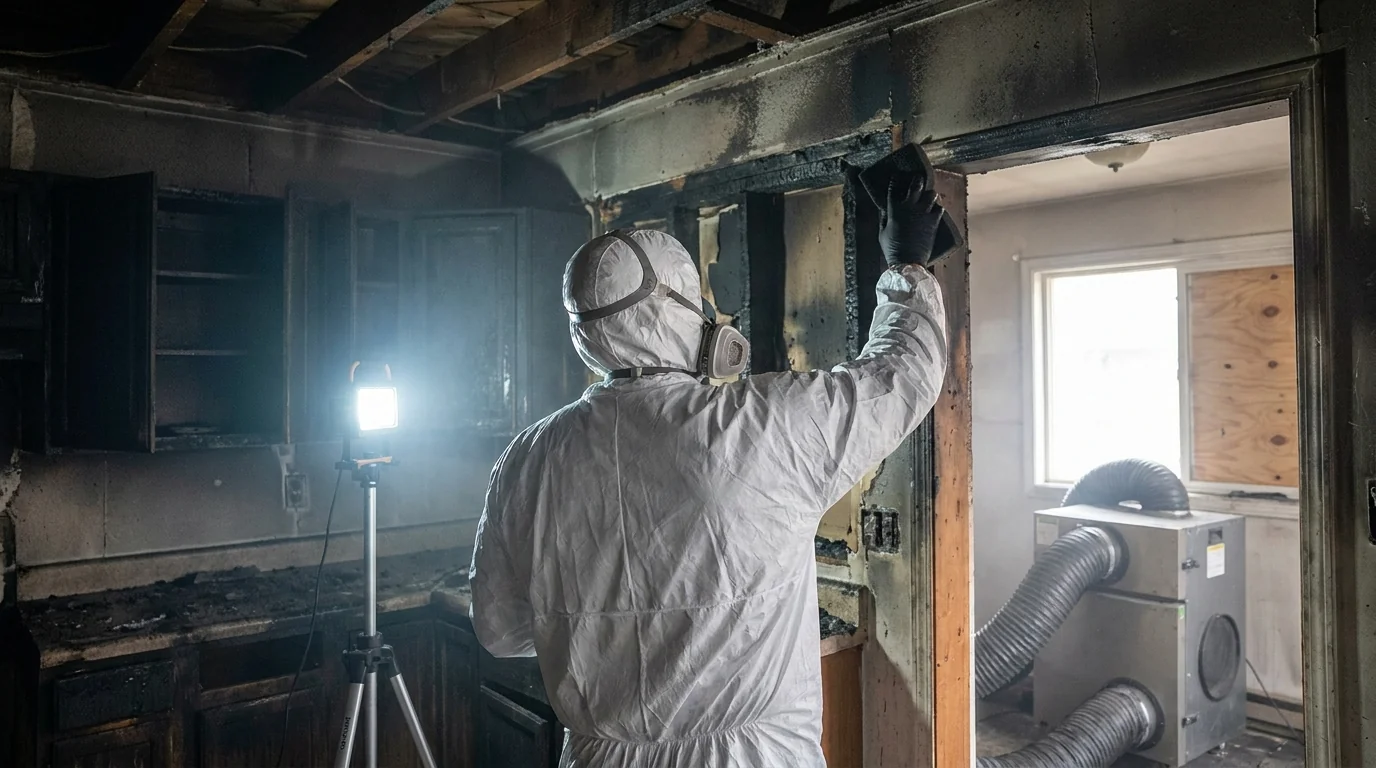
Fire Damage Restoration in Newark
24/7 fire damage restoration in Newark, NJ. IICRC-certified, insurance billing accepted. Call (908) 970-8533.
Our IICRC-certified technicians are dispatched from our Fair Lawn, NJ headquarters and are typically on-site in Newark within 60 minutes of your call.
When a fire tears through a brick three-family in the Ironbound or a Forest Hill colonial, the damage doesn’t stop when the flames do. Smoke and soot keep working — etching glass, corroding metal fixtures, and penetrating plaster walls that in Newark’s pre-war housing stock can run three coats deep. The Restoration Group responds 24/7 from Kenilworth, reaching most Newark addresses in under 30 minutes via McCarter Highway, with board-up crews and certified restorers dispatched on the same call.
Why Newark Properties Face Distinct Fire Damage Challenges
Newark’s housing density is the first thing any experienced restoration crew notices. Frame two- and three-families in Vailsburg and Weequahic sit close enough that a fire on one side of a shared wall can push heat, smoke, and firefighting water into neighboring units before the engine company arrives. That means a single-unit fire routinely becomes a multi-unit restoration project, with documentation needed for several tenants and potentially multiple insurance policies.
The building stock compounds the problem. Homes built before 1950 — and much of Newark’s residential inventory is exactly that — often have balloon-frame construction, where wall cavities run uninterrupted from the basement to the attic. Fire and smoke travel those cavities fast and silently, showing up in rooms that looked untouched. Thermal imaging is standard on every Newark job we run because visible char is rarely the whole story.
Newark’s institutional and commercial corridor adds another layer. Property managers overseeing buildings near University Heights or the arena district around Prudential Center need insurance-ready documentation, not just cleanup. Adjusters want itemized scope reports, photo logs, and signed certificates — and that paperwork starts at the same moment the physical work does.
Our Fire Damage Restoration Process in Newark
The first hour on-site is about stopping secondary damage. We board up openings, tarp any roof penetration from firefighting operations, and isolate HVAC systems so soot doesn’t redistribute through ductwork. In Newark’s older multifamily buildings, that duct isolation step matters more than it does in newer construction — cast-iron radiator systems are generally self-contained, but converted forced-air systems in renovated buildings can carry odor throughout a structure in hours.
Once the building is secured, we run a full scope assessment: structural integrity check, moisture mapping (firefighting water is always present), and surface testing to identify soot type. Wet smoke from smoldering fires — common in upholstered furniture and insulation — requires different cleaning chemistry than dry smoke from fast, hot fires. Getting that distinction wrong means odor returns weeks after the job closes.
Content pack-out follows for salvageable items. Electronics, textiles, and documents go to our processing facility; structural materials get cleaned in place or removed depending on char depth. Deodorization uses thermal fogging and hydroxyl generation rather than masking agents, because Newark’s older plaster walls hold odor molecules the way newer drywall simply doesn’t.
Reaching Newark from Kenilworth
Our shop in Kenilworth sits roughly 15 minutes from Newark Penn Station via Route 22 East and McCarter Highway — a route our crews run day and night. We cover all Newark ZIP codes, from 07102 in Downtown Newark to 07105 in the Ironbound. For properties near Newark Liberty International Airport or along the eastern edge of the city, we route through the Turnpike extension and typically arrive faster than GPS estimates because our drivers know the interchange timing.
For landlords and property managers with multiple Newark addresses, we can stage a second crew from our network when a single large loss — a fire in a six-unit building, for instance — requires simultaneous board-up and interior work on different floors.
Insurance Coordination and Documentation
New Jersey’s Division of Consumer Affairs licensing requirements mean our contracts and scope documents are formatted to meet state standards, which matters when an adjuster is reviewing line items. We photograph every affected surface before touching it, generate moisture and soot readings tied to specific room locations, and produce a written scope that carriers can approve without a second site visit in most cases. We bill major carriers directly and work with your adjuster’s timeline, not against it.
Local Note
In Newark’s Ironbound neighborhood, many older buildings have interior courtyards and shared rear structures that aren’t visible from the street — and aren’t always reflected accurately in county property records. Firefighting water from a rear-structure fire can drain toward the main building’s foundation before anyone realizes the exposure. On Ironbound jobs, we walk the full parcel before finalizing scope, because the damage footprint is often larger than the fire report describes.
If smoke is still in the air at a Newark property, call (908) 970-8533. Our IICRC Certified Firm team is available around the clock, and we’ll have eyes on the structure and a scope started before most contractors return a voicemail.
Fire Damage Restoration in Newark: Service Coverage
Frequently Asked Questions
How fast can you arrive for fire damage restoration in Newark?
How quickly can you reach the Ironbound or Vailsburg for a fire damage emergency?
Newark has a lot of pre-war balloon-frame homes — does that change how you scope a fire job?
What does fire damage restoration typically involve in Newark's older multifamily buildings?
How do you handle smoke odor in Newark homes with original plaster walls?
Can you handle insurance documentation for a Newark property manager overseeing multiple units?
Fire Damage Restoration response in Newark
Most Newark calls see a technician on-site within 60 minutes from our Fair Lawn headquarters.