Mold Remediation in Newark
24/7 mold remediation in Newark, NJ. IICRC-certified, insurance billing accepted. Call (908) 970-8533.
Our IICRC-certified technicians are dispatched from our Fair Lawn, NJ headquarters and are typically on-site in Newark within 60 minutes of your call.
Newark’s combined sewer system and its dense inventory of pre-war brick and frame buildings create a mold environment unlike most of New Jersey. When Ida dropped seven inches of rain in a few hours, Ironbound basements filled with a mix of stormwater and raw sewage — and within 48 to 72 hours, mold colonies were already establishing on framing, insulation, and drywall that had never fully dried. That pattern repeats on a smaller scale every heavy-rain season, and it’s why mold remediation in Newark demands more than a bleach spray and a dehumidifier.
Why Newark Properties See Elevated Mold Risk
The geography works against property owners here. The Ironbound sits in a low-lying basin along the Passaic River, and combined sewer overflows push contaminated water into basements across zip codes 07105 and 07102 whenever rainfall overwhelms the system. That sewage-laced moisture carries bacteria and organic material that accelerates mold growth on any porous surface it contacts — wood framing, paper-faced drywall, ceiling tile, carpet padding.
Beyond flooding, the housing stock itself is a factor. Forest Hill’s grand colonials and the two- and three-family frame buildings throughout Vailsburg and Weequahic were constructed before modern vapor barriers and ventilation standards existed. Plaster walls, balloon-frame cavities, and uninsulated crawl spaces trap humidity. A single slow pipe leak inside a wall can feed a hidden mold colony for months before a musty odor or a soft spot in the baseboard gives it away. In multifamily buildings — which make up the majority of Newark’s residential inventory — one unit’s moisture problem frequently migrates through shared walls and floor assemblies into adjacent units, multiplying the affected area and the remediation scope.
Our Mold Remediation Process in Newark
Every job starts with a thorough inspection using moisture meters and thermal imaging to map where water has traveled, not just where it’s visible. Mold you can see is rarely the full picture, especially in older plaster and lath construction.
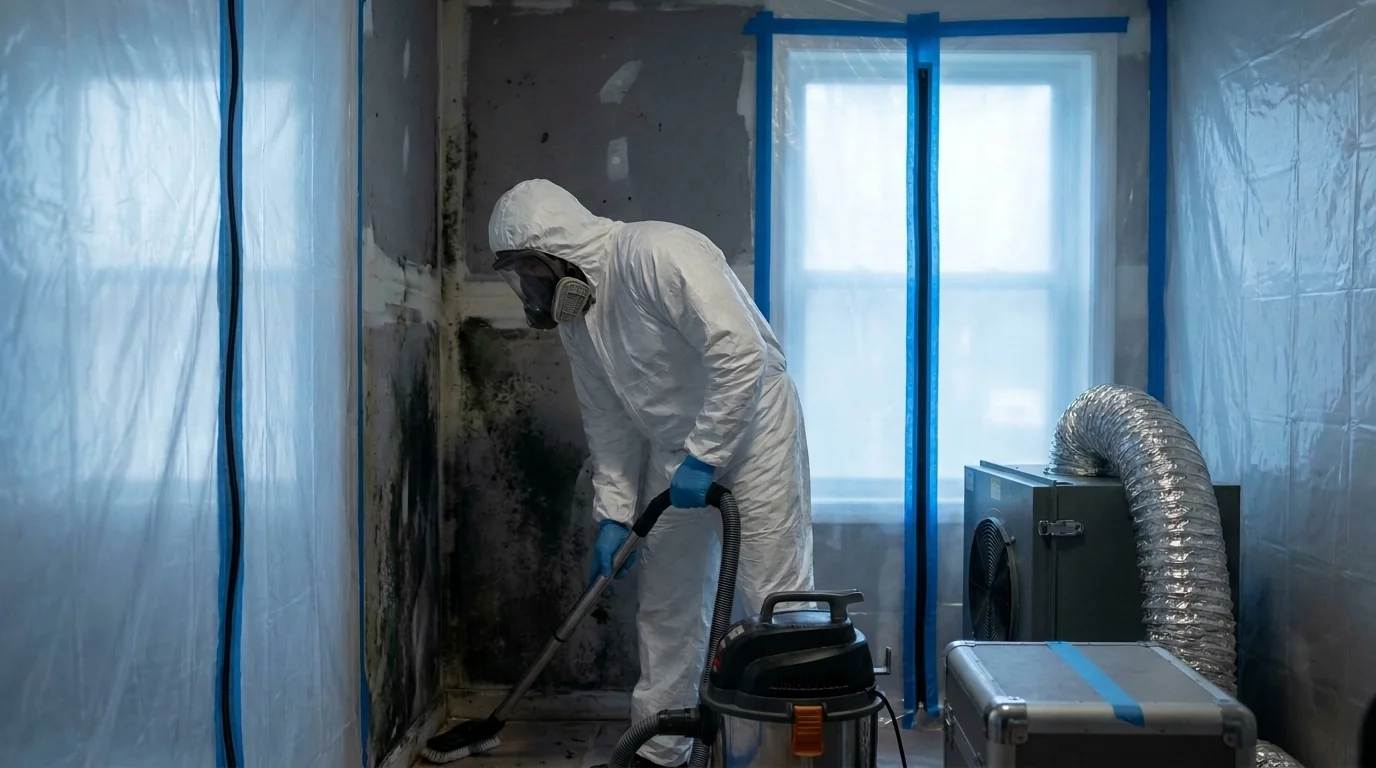
Once the extent of contamination is confirmed, we establish containment using negative air pressure and poly barriers to prevent spores from migrating to unaffected areas — critical in multifamily buildings where HVAC systems can distribute spores across multiple units. HEPA-filtered air scrubbers run continuously throughout the remediation.
Affected porous materials — drywall, insulation, wood framing where necessary — are removed and bagged per EPA guidelines. Non-porous surfaces are cleaned with EPA-registered antimicrobial agents. Structural wood that can be retained is HEPA-vacuumed, treated, and dried to verified moisture content before any encapsulation or reconstruction begins. We dry to the IICRC S520 standard, not to a visual check.
Documentation runs in parallel: photos, moisture readings, and a written scope are compiled throughout, formatted for insurance carriers and, where applicable, for the NJ Department of Community Affairs if a certificate of habitability is part of the close-out.
Reaching Newark from Kenilworth
The shop is in Kenilworth, roughly 15 minutes up McCarter Highway from Newark under normal conditions. Because we operate 24/7, crews can mobilize at any hour — which matters when a property manager at a University Heights apartment complex discovers a ceiling collapse at 2 a.m. or a Vailsburg landlord calls after a weekend pipe failure. We stage equipment for Newark jobs before dispatch so the truck arriving on site is ready to begin containment, not waiting on a supply run.
For larger commercial properties near the Prudential Center arena district or institutional clients along the hospital corridor, we coordinate access and staging in advance — loading docks, freight elevators, and parking logistics in dense urban blocks require a call ahead, not an assumption.
Insurance and Documentation for Newark Landlords and Property Managers
Newark’s rental market means a significant share of mold calls come from landlords and property management companies, not owner-occupants. Insurance claims for mold tied to a covered water loss — a burst riser, a roof failure, a sewage backup — require detailed documentation to avoid denial. We photograph affected areas before, during, and after remediation, log moisture readings at each stage, and produce a written scope that maps directly to the adjuster’s line items.
For properties subject to NJ’s landlord-tenant habitability standards, that documentation also supports the landlord’s compliance record if a tenant files a complaint with the city.
Local Note
In Newark’s older three-family frame buildings — common throughout Vailsburg and the blocks surrounding Branch Brook Park — balloon-frame wall cavities run uninterrupted from the basement to the attic. When mold establishes in a first-floor wall cavity, it can wick upward through that open channel and colonize framing two floors above the original moisture source. We’ve learned to scope these jobs vertically, not just horizontally. If your building was constructed before 1950 and you’re seeing mold on one floor, the inspection needs to include the floors above it before any remediation plan is finalized.
If you’re dealing with a musty smell, visible growth, or a recent water event at a Newark property, call (908) 970-8533. We’ll assess the full scope, handle the insurance documentation, and remediate to a standard that holds up — whether your property is a Forest Hill colonial, a Ironbound row house, or a multifamily building near Newark Penn Station.
Mold Remediation in Newark: Service Coverage
Frequently Asked Questions
How fast can you arrive for mold remediation in Newark?
Are Ironbound basement mold cases more complicated because of sewage backup history?
How does Newark's pre-war housing stock affect a mold remediation timeline?
Can you handle mold remediation in a Newark multifamily building where multiple units are affected?
What does the mold remediation process actually involve, and how disruptive is it?
Will my insurance cover mold remediation at my Newark property, and how do you help with the claim?
Mold Remediation response in Newark
Most Newark calls see a technician on-site within 60 minutes from our Fair Lawn headquarters.