Water Damage Restoration in Springfield
24/7 water damage restoration in Springfield, NJ. IICRC-certified, insurance billing accepted. Call (908) 970-8533.
Our IICRC-certified technicians are dispatched from our Fair Lawn, NJ headquarters and are typically on-site in Springfield within 60 minutes of your call.
When the Rahway River’s west branch backs up after a hard rain, Springfield’s low-lying streets can flood faster than most homeowners expect — and the township’s dense stock of finished basements means the water has somewhere to go that hurts. Whether it’s a burst supply line in a 1940s colonial off Mountain Avenue or a sump failure in a townhome complex near the Millburn line, standing water in a Springfield home starts damaging structural materials within the first hour and can trigger mold colonization in as little as 24 to 48 hours if drying doesn’t begin quickly.
Why Springfield Properties See Water Damage Issues
Springfield Township’s geography sets up a recurring problem. The Watchung ridges funnel rainfall runoff directly toward the township’s lower elevations, and the west branch of the Rahway River has very little room to absorb surge before it spills. Residents near the Route 22 corridor saw exactly how severe that can get during Hurricane Ida, when Route 22 itself became impassable and water pushed into basements and ground-floor commercial spaces across the township.
The housing stock compounds the risk. Much of the Baltusrol area and Springfield Center is built on homes dating from the 1920s through the 1950s — colonials and capes with original cast-iron drain stacks, aging galvanized supply lines, and stone or cinder-block foundation walls that weep groundwater under hydrostatic pressure even without a direct flood event. These older foundations were not waterproofed to modern standards, and their porous masonry holds moisture long after the visible water is gone. Newer townhome developments closer to the Millburn border add a different challenge: shared utility chases and party walls that can carry water horizontally from one unit into an adjacent one, complicating both the source investigation and the scope of drying.
Our Water Damage Restoration Process in Springfield
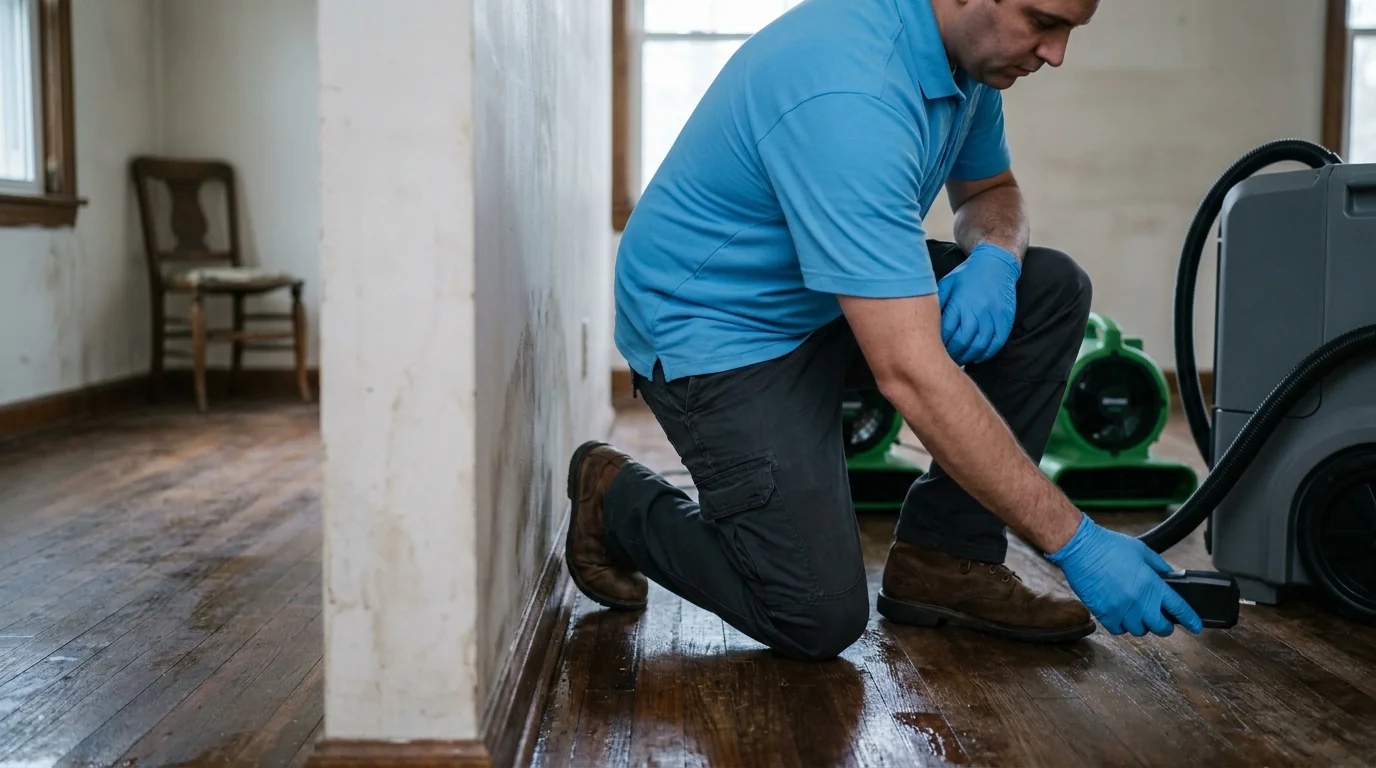
Every job starts with a moisture mapping inspection — thermal imaging and calibrated moisture meters across walls, subfloors, and ceiling assemblies — because water in a Springfield basement rarely stays in the basement. In finished lower levels, it wicks up into wall cavities and under laminate or hardwood flooring before it’s visible at the surface.
From there, the process follows a structured sequence:
- Water extraction: Truck-mounted and portable extractors pull standing water from carpet, concrete, and hardwood. In stone-foundation basements common to the Baltusrol area, we pay close attention to floor-wall joints where water pools behind finished framing.
- Structural drying: Industrial desiccant and refrigerant dehumidifiers, paired with high-velocity air movers, are positioned according to the IICRC S500 standard for psychrometric drying. Readings are logged daily so drying progress is documented — useful for insurance adjusters and for confirming the structure is genuinely dry before any rebuild begins.
- Content and materials assessment: Drywall, insulation, and subfloor materials are evaluated for salvageability. In homes with original plaster walls — still common in pre-1950 Springfield colonials — we test moisture levels carefully before making removal decisions, since plaster can absorb significant water without appearing visibly damaged.
- Antimicrobial treatment: Applied to affected cavities after drying to address microbial risk in the humid window before final clearance.
Documentation at every step is shared with homeowners and uploaded directly for insurance review.
Reaching Springfield from Kenilworth
The Restoration Group operates out of Kenilworth, which puts Springfield well within our primary service area. Route 22 connects the two townships directly — our crews can be on site around the clock, any day of the week, because we operate 24/7. For addresses in Springfield Center or along the Mountain Avenue corridor, the drive typically routes through the Route 22 interchange without navigating surface-road congestion. Calls to (908) 970-8533 reach a live dispatcher at any hour.
Springfield Insurance Coordination
Water damage claims in Union County follow standard homeowner policy structures, but the documentation requirements matter. Adjusters want to see moisture readings before and after drying, photographs of affected materials prior to any demolition, and a clear chain of custody for contents removed from the loss area. We carry that documentation through the entire job — from the initial moisture map to the final clearance readings — in a format most major carriers accept without a supplemental request. For Route 22 commercial losses, we also work with commercial property policies and can coordinate directly with property managers handling multi-tenant buildings.
Local Note
In Springfield’s pre-1950 colonials and capes, original plaster walls behave very differently from modern drywall during a water loss. Plaster is dense and slow to release absorbed moisture, which means a wall that reads wet on a moisture meter on day one may still be releasing vapor on day five even after surface conditions look normal. We’ve found that drying timelines in these homes routinely run 30 to 40 percent longer than in newer construction — something worth knowing before a homeowner or adjuster assumes the job should wrap in a standard three-day window. Rushing that timeline risks trapping moisture behind rebuilt surfaces, which is exactly the condition that leads to mold callbacks months later.
If you’re dealing with water in a Springfield home or business right now, the window for limiting structural damage and preventing secondary mold growth is measured in hours, not days. Call (908) 970-8533 — our team serves the 07081 ZIP code 24 hours a day, seven days a week, and can begin extraction and drying the same visit as the inspection.
Water Damage Restoration in Springfield: Service Coverage
Frequently Asked Questions
How fast can you arrive for water damage restoration in Springfield?
How quickly can The Restoration Group reach a home in the Baltusrol area after a flooding call?
Springfield's older colonials often have finished basements — does that change how water extraction works?
My Springfield home has original plaster walls — will they need to come out after a water loss?
Does flooding along the Route 22 corridor involve any special coordination for commercial properties?
How long does structural drying typically take in a Springfield home after a basement flood?
Will my homeowners insurance cover water damage restoration in Springfield?
Water Damage Restoration response in Springfield
Most Springfield calls see a technician on-site within 60 minutes from our Fair Lawn headquarters.