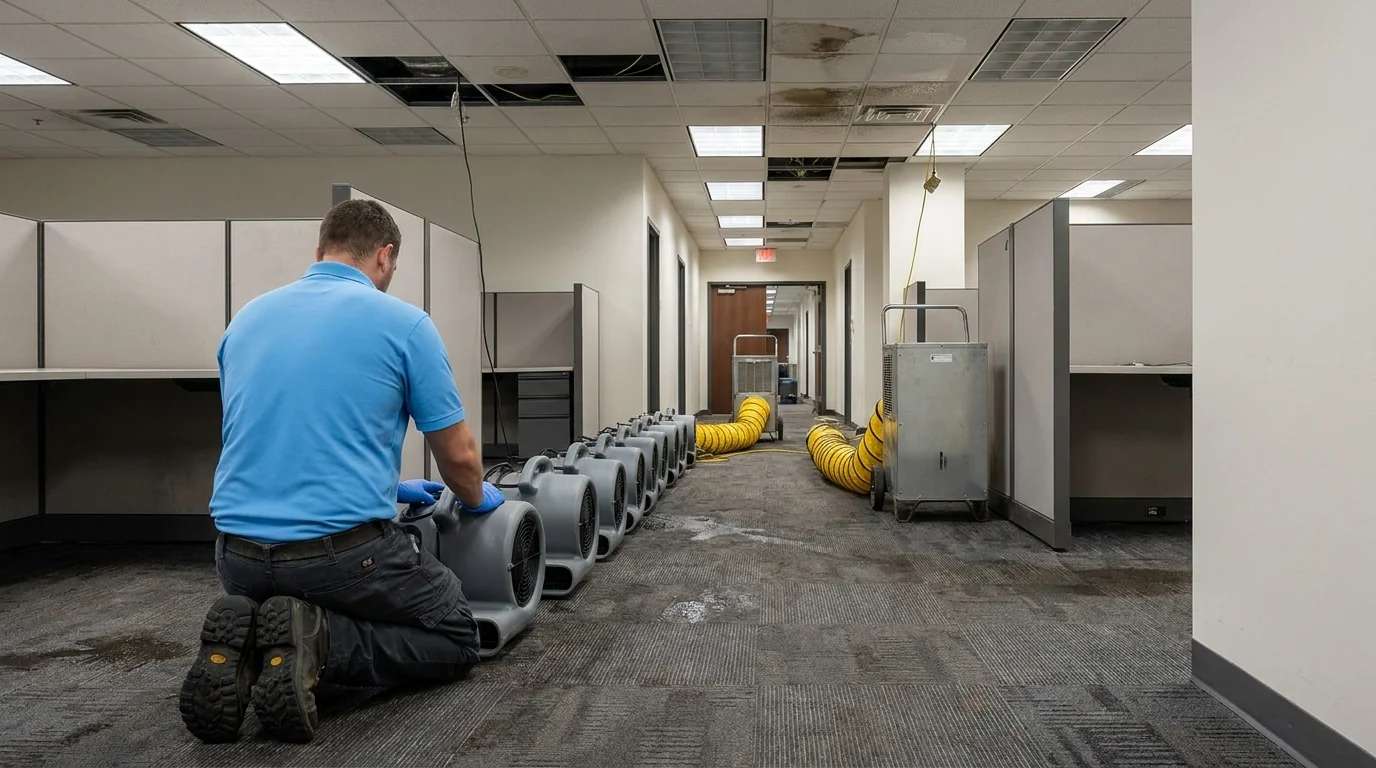
Commercial Restoration in Summit
24/7 commercial restoration in Summit, NJ. IICRC-certified, insurance billing accepted. Call (908) 970-8533.
Our IICRC-certified technicians are dispatched from our Fair Lawn, NJ headquarters and are typically on-site in Summit within 60 minutes of your call.
When a burst supply line floods the lower level of a Springfield Avenue office building at 2 a.m., or a kitchen fire chars the back corridor of a Downtown Summit retail space, the recovery timeline is measured in days of lost revenue — not just square footage of damaged material. Summit’s commercial building stock is a particular challenge: many of the city’s most active professional offices, medical suites, and mixed-use storefronts occupy structures built between 1890 and 1940, with plaster walls, original cast-iron plumbing, and finished basements that were never designed to shed water quickly. The Restoration Group responds 24/7 to commercial losses throughout Summit, bringing the equipment and documentation discipline that complex, high-value properties demand.
Why Summit Commercial Properties Face Distinct Restoration Challenges
Summit’s hilltop position protects it from the river flooding that hammers neighboring communities, but the city’s steep lots create their own hydraulic problem. Heavy rainfall channels stormwater toward the downhill face of any building on a grade — which, in the Northside and Franklin School area, often means water pressing against century-old stone foundations that were waterproofed with tar, not membrane systems. Inside those foundations, clay sewer laterals running beneath root-dense, tree-lined streets back up with regularity, pushing contaminated water into finished lower levels that tenants use as conference rooms, server closets, and storage.
Freezing winters compound the risk. Older commercial wings in Summit — particularly those attached to buildings near the Summit train station corridor that were expanded in the 1920s and 1930s — often have uninsulated supply and radiator lines running through exterior walls. A single hard freeze can burst a line inside a plaster wall cavity, and that moisture sits undetected until a ceiling tile sags or a floor buckles. By the time visible damage appears, secondary mold colonization can begin within 24 to 72 hours of initial saturation.
Our Commercial Restoration Process in Summit
Every commercial job in 07901 starts with a structured loss assessment before a single piece of equipment is placed. We photograph and document affected materials to insurance-grade standards, then deploy thermal imaging and calibrated moisture meters to map saturation through plaster, masonry, and original hardwood — materials that hold and release moisture on a different schedule than modern drywall. Extraction and drying plans are built around the actual building envelope, not a generic template.
For water losses, we set commercial-grade desiccant or refrigerant dehumidifiers scaled to the cubic footage of the affected space, and we log psychrometric readings at each monitoring visit so the drying record is defensible to an adjuster. For fire and smoke losses, we assess residue type — protein smoke from a kitchen fire behaves differently than synthetic smoke from an electrical event — and select cleaning chemistry accordingly. Structural repairs are scoped to match existing finishes: if the damaged ceiling is original plaster with a period-appropriate profile, we document that before demolition so reconstruction can match it.
When the loss involves a tenant-occupied building, we coordinate work sequencing with property managers to minimize disruption to operating businesses. Containment barriers, negative air pressure, and defined access routes protect unaffected suites during active mitigation.
Reaching Summit from Kenilworth
The Restoration Group operates out of Kenilworth, placing Summit well within our primary response zone. Our crews travel Route 22 to the Springfield Avenue exit and can be on-site at properties near Downtown Summit or the Brayton School area around the clock — our 24/7 availability means a call at midnight gets the same crew mobilization as a call at noon. We stage equipment in advance for commercial losses so arrival isn’t delayed by a secondary warehouse run.
Insurance Documentation for Summit Commercial Losses
Commercial property claims in Summit frequently involve multiple coverage layers — building owner’s policy, tenant’s business interruption coverage, and sometimes a condominium association master policy for mixed-use buildings. We produce itemized moisture logs, photo documentation, and scope-of-work reports formatted for direct submission to adjusters. Our team communicates directly with carriers so property managers aren’t translating technical findings into insurance language under pressure.
Local Note
One pattern we’ve learned working in Summit’s older commercial corridors: plaster walls in pre-war buildings dry significantly more slowly than modern gypsum board — often 40 to 60 percent longer to reach equilibrium moisture content — because dense lime plaster releases absorbed water gradually and traps it behind original lath. Crews unfamiliar with this will pull equipment too early, leaving residual moisture that feeds mold growth inside the wall cavity weeks after the job is closed. We extend monitoring cycles on Summit commercial jobs specifically to account for this, and we don’t sign off on a dry structure until meter readings are stable across multiple consecutive visits.
If your Summit property has taken on water, smoke, or structural damage, call The Restoration Group at (908) 970-8533. We’ll assess the loss, protect your contents, and move your building toward a complete, period-appropriate restoration — without shortcuts that create problems six months from now.
Commercial Restoration in Summit: Service Coverage
Frequently Asked Questions
How fast can you arrive for commercial restoration in Summit?
How quickly can The Restoration Group reach a commercial property in Downtown Summit or the Northside?
Summit's older commercial buildings have plaster walls and original hardwood floors — does that change how you handle a water loss?
Clay sewer laterals back up frequently in Summit — is a sewage backup in a finished commercial basement treated differently than a clean-water loss?
How does The Restoration Group handle a fire loss in a Summit commercial building where the structure has historic or period-significant finishes?
Does a commercial restoration claim in Summit typically involve multiple insurance policies, and can you help coordinate them?
Commercial Restoration response in Summit
Most Summit calls see a technician on-site within 60 minutes from our Fair Lawn headquarters.