Emergency Board-Up and Tarping in Summit
24/7 emergency board-up and tarping in Summit, NJ. IICRC-certified, insurance billing accepted. Call (908) 970-8533.
Our IICRC-certified technicians are dispatched from our Fair Lawn, NJ headquarters and are typically on-site in Summit within 60 minutes of your call.
When a nor’easter tears a slate panel off a Northside Victorian at midnight, or a kitchen fire blows out windows in one of the deep-lot Colonials near the Brayton School area, the first 60 minutes determine how much of the original millwork, plaster crown, and hardwood flooring survives. Emergency board-up and tarping is not about slapping plywood over an opening — in Summit’s 07901 housing stock, it is precision work that has to account for century-old framing, irreplaceable leaded glass, and neighbors who will notice if a crew handles a $2 million property carelessly. The Restoration Group responds 24/7 from Kenilworth to protect what matters most before weather, vandals, or secondary moisture damage can compound the loss.
Why Summit Properties Face Distinct Board-Up and Tarping Risks
Summit sits on a ridge that spares it from the Passaic River flooding that batters communities to the north and east, but that elevation creates its own hazards. Steep lots along the Springfield Avenue corridor and the blocks radiating toward the New Providence border funnel stormwater hard against foundation walls and into lower-level window wells — a broken basement window during a heavy rain event can admit hundreds of gallons before morning. The city’s housing stock is dominated by homes built between 1890 and 1940: slate roofs that shed individual tiles rather than failing all at once, copper gutters that pull away from original fascia boards when ice dams form, and uninsulated radiator supply lines in older rear wings that burst during hard freeze events. A single cracked supply line inside a plaster wall can go undetected for hours; by the time the homeowner calls, the board-up need is secondary to a moisture emergency already in progress. Knowing these patterns changes how we stage a response.
Our Emergency Board-Up and Tarping Process in Summit
When a call comes in from the Downtown Summit or Franklin School area, the crew loads for the specific conditions we expect to find. For roof damage, that means heavy-duty polyethylene tarps rated for wind uplift — not lightweight blue poly — secured with baton strips screwed into solid sheathing rather than stapled into deteriorated skip sheathing common under century-old slate. We probe the deck first: a tarp anchored to punky wood fails in the next gust and leaves the interior exposed again.
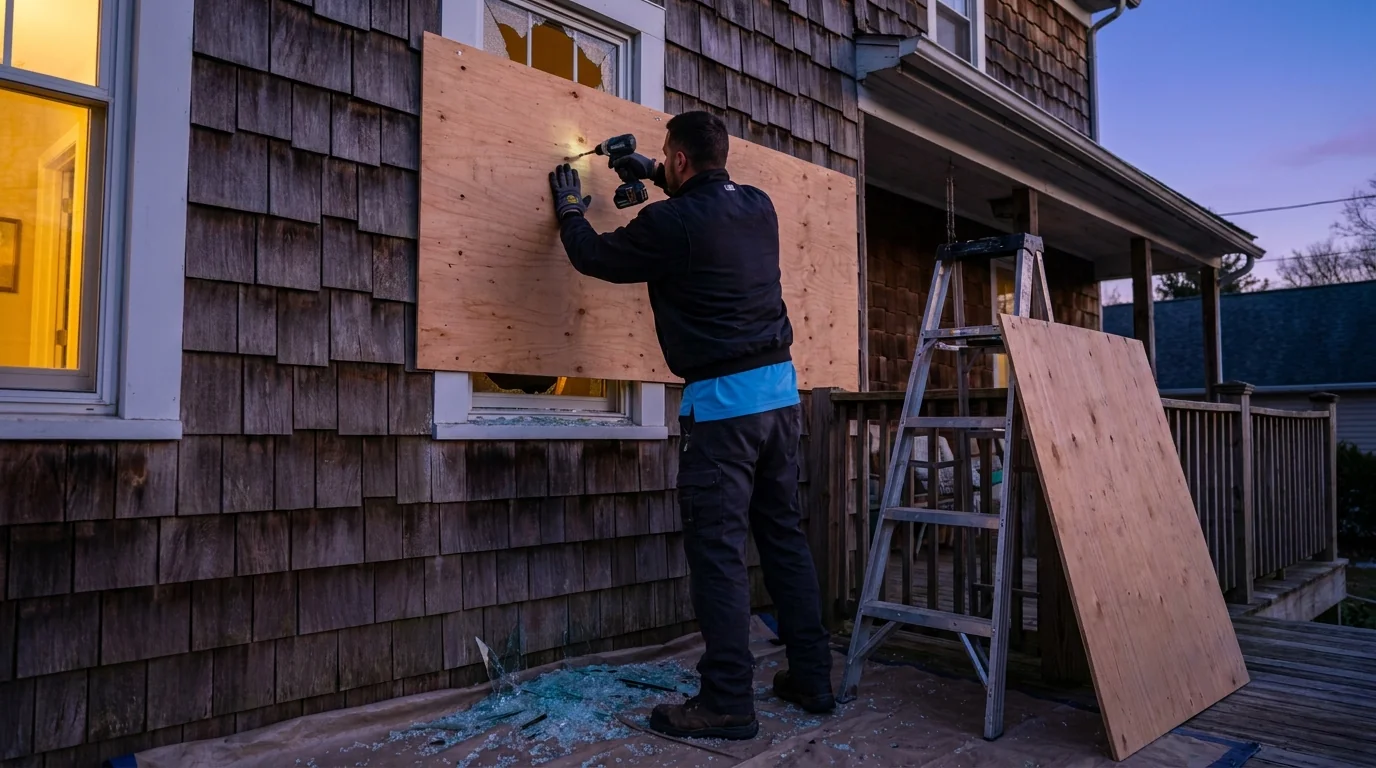
For window and door openings, we cut structural plywood to fit the rough opening, not the trim. Summit homeowners routinely have original leaded or divided-light windows; if the glass is intact but the frame is compromised, we work around it rather than through it. Exterior trim profiles on pre-war homes are often irreplaceable, so fasteners go into framing members, not finish wood. Every opening gets photographed before and after boarding — documentation that matters when the insurance adjuster arrives and when the reconstruction crew needs to match original profiles.
For fire-damaged structures, we assess whether the roof deck can bear foot traffic before anyone goes up. Smoke and heat degrade sheathing faster than visible charring suggests. If the deck is suspect, we tarp from ladder positions and use extension poles rather than risk a collapse.
Reaching Summit from Kenilworth
Kenilworth sits roughly 8 miles from Summit’s center. The fastest route runs west on Route 22 to the Springfield Avenue exit, putting crews into Downtown Summit quickly under normal conditions. For addresses on the north side of the city — near Overlook Medical Center or the blocks approaching the New Providence border — we route through Glenside Avenue to avoid the Springfield Avenue hill during icy conditions, which matter more in Summit than in the flatlands we also serve. Because our dispatch operates around the clock, a call at 2 a.m. after a freeze event gets the same crew mobilization as a midday storm response.
Insurance and Contractor Coordination in Summit
Board-up and tarping costs are almost universally covered under the “protection from further damage” provision of a standard homeowner’s policy — insurers expect you to secure the property, and they expect documentation proving you did. We photograph every opening before boarding, note material conditions, and provide a written scope that adjusts if the adjuster’s visit reveals additional exposure. Summit properties frequently carry scheduled personal property riders for antiques, art, and period fixtures; our crews are briefed to flag anything that appears to be a high-value item so it can be noted in the loss documentation rather than discovered missing later. We are an NJ Licensed Home Improvement Contractor and an IICRC Certified Firm (#210213), which satisfies the credential requirements most carriers ask for before approving emergency vendor invoices.
Local Note
Slate roofs in Summit’s older neighborhoods present a specific tarping challenge that crews unfamiliar with the housing stock routinely get wrong: the battens holding slate tiles are often the only structurally sound attachment point left after a wind event, and driving fasteners through them to anchor a tarp can crack adjacent tiles that were otherwise undamaged. We use weighted perimeter ballast and ridge-line tie-offs wherever the deck condition allows, reserving mechanical fasteners for areas where the sheathing is confirmed solid. It takes longer to rig, but it avoids turning a 10-tile loss into a 40-tile loss — a distinction that matters considerably when matching hand-split Vermont slate that has been on the same Northside roof since 1912.
If your Summit property has been damaged by fire, storm, or a sudden structural failure, call (908) 970-8533 now. The Restoration Group is available 24/7 to board up openings, tarp exposed roofing, and secure the structure so that the damage stops where it is — protecting the original character of your home while the recovery process begins.
Emergency Board-Up and Tarping in Summit: Service Coverage
Frequently Asked Questions
How fast can you arrive for emergency board-up and tarping in Summit?
How quickly can The Restoration Group reach a Summit address after an after-hours call?
Can you board up a property near Overlook Medical Center without blocking the adjacent sidewalk or driveway?
What board-up approach do you use on Summit's pre-war homes with original leaded or divided-light windows?
Will tarping a slate roof in the Northside or Franklin School area cause additional tile damage?
Does homeowner's insurance typically cover emergency board-up and tarping costs for Summit properties, and how do you document the work?
Emergency Board-Up and Tarping response in Summit
Most Summit calls see a technician on-site within 60 minutes from our Fair Lawn headquarters.