Emergency Board-Up and Tarping in Kenilworth
24/7 emergency board-up and tarping in Kenilworth and surrounding areas. IICRC-certified, insurance billing accepted. Call (908) 970-8533.
A broken window at 2 a.m. A roof torn open by a falling tree. A door frame blown out by a fire department forced entry. The structure is already damaged — what happens in the next few hours determines whether that damage stays contained or compounds into something far worse. Rain, wind, and opportunistic theft don’t wait for business hours, and neither does secondary damage. Emergency board-up and tarping is the work that stops the clock on a loss that is actively getting larger.
What emergency board-up and tarping actually involves
Board-up and tarping is not nailing a piece of plywood over a hole. Done correctly, it is a systematic weatherproofing and security operation that has to account for the structural condition of what remains, the type of opening being sealed, the weather forecast, and the documentation requirements of your insurance carrier.
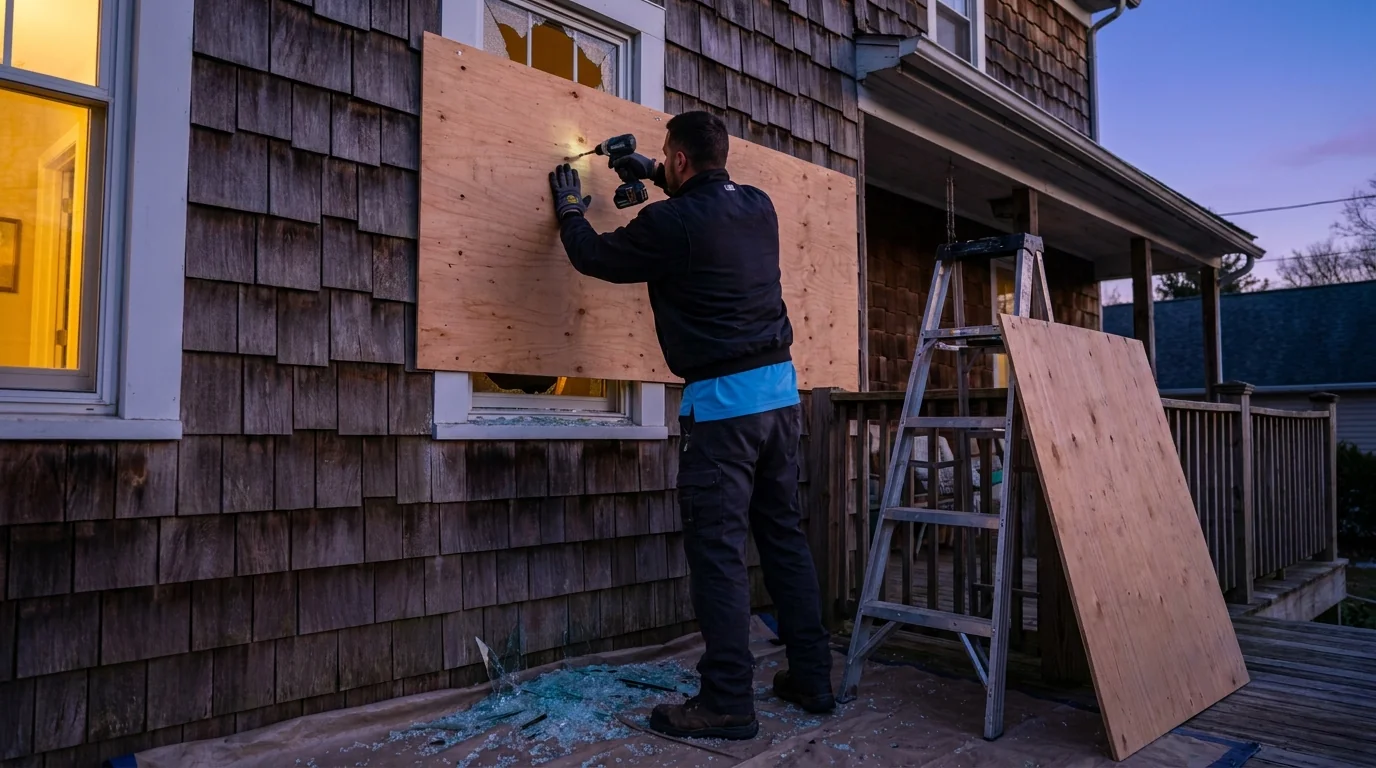
For window and door openings, crews cut plywood to fit each opening precisely, fasten it through the frame rather than the surrounding siding or brick, and seal the perimeter to prevent wind-driven rain from tracking in behind the board. For larger structural breaches — a collapsed wall section, a garage door blown inward — the approach shifts to framing temporary supports before any covering goes on.
Roof tarping involves more than throwing a blue tarp and weighing the corners with sandbags. A proper emergency tarp installation uses reinforced polyethylene sheeting (typically 6-mil or heavier), runs the tarp over the ridge so water sheds away from the breach rather than pooling at its edge, and secures it with wooden battens screwed into undamaged decking — not just rope or bungee cords that will fail in the next wind event. On fire-damaged roofs, crews first confirm the decking can support foot traffic before any tarping begins.
Timeline matters here. A compromised roof open to a single overnight rainstorm can soak insulation and ceiling drywall to the point where what was a fire loss becomes a simultaneous water loss. Most board-up and tarping work on a residential property can be completed in two to four hours once a crew is on site.
Our process
-
Site safety assessment before any work begins. After a fire or structural event, not every part of a building is safe to work on or near. The crew walks the perimeter, identifies unstable walls, compromised roof sections, and any active utility hazards before staging equipment or climbing.
-
Photographic documentation of all openings. Every breach is photographed before it is covered — the size, the cause, the condition of surrounding materials. This documentation goes directly to your insurance adjuster and establishes the pre-board-up condition of the structure. Skipping this step is one of the most common mistakes that creates claim disputes later.
-
Measurement and material staging. Plywood is cut on-site to fit actual opening dimensions. Tarps are sized to extend at least three feet beyond the breach on all sides, with enough material to run over the ridge on roof applications. Using undersized materials is a shortcut that fails at the worst possible moment.
-
Installation and perimeter sealing. Boards are fastened with structural screws into solid framing, not staples or finish nails. Tarp battens are screwed into undamaged decking at intervals no greater than 18 inches. Seams between tarp sections are overlapped a minimum of 12 inches and taped with UV-resistant seam tape.
-
Post-installation inspection and written report. Before leaving the site, the crew confirms every opening is sealed, documents the materials used and the fastening method, and provides a written scope that your adjuster can reference when reviewing the emergency services line item on your claim.
What separates a good board-up response from a bad one
The most common failure in emergency board-up work is speed prioritized over method. A crew that arrives fast but uses undersized plywood, drives screws into siding instead of framing, or runs a tarp without a ridge-over installation has created the appearance of protection without the substance of it. The next rain event proves the difference.
On fire-damaged structures specifically, a common oversight is boarding openings without first checking whether the fire department has left the structure in a condition where the roof load has changed. Wet insulation from suppression water adds significant weight; boarding windows and doors without accounting for structural shift can trap moisture and accelerate mold colonization in the wall cavities behind the boards.
Insurance adjusters look for two things when reviewing emergency board-up line items: itemized material quantities with dimensions, and before-and-after photographs. Carriers will push back on lump-sum invoices with no supporting documentation. The written scope produced at the end of each job is what protects the claim.
Seasonal and regional considerations
In northern New Jersey, the window between a storm event and the next precipitation is often measured in hours rather than days. Nor’easters move quickly, and a roof breach left open overnight during a nor’easter can take on hundreds of gallons of water before morning. The freeze-thaw cycle from November through March adds a second layer of urgency: water that enters through an unsealed opening and then freezes inside wall cavities expands and forces framing apart, turning a manageable breach into a structural repair.
Summer storm season — particularly the period from late June through September when convective storms track through the region — is peak demand for emergency tarping. Scheduling response within the same day as a storm event is critical to preventing what would otherwise be a roof claim from becoming a combined roof-and-interior loss.
Service area
The Restoration Group is based in Kenilworth, NJ and responds to emergency board-up and tarping calls throughout Union County, Essex County, and the surrounding region — including Cranford, Westfield, Summit, Mountainside, Springfield, Maplewood, and neighboring communities. Each service-area page links back here for the full technical detail on how this work is done.
If a storm, fire, or structural failure has left your property open to the elements, call (908) 970-8533 now. Crews are available around the clock — the sooner the opening is sealed, the smaller the total loss stays.
Frequently Asked Questions
What size tarp and what fastening method should be used on a storm-damaged roof?
Why does the board-up crew photograph the openings before covering them?
Can a roof be tarped safely right after a fire, or does the structure need to be assessed first?
How is plywood fastened during a board-up, and why does the fastening method matter?
How long do emergency boards and tarps typically stay in place before permanent repairs begin?
Looking for the best emergency board-up and tarping company in Fair Lawn?
The Restoration Group provides licensed and insured emergency board-up and tarping in Fair Lawn, NJ and the surrounding area, and has served local property owners since 2021. We answer calls 24/7 — call (908) 970-8533 for immediate help.
Need Emergency Board-Up and Tarping now?
We respond 24/7 across Fair Lawn and surrounding NJ cities.
Related Coverage
- Our Restoration Services
- Contact The Restoration Group
- Emergency Board-Up and Tarping in Brooklyn
- Emergency Board-Up and Tarping in Cranford
- Emergency Board-Up and Tarping in Elizabeth
- Emergency Board-Up and Tarping in Jersey City
- Emergency Board-Up and Tarping in Kenilworth
- Emergency Board-Up and Tarping in Manhattan
- Emergency Board-Up and Tarping in Newark
- Emergency Board-Up and Tarping in Springfield
- Emergency Board-Up and Tarping in Summit
- Emergency Board-Up and Tarping in Union
- Emergency Board-Up and Tarping in Westfield