Emergency Board-Up and Tarping in Cranford
24/7 emergency board-up and tarping in Cranford, NJ. IICRC-certified, insurance billing accepted. Call (908) 970-8533.
Our IICRC-certified technicians are dispatched from our Fair Lawn, NJ headquarters and are typically on-site in Cranford within 60 minutes of your call.
Cranford’s reputation as the “Venice of New Jersey” is charming until a storm rolls through and the Rahway River decides it has somewhere else to be. After Ida soaked the Riverside Drive area in 2021, dozens of homeowners woke up to broken windows from debris, roof damage from fallen limbs, and wide-open structures sitting exposed while floodwaters receded. That combination — storm-driven structural breach plus lingering moisture — is exactly when a fast board-up and tarping response matters most. The Restoration Group dispatches from Kenilworth around the clock, which puts a crew on-site in Cranford (07016) before secondary damage compounds the original loss.
Why Cranford Properties Are Especially Vulnerable After Storms
The housing stock along the Rahway River Parkway and through neighborhoods like Lincoln Park East and Cranford West is predominantly 1900s–1940s colonials and Cape Cods. These homes were built before modern impact-resistant glazing was standard, which means a single large branch or wind-driven debris can shatter a double-hung window and leave the interior open to rain within seconds. Older wood-framed roof decks — common on Cranford’s pre-war capes — are also more susceptible to puncture from falling limbs than modern OSB sheathing.
Cranford’s geography adds another layer. The town sits in a low basin where the Rahway River and its tributaries converge, and storm sewers overwhelm quickly during heavy rain events. When flooding and wind damage happen simultaneously, as they did during Floyd, Irene, and Ida, homeowners are dealing with open roof sections and standing water at the same time. Every hour a structure stays open accelerates moisture intrusion into wall cavities and subfloor assemblies — the kind of damage that turns a manageable repair into a full gut-renovation.
Our Board-Up and Tarping Process in Cranford
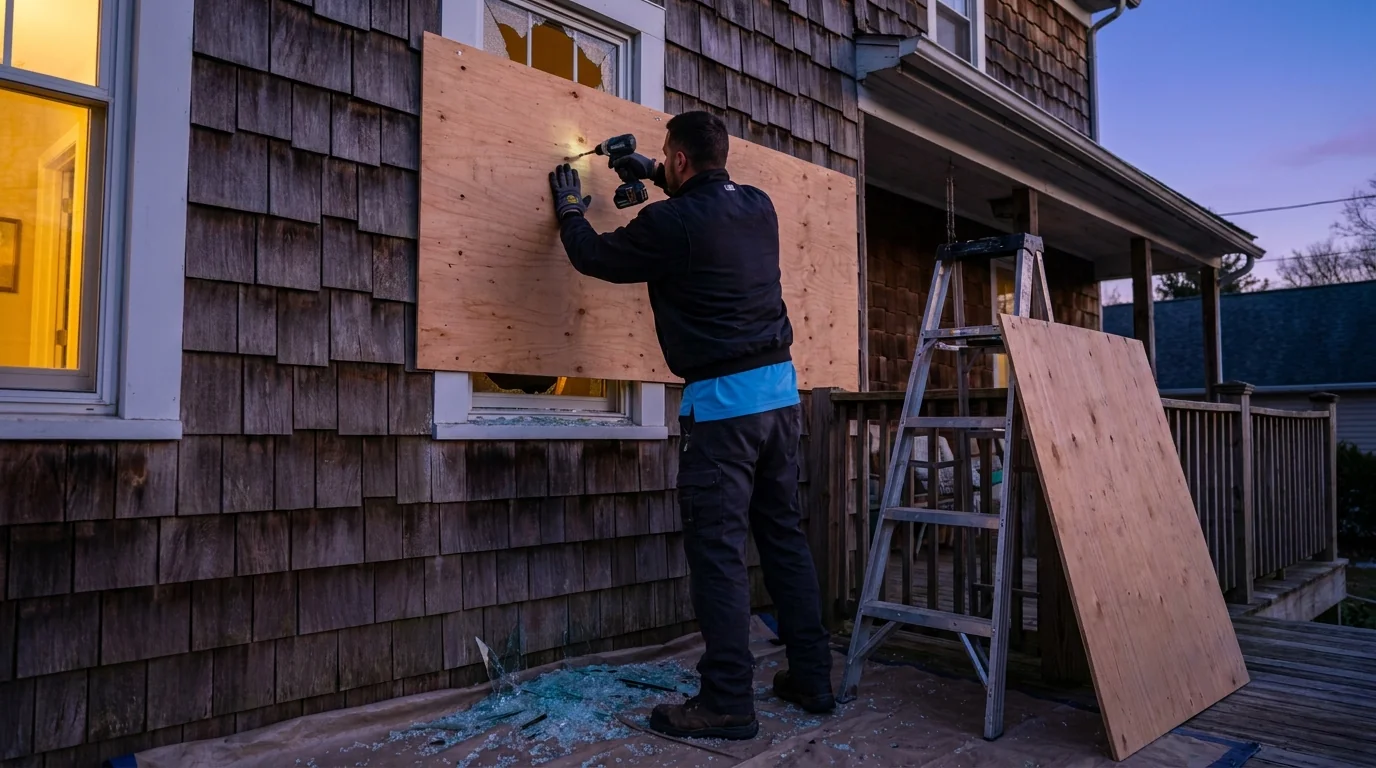
When you call, we ask three questions: what’s open, what’s wet, and is the structure safe to enter. That triage shapes what we bring on the truck. For broken window board-ups, we use 3/4-inch CDX plywood cut and fastened with structural screws rather than nails — a detail that matters on older Cranford homes where window framing may not hold a nail-driven board under wind load. Frames are protected with foam backer rod before the panel goes on so the board doesn’t lever against deteriorated wood trim.
For roof tarping, we use reinforced polyethylene tarps rated at a minimum 6 mil — heavier for larger spans — anchored with 2x4 wood battens screwed through the tarp into the roof deck. We avoid staple guns on older roof decks because the fasteners pull through when the tarp catches wind. Every opening is photographed before and after boarding, with measurements recorded for your insurance adjuster. If there’s active water intrusion alongside the structural breach, we can deploy drying equipment the same visit so you’re not waiting on a second crew.
Getting to Cranford from Our Kenilworth Base
Kenilworth shares a border with Cranford, which means our drive time is measured in minutes, not hours. We typically route via South Michigan Avenue or Boulevard, depending on traffic, and can reach the Nomahegan Park corridor or the Downtown Cranford business district quickly regardless of time of day. For addresses deeper into Cranford West or along the Riverside Drive flood zone, we’re familiar with the street layout and don’t need GPS to find you in the dark. Because we operate 24/7, a 2 a.m. call after a nor’easter gets the same crew and the same equipment as a midday call.
Insurance Documentation for Cranford Homeowners
Many Cranford homeowners carry both standard homeowners policies and National Flood Insurance Program (NFIP) policies — a necessity given the town’s repeat-flood history. Board-up and tarping costs are generally covered under the “protection of property” provision of a standard HO-3 policy when the damage is sudden and accidental. We provide a detailed written scope, time-stamped photographs, and a materials list formatted to meet adjuster requirements. If your carrier or NFIP adjuster needs a supplemental estimate, we can coordinate directly. We’re a licensed NJ Home Improvement Contractor and an IICRC Certified Firm (#210213), which some carriers require before approving emergency service vendors.
Local Note: What Cranford’s Older Window Frames Mean for Board-Up Work
One thing you learn working in Cranford’s pre-war housing stock is that original wood window casings — especially on the colonials between Droescher’s Mill and the Canoe Club stretch of the river — are often painted over so many times that the wood beneath has lost structural integrity. A standard board-up technique that relies on screwing into the casing can split the frame entirely, creating a larger opening than the one you started with. We carry wider backing plates and use toggle anchors into the surrounding masonry or sheathing on houses where the casing won’t hold. It takes an extra fifteen minutes, but it means the board stays put through the next storm rather than peeling off overnight.
If your Cranford home has been breached by storm damage, fire, or a break-in, call The Restoration Group at (908) 970-8533. We’re available around the clock, we know the neighborhood, and we’ll have your property secured and documented before the next weather system moves through.
Emergency Board-Up and Tarping in Cranford: Service Coverage
Frequently Asked Questions
How fast can you arrive for emergency board-up and tarping in Cranford?
How quickly can The Restoration Group reach the Riverside Drive flood zone in Cranford after a storm?
Are the older colonial and Cape Cod homes in Lincoln Park East harder to board up than newer construction?
Does Cranford's repeat-flood history affect how I should document a board-up claim for my NFIP policy?
What type of tarp do you use for roof tarping, and how is it anchored on an older roof deck?
Can you handle both the board-up and initial drying in the same visit if my Cranford home has water intrusion alongside the structural damage?
Will my homeowners insurance cover emergency board-up and tarping in Cranford?
Emergency Board-Up and Tarping response in Cranford
Most Cranford calls see a technician on-site within 60 minutes from our Fair Lawn headquarters.