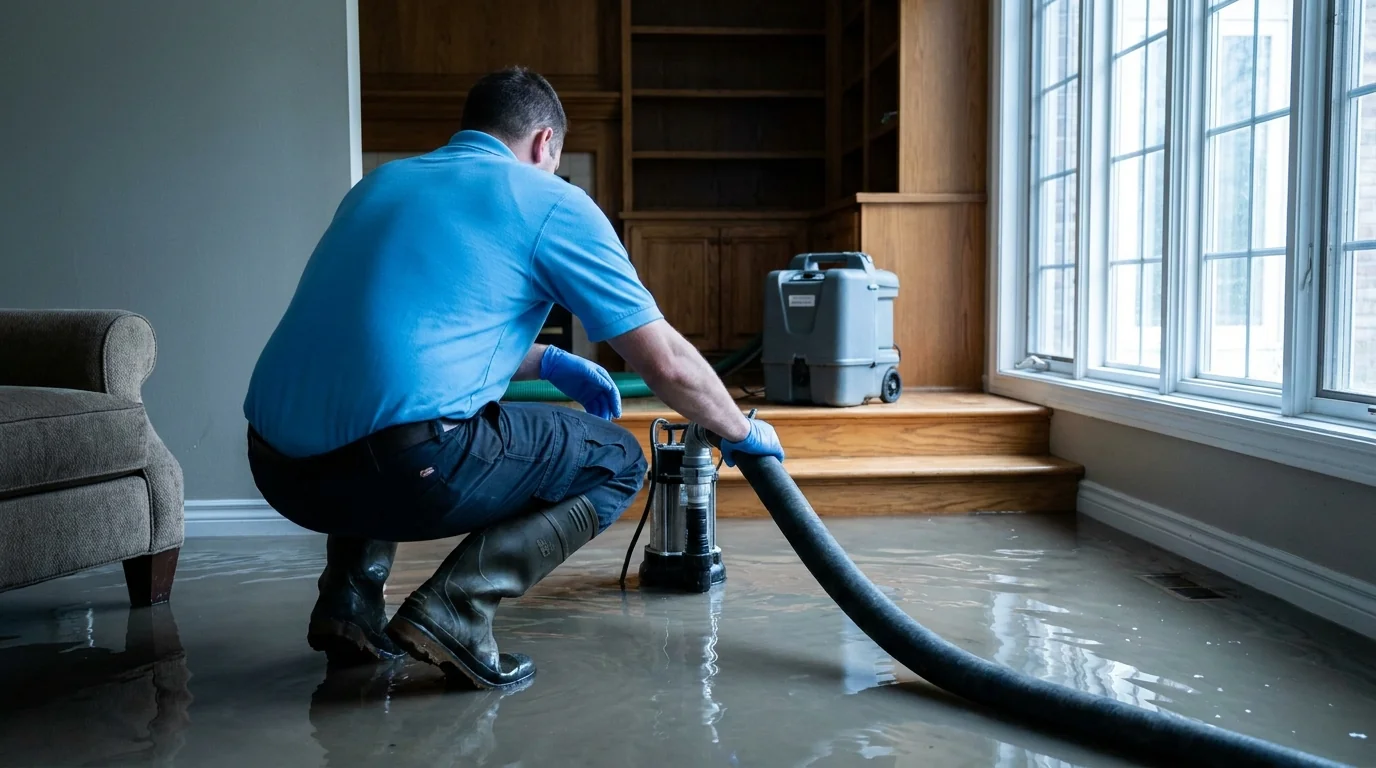
Flood Damage Restoration in Summit
24/7 flood damage restoration in Summit, NJ. IICRC-certified, insurance billing accepted. Call (908) 970-8533.
Our IICRC-certified technicians are dispatched from our Fair Lawn, NJ headquarters and are typically on-site in Summit within 60 minutes of your call.
Summit’s steep hillside lots and century-old plumbing create a particular kind of flood emergency — one that rarely announces itself with a rising river but instead arrives as a burst supply line behind a plaster wall, a clay sewer lateral overwhelmed by a hard rain, or stormwater funneling straight into a finished basement on a Northside street. When that happens inside a 1910 Colonial or a 1920s Tudor with original hardwood floors, hand-planed millwork, and irreplaceable built-ins, the margin for error during cleanup is essentially zero. The Restoration Group responds 24/7 to flood damage calls across Summit, ZIP code 07901, with equipment and protocols calibrated to the specific demands of high-value older homes.
Why Summit Properties See Flood Damage Differently
Summit’s elevation is a genuine asset — the Passaic River flooding that periodically hammers downstream communities rarely reaches here. But elevation creates its own drainage physics. Steep grades along the Franklin School area and the blocks climbing away from Springfield Avenue downtown push stormwater downhill fast, and when it meets the foundation of a home built before modern waterproofing standards existed, it finds a way in. Basement window wells overflow. Areaway drains clog with leaf debris from mature oaks and maples. French drains installed decades ago lose capacity.
Inside the walls, aging galvanized and copper supply lines — many original to homes built between 1890 and 1940 — are vulnerable to pressure spikes and freeze events. An uninsulated line in an older wing or a rarely-heated third floor can burst silently and saturate plaster walls for hours before anyone notices the ceiling below is soft. Clay sewer laterals under Summit’s tree-lined streets are another chronic source: root intrusion narrows the pipe over decades, and a single heavy rain can push sewage back through a basement floor drain.
Our Flood Damage Restoration Process in Summit
The first thing we do on arrival is locate the water’s path, not just its destination. In Summit’s older homes, water migrates through plaster and lath, travels along subfloor joists, and pools in finished basement cavities that look dry at the surface. We use thermal imaging cameras and calibrated moisture meters to map the full extent of saturation before any demolition decisions are made — because in a home with original plaster walls and period trim, unnecessary removal is damage in itself.
Once the scope is clear, we extract standing water, place desiccant and refrigerant dehumidifiers sized to the actual cubic footage of the affected space, and establish drying targets based on the IICRC S500 standard for structural drying. We document moisture readings at every checkpoint — critical for insurance claims and equally important for confirming that a plaster wall with three coats of paint has actually dried through, not just on the surface. Contents handling — rugs, furniture, artwork — is treated as a separate workstream, with high-value items inventoried, photographed, and moved to a dry staging area before any wet work begins.
Reconstruction, when needed, is matched to the home’s existing finish quality. Plaster repair, period-profile baseboard, and refinished hardwood are part of the job, not an afterthought.
Reaching Summit from Kenilworth
From our Kenilworth headquarters, Summit is a straightforward run — typically via Route 22 West to the Broad Street corridor into town, or through Springfield Avenue depending on traffic. We’re available around the clock, so a call at 2 a.m. about a pipe that let go in a basement near the Brayton School area or off the New Providence border gets the same response as a midday call. We’ll confirm an estimated arrival window when you call (908) 970-8533 so you’re not waiting without information.
Summit Insurance Coordination
Flood damage claims in Summit frequently involve multiple coverage questions — homeowners policy for sudden and accidental discharge, sewer backup riders, and occasionally flood policy if the homeowner carries one. We document the loss thoroughly from the first hour: photos of the water source, moisture mapping printouts, equipment placement logs, and itemized records of any contents moved or protected. That documentation package is what adjusters need to process a claim efficiently, and we’ve built our intake process around producing it as a matter of course, not as an extra step.
Local Note
One pattern we’ve seen repeatedly in Summit’s older homes near the Reeves-Reed Arboretum neighborhood and along the larger lots off Northside: plaster walls dry significantly more slowly than modern drywall — sometimes 40 to 60 percent longer — because dense three-coat plaster releases absorbed moisture gradually even under aggressive dehumidification. Homeowners sometimes see surface readings drop and assume the wall is done, but the core is still wet. We extend monitoring cycles on plaster assemblies specifically to catch this, and we won’t sign off on a drying job until deep-probe readings confirm the full thickness has reached equilibrium. Skipping that step is how mold gets started inside a wall that looked fine at closeout.
If you’re dealing with flood damage in Summit right now — whether it’s a burst pipe in a finished basement, a backed-up sewer, or stormwater that found its way into a lower level — call (908) 970-8533. We’ll walk you through immediate steps to limit the damage while we’re in transit, and we’ll arrive with the equipment and the care that Summit homes require.
Flood Damage Restoration in Summit: Service Coverage
Frequently Asked Questions
How fast can you arrive for flood damage restoration in Summit?
Are Summit's older homes near the Franklin School area more prone to hidden water damage after a flood?
How does Summit's clay sewer lateral problem affect flood cleanup in a finished basement?
What does flood damage restoration typically involve in a Summit home with original hardwood floors and plaster walls?
Can you work directly with my insurance adjuster on a flood claim for a Summit property in 07901?
How do you handle high-value contents — antiques, rugs, artwork — during flood mitigation in a Summit home?
Flood Damage Restoration response in Summit
Most Summit calls see a technician on-site within 60 minutes from our Fair Lawn headquarters.