Mold Inspection and Testing in Summit
24/7 mold inspection and testing in Summit, NJ. IICRC-certified, insurance billing accepted. Call (908) 970-8533.
Our IICRC-certified technicians are dispatched from our Fair Lawn, NJ headquarters and are typically on-site in Summit within 60 minutes of your call.
Summit’s older housing stock creates a particular mold challenge that most homeowners don’t anticipate until they’re already dealing with the consequences. The large 1890s-to-1930s homes that line the streets near the Franklin School area and throughout Northside were built with plaster walls, deep finished basements, and original plumbing that has now been aging for a century or more. When a clay sewer lateral backs up, a radiator line bursts in an uninsulated wing, or stormwater channels down a steep lot into a lower level, moisture finds its way into cavities that are genuinely difficult to reach and even harder to dry. Mold can begin colonizing porous surfaces within 24 to 48 hours of a moisture event — and in a home with historic millwork, hardwood floors, and irreplaceable plaster detailing, the cost of discovering that too late is significant.
Why Summit Homes Are Particularly Susceptible to Hidden Mold
Summit’s elevation along the Watchung ridge protects it from the river flooding that affects lower-lying Union County communities, but the topography creates its own moisture problems. Steep lots push stormwater toward foundations, and the clay-heavy soil common throughout the 07901 ZIP code doesn’t drain quickly. That combination means lower levels stay damp longer after heavy rain events, even when no visible water intrusion occurred. Copper gutters and slate roofs — hallmarks of Summit’s historic homes — perform well when maintained, but aging joints and cracked flashing concentrate water at foundation walls in ways that aren’t obvious until mold is already established inside the wall assembly.
Original plumbing is another persistent factor. Supply lines running through uninsulated exterior walls or unheated attic spaces are vulnerable to freeze events, and when they fail, the leak often travels inside plaster walls before anyone notices. That slow, hidden moisture is exactly the condition mold thrives in — and it’s exactly the condition a visual inspection alone will miss.
Our Mold Inspection and Testing Process in Summit
A mold assessment in a Summit property isn’t the same as one in a post-1980 suburban home with drywall construction. Our process is calibrated to the building materials and layout patterns common in this area.
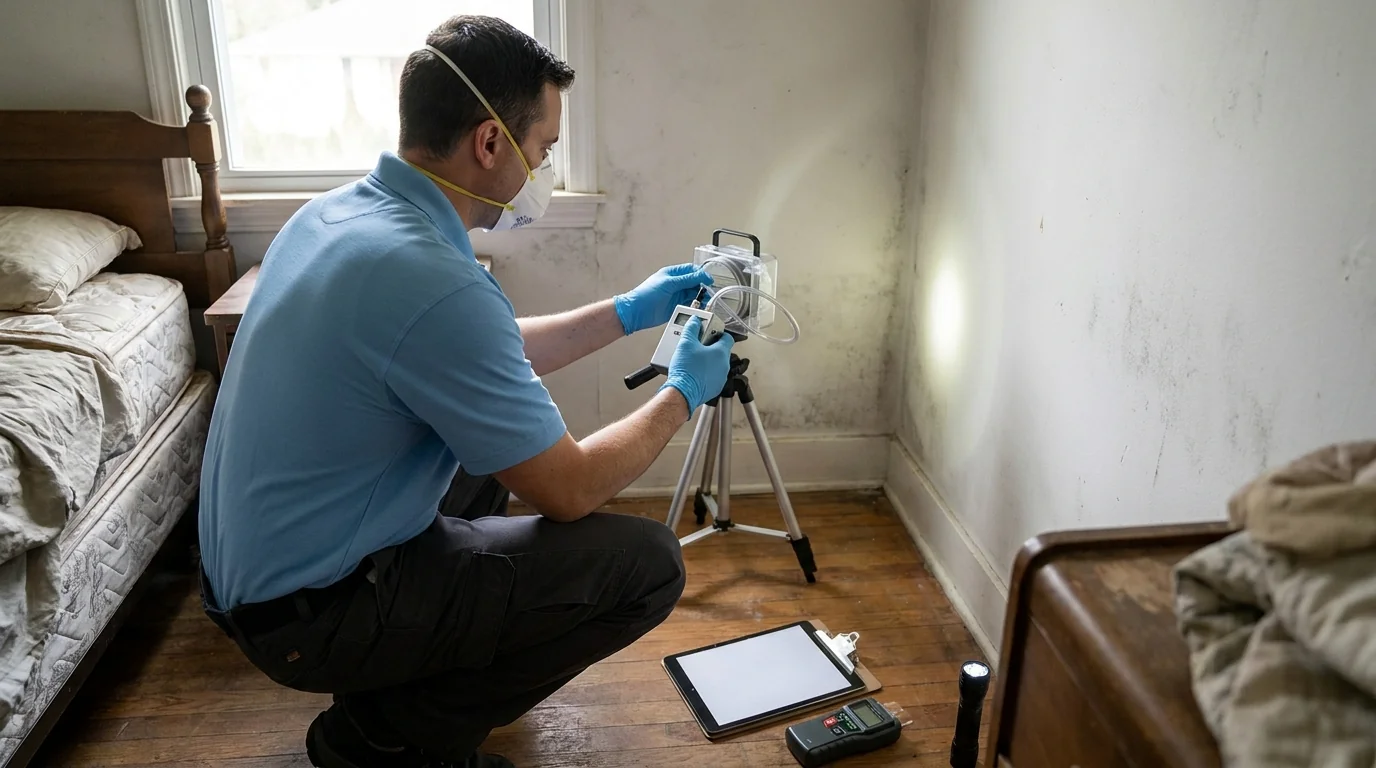
We begin with a detailed visual inspection and moisture mapping using thermal imaging and calibrated moisture meters to identify elevated readings behind plaster walls, under original hardwood flooring, and in finished basement spaces. Because plaster is denser than modern drywall, it can hold moisture without showing surface staining for weeks — thermal imaging catches what the eye misses.
Where moisture readings or visual evidence suggest mold activity, we collect air samples and surface samples for laboratory analysis. Air sampling establishes the indoor spore count and species profile and compares it against an outdoor baseline collected the same day — that comparison is what tells us whether elevated spore levels are a building problem or simply ambient outdoor conditions. Surface samples from suspect areas identify the specific mold genus and inform any remediation scope. All samples are analyzed by an accredited third-party laboratory, and you receive a written report with findings and, if remediation is warranted, a clear scope of work.
Reaching Summit from Our Kenilworth Location
Our team dispatches from Kenilworth, which puts us on Route 22 west and into Summit in well under 30 minutes under normal conditions — and because we operate 24/7, scheduling is available whenever you discover a problem. We’re familiar with the residential streets that run off Springfield Avenue downtown and the neighborhoods near the Brayton School area, and we know that parking and access at larger historic properties often requires a quick coordination call before arrival. We’ll handle that.
Summit Insurance Coordination
Mold discovered after a covered water loss — a burst pipe, an appliance failure, a roof leak — is often at least partially covered under standard homeowner’s policies. The documentation we produce during inspection and testing is structured to support that claim: moisture readings with timestamps, photographic evidence of affected materials, lab reports with chain-of-custody documentation, and a written assessment that adjusters can work from directly. We communicate with your carrier’s adjuster throughout the process so you’re not translating technical findings yourself.
Local Note: What Summit’s Plaster Walls Mean for Mold Testing
One detail that consistently surprises homeowners in the Northside and Franklin School area neighborhoods: plaster walls don’t show mold staining on the surface the way drywall does. Drywall paper is a direct food source for mold and shows visible growth relatively quickly. Plaster itself is more resistant, but the wood lath behind it and the insulation or void space between the lath and the exterior wall are not — and mold can colonize that hidden layer extensively before any surface sign appears. We adjust our sampling strategy in plaster-wall homes to include more wall-cavity air sampling through small probe points, which we patch cleanly after testing. In a home near Reeves-Reed Arboretum or anywhere else in Summit where interior finish quality matters, that approach protects both the integrity of the assessment and the condition of your walls.
If you’ve had any water event in your Summit home — or if you’re noticing a musty odor without a clear source — call The Restoration Group at (908) 970-8533. We’ll tell you what’s there, what it means, and what, if anything, needs to be done about it.
Mold Inspection and Testing in Summit: Service Coverage
Frequently Asked Questions
How fast can you arrive for mold inspection and testing in Summit?
Are Summit's older homes in the Northside and Franklin School area more likely to have hidden mold than newer construction?
Summit's lots are steep — can stormwater infiltration cause mold even without visible flooding?
How does mold testing work in a Summit home with plaster walls, and will the process damage the walls?
What does an air quality test actually measure, and how do you interpret results in a Summit home?
If mold is found after a pipe burst in my Summit home, will my homeowner's insurance cover the inspection and remediation?
Mold Inspection and Testing response in Summit
Most Summit calls see a technician on-site within 60 minutes from our Fair Lawn headquarters.