Sewage Cleanup and Sanitization in Summit
24/7 sewage cleanup and sanitization in Summit, NJ. IICRC-certified, insurance billing accepted. Call (908) 970-8533.
Our IICRC-certified technicians are dispatched from our Fair Lawn, NJ headquarters and are typically on-site in Summit within 60 minutes of your call.
Summit’s clay sewer laterals run beneath streets shaded by century-old oaks whose roots have had generations to infiltrate the joints. When one of those laterals backs up — and in the 07901 ZIP code, they do, especially after a heavy rain drives groundwater into aging pipe seams — raw sewage doesn’t just pool in a utility corner. In Summit’s deep, finished basements, it saturates hardwood floors, wicks into plaster walls, and reaches custom millwork that took craftsmen months to install. The Restoration Group responds 24/7 and arrives ready for the specific demands these homes place on a cleanup crew.
Why Summit Properties See Sewage Backup Issues
Summit’s elevation is a genuine advantage — the Rahway River flooding that hammers lower Union County towns rarely reaches here. But that hilltop geography creates its own drainage physics. Steep lots funnel stormwater downhill fast, and when the municipal sewer system is already stressed, the path of least resistance is back up through a floor drain or toilet in a finished lower level. The problem is compounded by the housing stock itself: many homes in the Franklin School and Brayton School areas were built between the 1890s and 1930s, when sewer laterals were laid in clay or Orangeburg pipe. Those materials were never meant to last a century. Root intrusion, joint separation, and gradual collapse are predictable outcomes, not freak accidents.
Inside the house, original cast-iron drain stacks corrode from the inside out. A slow pinhole drip behind a plaster wall can go undetected for months until a sewage backup reveals the full extent of the damage. Because Summit homes frequently have original plaster on lath rather than modern drywall, contamination spreads differently — plaster is denser and slower to release absorbed moisture, which means the window for effective extraction is shorter than it would be in a newer build.
Our Sewage Cleanup and Sanitization Process in Summit
The first priority on any sewage call is stopping ongoing exposure. We locate the source — whether it’s a failed lateral, a blocked stack, or a septic overflow on properties near the New Providence border — and coordinate with the homeowner’s plumber before extraction begins. We don’t want to clean a space that’s still receiving flow.
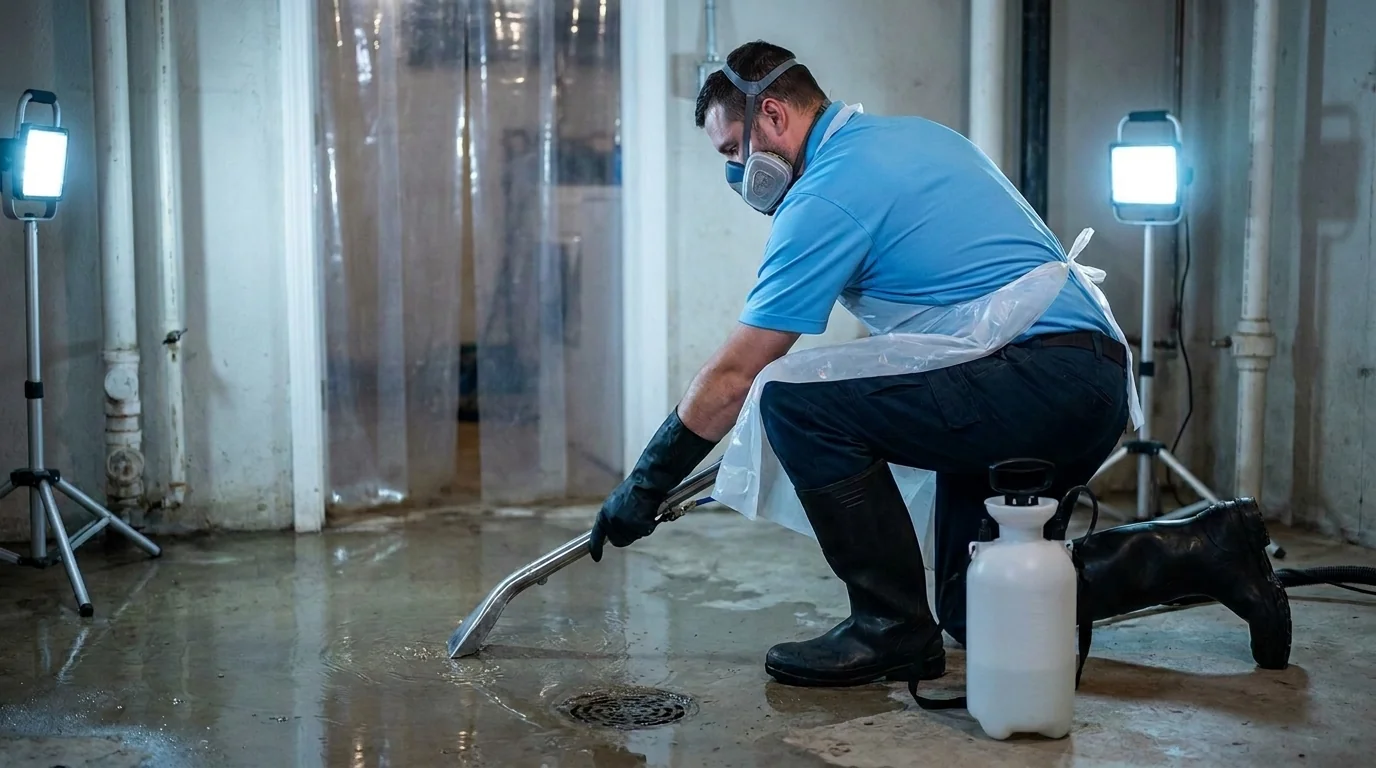
Once the source is controlled, we extract standing sewage using truck-mounted units powerful enough to handle the volume a finished basement accumulates. Affected materials are categorized: what can be dried and sanitized in place, what must be removed, and what — in the case of contaminated plaster, insulation, or structural wood — needs to be documented for the insurance adjuster before demolition. We photograph everything at this stage because Summit homeowners and their carriers both need a clear record.
Sanitization follows IICRC S500 and S520 protocols for Category 3 water, which is the classification raw sewage falls under. We apply EPA-registered antimicrobials to all affected surfaces, including subflooring, wall cavities, and HVAC components if contaminated air has been circulated. Drying equipment — desiccant dehumidifiers and high-velocity air movers — runs until moisture readings in walls and floors return to pre-loss baselines. In older plaster construction, that process routinely takes longer than it would in a home with modern materials, and we account for that in our drying plan rather than pulling equipment prematurely.
Reaching Summit from Kenilworth
Our Kenilworth headquarters puts us on Route 22 West or the Garden State Parkway South within minutes, with straightforward access into Summit via Springfield Avenue or Morris Avenue depending on traffic. Whether the call originates near the Summit train station, in the Northside, or closer to the Reeves-Reed Arboretum, we’re routing a crew immediately — 24 hours a day, every day of the year. We carry the equipment load-out for sewage response on every dispatch, so there’s no secondary trip to retrieve specialty gear.
Local Note
In Summit’s older homes — particularly those with original finished basements in the Northside and the blocks surrounding Downtown Summit — sewage backups frequently reach the mechanical room before the homeowner notices. Boilers, electrical panels, and custom built-in cabinetry sit in the same space. Our crews are trained to document and carefully stage high-value contents, including antique furniture and period fixtures, before extraction equipment enters the room. We’ve learned that a drop cloth and a careful hand on a 1920s built-in matters as much to Summit homeowners as the speed of the water removal itself. We treat the house the way its owners do.
Summit Insurance Coordination
Sewage backup coverage is typically a rider on a standard homeowner’s policy, not an automatic inclusion — and many Summit homeowners don’t discover that distinction until they’re standing in contaminated water. We document the loss thoroughly from the moment we arrive: photos, moisture readings, material assessments, and a written scope. That documentation goes to your adjuster in a format carriers recognize, which shortens the back-and-forth and reduces the chance of a disputed line item. We bill carriers directly when the policy allows and walk homeowners through what to expect if coverage is partial or denied.
If you’re dealing with sewage in a Summit home right now, call (908) 970-8533. We’ll have a crew moving toward you immediately, equipped for the specific demands of Summit’s older housing stock and ready to protect what matters most in your home.
Sewage Cleanup and Sanitization in Summit: Service Coverage
Frequently Asked Questions
How fast can you arrive for sewage cleanup and sanitization in Summit?
How quickly can The Restoration Group reach a sewage backup in Summit's Northside or Downtown Summit?
Summit's older homes often have finished basements with original hardwood and plaster walls — does sewage cleanup work differently in those spaces?
Are clay sewer laterals common under Summit streets, and does that affect how often backups happen?
Does sewage backup coverage typically apply to Summit homeowners, and how do you help with the claim?
What does the sanitization step actually involve after raw sewage is removed from a Summit home?
Will my homeowners insurance cover sewage cleanup and sanitization in Summit?
Sewage Cleanup and Sanitization response in Summit
Most Summit calls see a technician on-site within 60 minutes from our Fair Lawn headquarters.