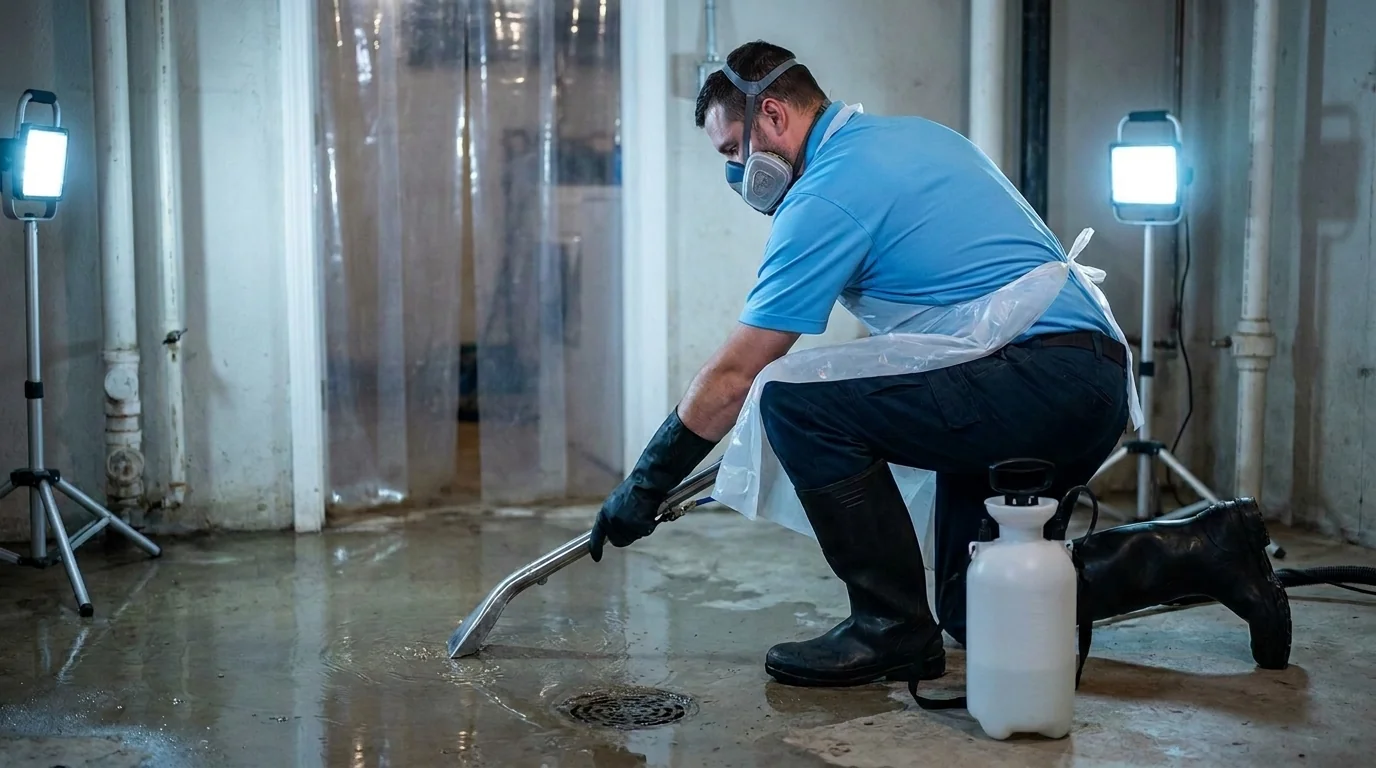
Sewage Cleanup and Sanitization in Cranford
24/7 sewage cleanup and sanitization in Cranford, NJ. IICRC-certified, insurance billing accepted. Call (908) 970-8533.
Our IICRC-certified technicians are dispatched from our Fair Lawn, NJ headquarters and are typically on-site in Cranford within 60 minutes of your call.
Cranford’s nickname — the Venice of New Jersey — tells you everything about why sewage emergencies here hit differently. The Rahway River winds through the center of town, and when it rises, the storm sewer network that serves neighborhoods from Riverside Drive to Sunny Acres backs up fast, pushing raw sewage up through floor drains and basement toilets before most homeowners realize what’s happening. If you’re dealing with that right now in the 07016 area, call (908) 970-8533 — the line is answered around the clock.
Why Cranford Properties See Sewage Backup So Often
Cranford’s flood history is unusually well-documented: Floyd in 1999, Irene in 2011, and Ida in 2021 each submerged whole blocks, and the pattern is the same every time. The Rahway River overtops its banks along Riverside Drive and the Rahway River Parkway corridor, and the town’s combined storm and sanitary sewer infrastructure — much of it original to the 1920s and 1930s — simply can’t carry the volume. Sewage doesn’t just back up in the homes closest to the river; the hydraulic pressure travels upstream through shared laterals, surfacing in basements blocks away from any visible flooding.
The housing stock compounds the problem. The colonials and cape cods built between 1900 and 1945 that make up most of Cranford West and Lincoln Park East were constructed with full, unfinished basements — practical for the era, but they give sewage a large, porous surface area to contaminate. Concrete block foundations common in that period are not waterproof; they absorb Category 3 water (the technical classification for raw sewage) into the masonry itself, not just the floor. That’s not a mop-and-bleach situation.
Our Sewage Cleanup and Sanitization Process in Cranford
Raw sewage is classified as Category 3 contaminated water under the IICRC S500 standard, meaning it carries pathogens — bacteria, viruses, and parasites — that require containment and professional-grade sanitization, not just extraction. Here’s how the work proceeds on a typical Cranford job:
Containment and safety assessment. Before any equipment goes in, the affected area is assessed and isolated. In older homes, this includes checking whether sewage has wicked into wood framing, subfloor, or masonry — common in pre-war construction.
Extraction and removal. Standing sewage is extracted with truck-mounted units. Saturated porous materials — drywall, insulation, carpet, wood subfloor — that cannot be reliably disinfected are removed and bagged for disposal per New Jersey solid waste guidelines.
Antimicrobial application. EPA-registered disinfectants are applied to all affected surfaces, including masonry walls and concrete floors. In Cranford’s older basements, this often means treating unparged concrete block, which requires a longer dwell time than smooth poured concrete.
Structural drying. Industrial air movers and desiccant or refrigerant dehumidifiers run until moisture readings in walls, framing, and subfloor return to normal baselines — typically measured with thermal imaging and pin-type meters.
Documentation. Every step is photographed and logged. For homeowners with NFIP (National Flood Insurance Program) policies — common in Cranford given its flood zone designations — thorough documentation is what makes the difference between a full claim payout and a dispute.
The Restoration Group is an IICRC Certified Firm (#210213) and a licensed NJ Home Improvement Contractor, which matters when your insurance adjuster or the NJ Division of Consumer Affairs asks for credentials.
Reaching Cranford from Kenilworth
The Restoration Group’s headquarters is in Kenilworth, directly adjacent to Cranford’s western border. In practical terms, that means crews can be on-site in Cranford — whether that’s a basement off Nomahegan Park or a colonial near Downtown Cranford — without navigating county-wide distances. Because the line is staffed 24/7, there’s no waiting until morning to get an assessment started. Sewage contamination begins degrading porous materials within hours, and mold colonization can begin in 24 to 48 hours in New Jersey’s humid summer conditions, so the speed of that first response matters.
Cranford Insurance Coordination
Cranford properties in FEMA-designated Special Flood Hazard Areas carry NFIP policies that cover sewage backup when it results from flooding — but the claims process requires specific documentation that a general contractor typically doesn’t provide. The Restoration Group prepares moisture logs, photographic evidence of contamination boundaries, and itemized scope-of-work reports formatted for carrier review. We work directly with adjusters and can communicate with your agent about what’s covered under your specific policy. Homeowners in the Riverside Drive area who have been through prior flood claims often already know the documentation drill; for first-timers, we walk through it step by step.
Local Note: What Cranford’s Masonry Basements Mean for Sanitization
One thing that surprises homeowners in Cranford’s older neighborhoods is how far sewage contamination travels into unparged concrete block walls. Unlike the poured concrete or modern stud-framed basements found in newer construction, the hollow-core block walls common in 1920s–1940s Cranford colonials wick moisture and contaminants into the cores of the blocks themselves. Standard surface disinfection isn’t enough — the cores need to be addressed, which sometimes means removing the bottom courses of block or injecting disinfectant into the voids. It’s a step that gets skipped by crews unfamiliar with this housing stock, and it’s one of the reasons sewage odors return weeks after a cleanup that looked finished on the surface.
If you’re dealing with a sewage backup anywhere in Cranford — from a septic overflow near the outskirts of Sunny Acres to a sewer line backup in a Downtown Cranford storefront — call (908) 970-8533. The line is open now.
Sewage Cleanup and Sanitization in Cranford: Service Coverage
Frequently Asked Questions
How fast can you arrive for sewage cleanup and sanitization in Cranford?
How quickly can The Restoration Group reach a sewage backup in the Riverside Drive area of Cranford?
Does Cranford's flood zone status affect how a sewage backup claim is handled under an NFIP policy?
Are homes near Nomahegan Park and Lincoln Park East more vulnerable to sewage backups than other parts of Cranford?
What makes raw sewage cleanup different from regular water damage cleanup, and why does it matter in Cranford's older housing stock?
How long does sewage cleanup and sanitization typically take in a Cranford basement?
Will my homeowners insurance cover sewage cleanup and sanitization in Cranford?
Sewage Cleanup and Sanitization response in Cranford
Most Cranford calls see a technician on-site within 60 minutes from our Fair Lawn headquarters.