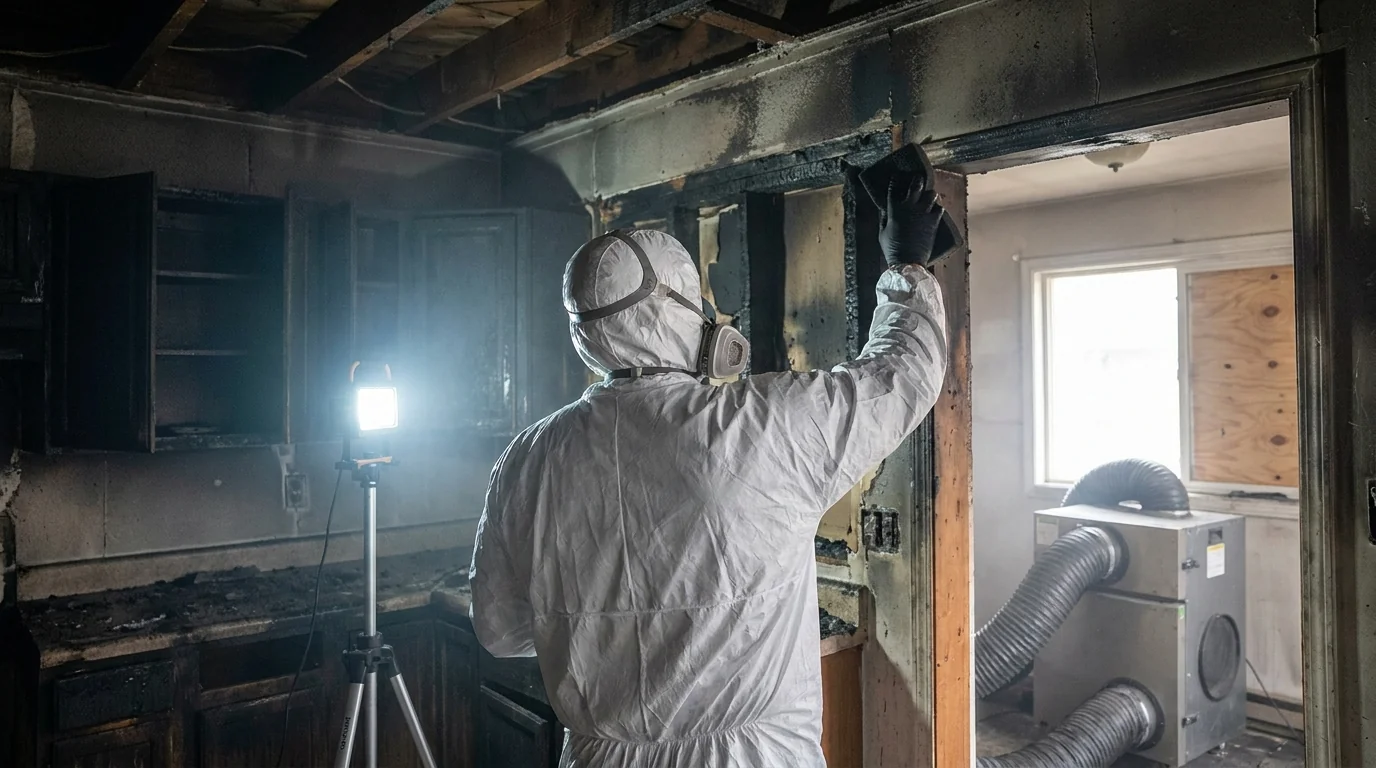
Fire Damage Restoration in Union
24/7 fire damage restoration in Union, NJ. IICRC-certified, insurance billing accepted. Call (908) 970-8533.
Our IICRC-certified technicians are dispatched from our Fair Lawn, NJ headquarters and are typically on-site in Union within 60 minutes of your call.
The smell of smoke doesn’t leave a house the way water does. It binds to drywall, soaks into ceiling joists, and settles into the plaster walls common in Union Township’s postwar capes and split-levels — the kind built in the 1940s through 1960s that make up much of the housing stock from Battle Hill down through Vauxhall. A kitchen fire in one of those homes isn’t just a surface problem. Smoke travels through wall cavities, soot coats HVAC ducts, and the residue left behind after the fire trucks leave can keep damaging finishes and air quality for weeks if the response is slow or incomplete.
Why Union’s Housing Stock Complicates Fire Damage
Union Township’s density of mid-century construction creates specific challenges after a fire that newer builds don’t share. Homes in the Battle Hill and Vauxhall neighborhoods were typically framed with old-growth lumber — denser and slower to char through than modern dimensional lumber, which sounds like an advantage until you realize it also holds heat longer and allows smoke to penetrate deeper into wall assemblies before the fire is suppressed.
Original cast-iron supply and drain plumbing is still common in these homes, and when firefighters run high-volume water through a structure, those aged pipes and their connections take a beating. A fire loss in Union frequently becomes a combined fire-and-water loss within hours of suppression — soaked subfloors, flooded finished basements, and saturated insulation that has to be addressed at the same time as the smoke and soot. Treating only the visible fire damage and ignoring the suppression water is one of the most common mistakes homeowners make in the days after a fire.
Our Fire Damage Restoration Process in Union
Every fire restoration job starts with a documented scope — not a verbal estimate, but a written room-by-room assessment that photographs affected materials, catalogs structural damage, and identifies what can be cleaned versus what has to be removed. That documentation matters for your insurance claim and for the NJ Division of Consumer Affairs licensing requirements that govern contractor work in the state.
From there, the process moves in a defined sequence:
- Emergency board-up and tarping to secure the structure against weather and unauthorized entry, critical in denser residential blocks where an open structure creates liability for neighbors.
- Controlled demolition of unsalvageable materials — charred framing, smoke-saturated insulation, damaged drywall — down to clean structural lines.
- Dry ice blasting and HEPA vacuuming on salvageable framing and masonry to remove soot without introducing additional moisture into already-stressed materials.
- Thermal fogging and ozone treatment to neutralize odor molecules embedded in surfaces that can’t be physically removed.
- Structural drying of any suppression water using commercial desiccant dehumidifiers and air movers, monitored with moisture meters until readings return to regional baseline.
- Reconstruction to pre-loss condition, coordinated with your insurance adjuster’s scope.
The IICRC Certified Firm standard (Firm #210213) governs our drying and decontamination protocols — not because it’s a marketing credential, but because it gives your insurance carrier a defensible methodology when they review the claim.
Reaching Union from Kenilworth
The Restoration Group operates out of Kenilworth, which shares a border with Union Township — crews traveling Morris Avenue or the Route 22 corridor can reach most Union addresses around the clock. For properties near the Union Center business district or along the 07083 ZIP code’s residential blocks, that proximity means a faster initial assessment and board-up, which limits secondary damage from weather exposure in the hours after suppression.
For commercial losses along the Route 22 retail corridor — restaurants, retail spaces, and service businesses that have their own fire and suppression risks — the same rapid response applies. Sprinkler-discharge events after a commercial kitchen fire can saturate thousands of square feet of inventory and flooring before business hours begin; early containment reduces the total loss significantly.
Working with Insurance After a Union Fire
New Jersey’s residential insurance market has tightened considerably in recent years, and Union Township homeowners are seeing more scrutiny on fire claims — particularly on older homes where adjusters may flag pre-existing deferred maintenance as a contributing factor. Detailed photo documentation taken before any demolition begins is the single most important thing a restoration contractor can do to protect your claim.
The Restoration Group bills carriers directly and prepares the scope of loss in the format most major insurers use, which reduces back-and-forth and keeps the project timeline from stalling while paperwork moves. We work within the adjuster’s process rather than around it.
Local Note
Union’s mid-century plaster walls behave differently than modern drywall during fire restoration — and it catches homeowners off guard. Plaster is more fire-resistant than drywall and often survives a room fire structurally intact, which looks like good news. But smoke and soot penetrate plaster’s porous surface deeply, and standard chemical sponge cleaning that works on painted drywall frequently isn’t enough. In homes throughout the 07083 ZIP code, we’ve found that plaster surfaces require a combination of dry chemical sponging followed by encapsulation primer before any finish coat — skipping that step means the odor comes back within months, especially in humid New Jersey summers. It’s a detail that matters in Union specifically because so much of the housing stock still has original plaster ceilings and walls.
If your home in Union Township has been affected by fire — whether a contained kitchen event or a more extensive structural loss — call (908) 970-8533 any time. The crew is close, the process is documented, and the goal is to get you back into a safe, restored home as efficiently as the work allows.
Fire Damage Restoration in Union: Service Coverage
Frequently Asked Questions
How fast can you arrive for fire damage restoration in Union?
How quickly can The Restoration Group reach Battle Hill or Vauxhall after a fire?
Union's older homes often have plaster walls — does that change how smoke damage is cleaned?
A fire suppression system discharged in my Route 22 commercial space overnight — is that handled the same way as a residential fire loss?
My Union Township home is in the 07083 ZIP code and was built in the 1950s — are there code upgrade requirements I should know about when rebuilding after a fire?
How long does fire and smoke restoration typically take for a mid-sized home in Union Center?
Will my homeowners insurance cover fire damage restoration in Union?
Fire Damage Restoration response in Union
Most Union calls see a technician on-site within 60 minutes from our Fair Lawn headquarters.