Mold Remediation in Union
24/7 mold remediation in Union, NJ. IICRC-certified, insurance billing accepted. Call (908) 970-8533.
Our IICRC-certified technicians are dispatched from our Fair Lawn, NJ headquarters and are typically on-site in Union within 60 minutes of your call.
When the Rahway River tributaries backed up through Vauxhall during Ida, a lot of Union Township basements sat under inches of water for days — long enough for mold to establish a foothold inside wall cavities and under flooring before the water was even pumped out. That pattern repeats every hard summer storm in the low spots off Morris Avenue, and it plays out differently here than in newer construction: Union’s dense stock of postwar capes, split-levels, and colonials — most built between the 1940s and 1960s — carries original cast-iron drains and galvanized supply lines that fail quietly, often behind finished basement walls where nobody notices until the smell arrives.
Why Union Properties See Mold Problems
Mold doesn’t need a flood to get started. It needs 24 to 48 hours of elevated moisture and an organic surface — drywall paper, wood framing, carpet backing — and Union’s housing stock gives it both in abundance. The finished and semi-finished basements common throughout Battle Hill and Union Center are especially vulnerable: a slow leak behind a laundry hookup or a weeping cast-iron cleanout fitting can saturate the wall cavity for weeks before it shows on the surface. By then, colonies are already behind the drywall.
The town’s geography compounds the risk. Low-lying sections near Vauxhall and the Route 22 corridor sit in drainage paths that collect runoff from surrounding higher ground. Commercial properties along Route 22 — restaurants, big-box retail — deal with sprinkler-discharge events and roof membrane failures that push water into adjoining tenant spaces overnight. Kean University’s student housing adds another layer: slow bathroom leaks and unreported condensation issues in older residence buildings can go unaddressed long enough for mold to colonize ceiling tiles and HVAC ductwork.
Our Mold Remediation Process in Union
Remediation in Union’s older homes requires a few extra steps that wouldn’t apply in newer construction. Before containment goes up, we assess whether the affected wall assembly uses the original horsehair plaster or has been re-drywalled at some point — the two materials hold moisture differently and require different drying targets. Lead paint is also a realistic presence in pre-1978 homes throughout the 07083 and 07088 ZIP codes, so we verify surface conditions before any demolition begins.
The process itself follows the IICRC S520 mold remediation standard:
- Inspection and moisture mapping — thermal imaging and moisture meters locate hidden saturation behind finishes before we open anything.
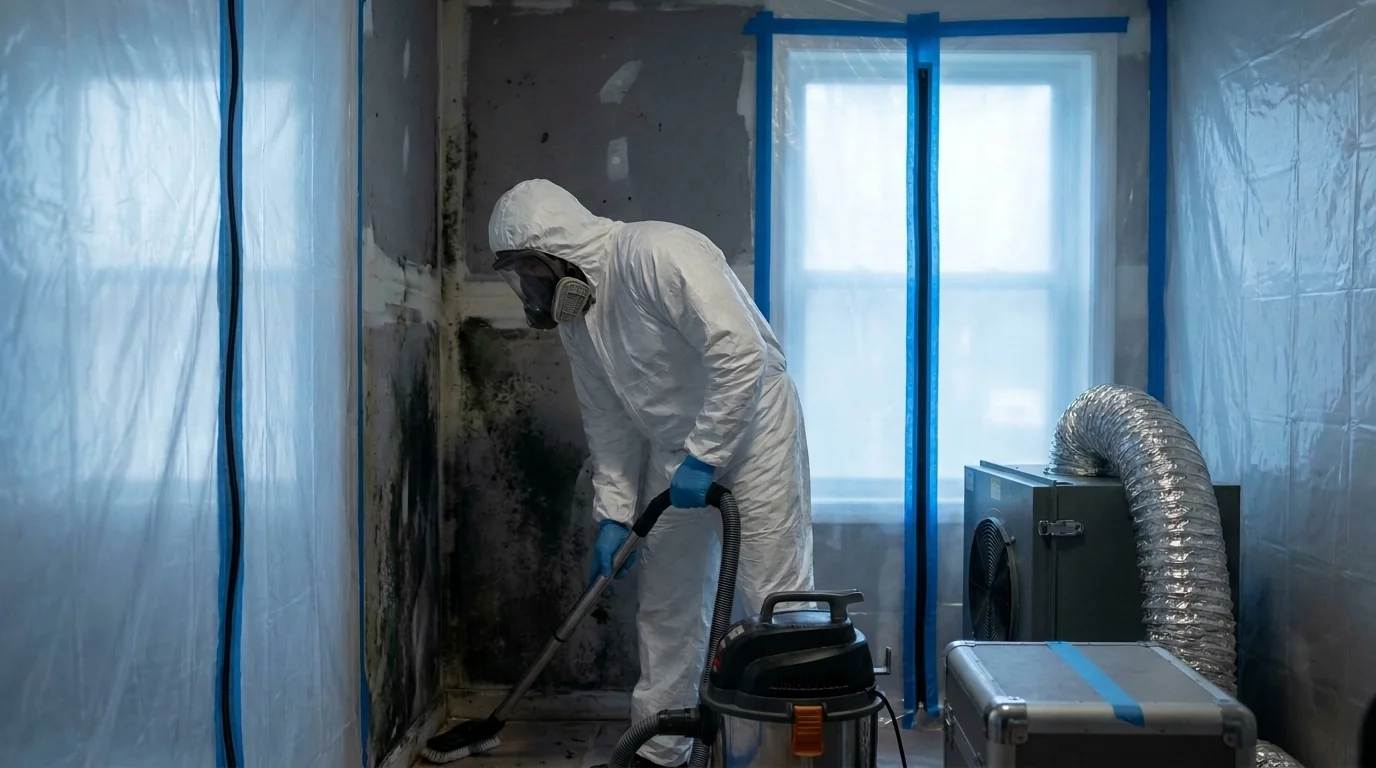
- Containment — negative-air chambers with HEPA-filtered exhaust isolate the work area from living spaces and HVAC returns.
- Controlled demolition — affected drywall, insulation, and framing are removed to clean, dry, unaffected material.
- HEPA vacuuming and antimicrobial treatment — all structural surfaces within the containment zone are vacuumed and treated.
- Drying verification — moisture readings are documented to confirm the substrate is at or below the target threshold before reconstruction begins.
- Post-remediation air testing — an independent industrial hygienist clears the space before containment comes down.
Reaching Union from Kenilworth
The Restoration Group is based in Kenilworth, which shares a direct border with Union Township — the crew is not driving in from across the county. Whether the call comes from a homeowner near Galloping Hill Golf Course or a property manager handling a commercial loss in the Union Center business district, dispatch is straightforward. Because our hours are 24/7, a mold concern discovered on a Sunday evening or after a late-night storm gets the same response as a weekday morning call at (908) 970-8533.
Local Note
One thing that catches homeowners off guard in Union’s split-level and raised-ranch layouts: the half-level between the garage and the main living floor is often uninsulated and shares a wall with the basement stairwell. When a basement moisture event happens, that intermediate level acts as a chimney for humid air — mold can appear on the back of closet walls on the main floor while the basement itself looks relatively dry. If you’re seeing musty odors upstairs but can’t find a visible source, that intermediate wall cavity is the first place we look.
Insurance Coordination for Union Homeowners
Most mold claims in Union originate from a covered water loss — a burst pipe, appliance failure, or storm intrusion — rather than from mold discovered in isolation. The distinction matters because insurers treat the two differently. We document the moisture source, the affected materials, and the remediation scope with the carrier’s requirements in mind: written moisture logs, photographs of each demo phase, and a line-item scope of work. We work directly with adjusters so you’re not translating between the remediation crew and your insurance company.
If the mold predates a covered event or is attributed to long-term seepage, coverage gets more complicated. We can provide the documentation an adjuster needs to make that determination, but we’ll tell you honestly upfront what the claim is likely to look like based on what we find during inspection.
If you’re dealing with a mold problem in Union Township — whether it’s a finished basement in Battle Hill, a commercial space on Route 22, or a slow leak that’s been working behind a wall for longer than you’d like to think — call (908) 970-8533. We’ll inspect, contain, and clear it to a standard you can document.
Mold Remediation in Union: Service Coverage
Frequently Asked Questions
How fast can you arrive for mold remediation in Union?
Are homes in Battle Hill and Union Center more prone to hidden mold than newer construction?
How does flooding near Vauxhall and Morris Avenue affect mold risk after a storm?
Does the age of Union's housing stock affect how long mold remediation takes?
What does post-remediation air testing involve, and is it required in New Jersey?
Can a mold problem at a commercial property on the Route 22 corridor be handled without shutting down operations?
Will my homeowners insurance cover mold remediation in Union?
Mold Remediation response in Union
Most Union calls see a technician on-site within 60 minutes from our Fair Lawn headquarters.