Smoke Damage Restoration in Union
24/7 smoke damage restoration in Union, NJ. IICRC-certified, insurance billing accepted. Call (908) 970-8533.
Our IICRC-certified technicians are dispatched from our Fair Lawn, NJ headquarters and are typically on-site in Union within 60 minutes of your call.
The acrid smell of smoke doesn’t leave on its own. In Union Township’s dense postwar neighborhoods — rows of 1940s and ’50s capes, split-levels, and colonials from Battle Hill to Vauxhall — smoke residue works its way into plaster walls, original wood trim, and the kind of forced-air ductwork that hasn’t been replaced since the Eisenhower administration. A kitchen fire, a chimney flashback, or even a neighbor’s house fire close enough to push smoke through your attic vents can leave odor and soot that linger for months if the cleanup isn’t done right the first time. The Restoration Group responds 24/7 from our Kenilworth base — minutes from Union’s 07083 and 07088 ZIP codes — to stop that damage from becoming permanent.
Why Union Homes Are Especially Vulnerable to Smoke Damage
Union Township’s housing stock tells the story. The capes and colonials built between 1945 and 1965 were constructed with real plaster-and-lath walls, original oak hardwood floors, and in many cases, the same cast-iron registers they came with. Plaster is porous in a way modern drywall simply isn’t — smoke proteins and soot particles penetrate the surface layer and bond to the substrate beneath. That means a fire that looks cosmetically minor can leave odor embedded inches into the wall structure.
Older homes in the Union Center and Vauxhall areas also tend to have less compartmentalization between living spaces and attic cavities. Smoke travels the path of least resistance, and in a 1952 split-level, that path often runs straight up through balloon-framed wall cavities into the attic and back down through interior partition walls. By the time visible soot is wiped off the kitchen ceiling, the same particulate is already coating insulation two floors up.
Heating systems compound the problem. Many of these homes still run oil or older gas furnaces with return-air systems that, during a fire event, actively pull smoke through the house. We’ve seen post-fire inspections on Morris Avenue-area properties where the ductwork distributed soot to every room — including bedrooms that were nowhere near the origin point.
Our Smoke Damage Restoration Process in Union
Smoke restoration isn’t a single step — it’s a sequenced process, and cutting corners on any phase means the smell comes back. Here’s how we work through it on a typical Union residential loss:
Containment and assessment first. We identify the fire’s origin point, map the smoke migration path through the structure, and test surface pH levels. Soot from synthetic materials (carpet, upholstery, plastics) is acidic and etches surfaces within hours; soot from wood or paper is alkaline and behaves differently on porous substrates like plaster.
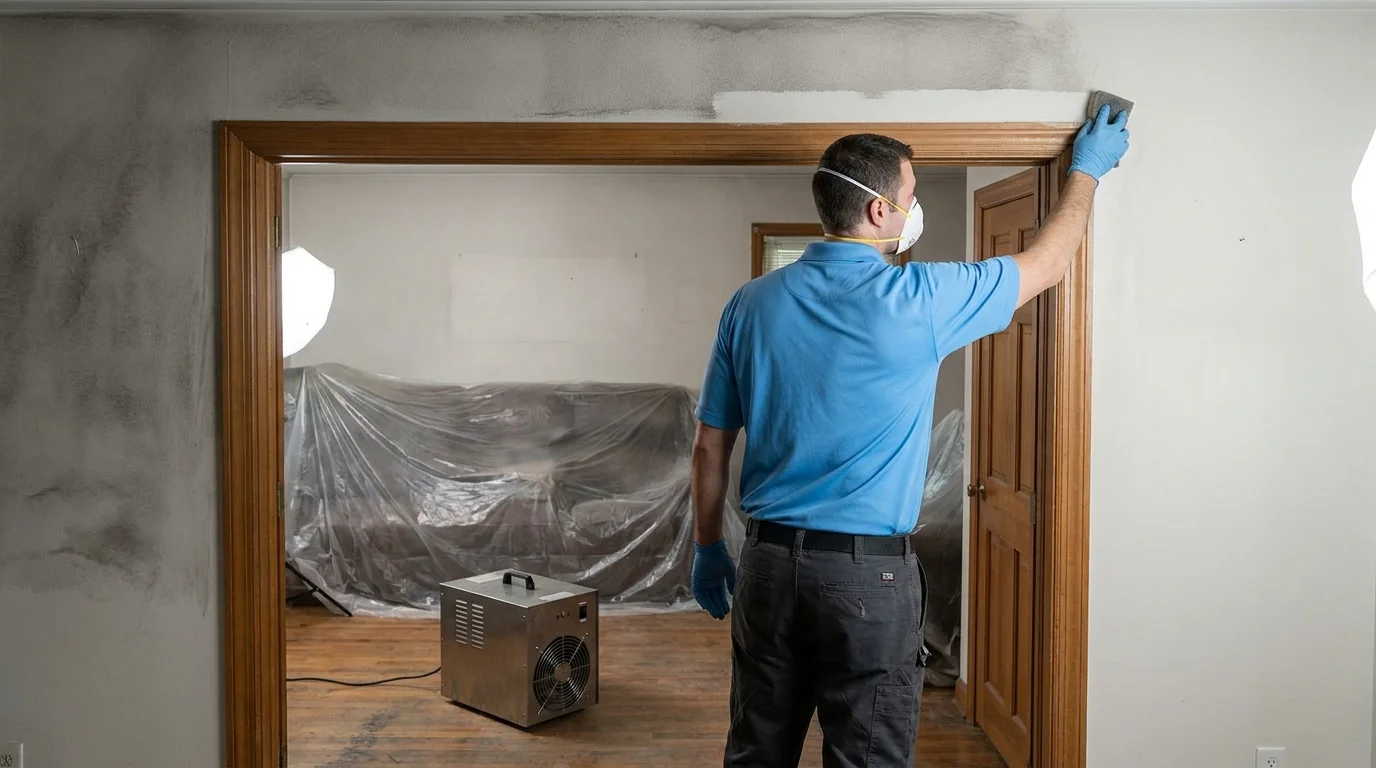
Dry soot removal before any wet cleaning. Wiping soot with a wet cloth before dry-removing it grinds particles deeper into porous surfaces. We use dry chemical sponges and HEPA-filtered vacuums first, then move to wet cleaning with appropriate alkaline or acidic neutralizing agents matched to the soot type.
Duct cleaning and HVAC decontamination. Given how many Union homes have older forced-air systems that spread smoke during a fire event, we treat duct decontamination as a required step, not an upsell.
Thermal fogging and hydroxyl treatment for odor. Odor molecules bond to surfaces at a molecular level. Thermal fogging replicates the behavior of smoke itself — the deodorizing agent penetrates the same cavities the original smoke reached. For occupied or partially occupied properties, hydroxyl generators provide a non-chemical alternative safe for use around remaining contents.
Sealing and repainting. Where smoke has deeply penetrated plaster, we apply shellac-based or pigmented shellac primer before finish coats. Standard latex primer will not lock in smoke odor.
Reaching Union from Kenilworth
Our shop sits in Kenilworth, directly on Union Township’s eastern border. From our location, we reach the Union Center business district and the Battle Hill residential grid via North Michigan Avenue or Chestnut Street in under ten minutes under normal conditions. Vauxhall, which sits closer to the Elizabeth River corridor in the township’s southern section, is accessible via Route 22 or Stuyvesant Avenue — typically 12 to 15 minutes depending on Route 22 interchange traffic. Because we’re 24/7, we’re not routing crews from a distant dispatch center at 2 a.m. — we’re coming from next door.
Local Note
Union’s older plaster-wall homes require a specific sequencing adjustment that matters on smoke jobs: plaster releases absorbed odor more slowly than drywall, but it also holds shellac-based sealers better once the surface is properly cleaned. Crews unfamiliar with the local housing stock sometimes skip the shellac primer step because the surface looks clean after washing — and the homeowner calls back six weeks later when summer humidity pulls the embedded odor back out of the walls. We’ve learned to treat plaster surfaces in Union’s postwar homes as a two-stage process: clean and seal, then confirm odor levels before scheduling finish paint.
Insurance Coordination for Union Smoke Claims
Most homeowner policies in New Jersey cover smoke damage as part of a fire loss, but the documentation requirements matter. We photograph affected materials room by room, log surface readings, and provide the scope of work in a format most major carriers accept directly. Union Township properties near Kean University — including student rentals and multi-family conversions — sometimes carry landlord policies with different documentation requirements than standard HO-3 policies; we’ve worked through both. We bill carriers directly where assignment of benefits is permitted, which keeps you from fronting the full cost while the claim processes.
If you’re dealing with smoke damage in Union — whether it’s a contained kitchen fire in a Battle Hill colonial or a whole-house loss near the Route 22 corridor — call (908) 970-8533. We’ll assess the damage, walk you through the process, and get crews moving the same day.
Smoke Damage Restoration in Union: Service Coverage
Frequently Asked Questions
How fast can you arrive for smoke damage restoration in Union?
How quickly can The Restoration Group reach a smoke damage emergency in the Vauxhall or Battle Hill areas of Union?
Union's older homes have plaster walls — does that change how smoke residue cleanup works compared to a newer house?
Are homes in Union's 07083 ZIP code more likely to have smoke spread through their ductwork during a fire?
What does smoke damage restoration typically involve for a multi-family or student rental property near Kean University?
How long does smoke odor treatment take in a typical Union Township home, and when is it safe to reoccupy?
Will my homeowners insurance cover smoke damage restoration in Union?
Smoke Damage Restoration response in Union
Most Union calls see a technician on-site within 60 minutes from our Fair Lawn headquarters.