Mold Inspection and Testing in Westfield
24/7 mold inspection and testing in Westfield, NJ. IICRC-certified, insurance billing accepted. Call (908) 970-8533.
Our IICRC-certified technicians are dispatched from our Fair Lawn, NJ headquarters and are typically on-site in Westfield within 60 minutes of your call.
Westfield’s Victorian and Tudor homes along streets like Wychwood and The Gardens were built in an era when basements were stone-footed and walls were horsehair plaster — materials that hold moisture differently than modern construction and can harbor mold colonies for months before a single dark stain appears on a surface. When a slow leak behind a plaster wall or a sump failure beneath a finished home theater finally surfaces, the question isn’t just whether mold is present — it’s how far it has traveled and what the air your family is breathing actually contains. That’s precisely what a professional mold inspection and testing assessment answers.
Why Westfield Properties Are Particularly Vulnerable to Hidden Mold
The housing stock in the 07090 ZIP code tells a specific story. Homes built between the 1890s and 1930s — common throughout Indian Forest and Manor Park — were constructed with original clay sewer laterals and cast-iron drain stacks that corrode slowly and quietly. A pinhole failure inside a plaster wall cavity can feed a mold colony for a full season before humidity readings in the room above ever register as unusual. Knob-and-tube era renovations often bypassed vapor barriers entirely, leaving wall cavities open to ground moisture that wicks upward through fieldstone foundations.
Finished basements compound the risk. Westfield homeowners have invested heavily in below-grade living space — home theaters, gyms, offices — and those improvements sit directly above slab-on-grade or crawl-space conditions that are among the most mold-conducive environments in any residential setting. A failed sump pump during a heavy storm event along Robinson’s Branch of the Rahway River can saturate carpet padding, drywall, and framing before the water is even visible at the base of the walls. Mold can begin colonizing porous materials within 24 to 48 hours of that kind of saturation.
Our Mold Inspection and Testing Process in Westfield
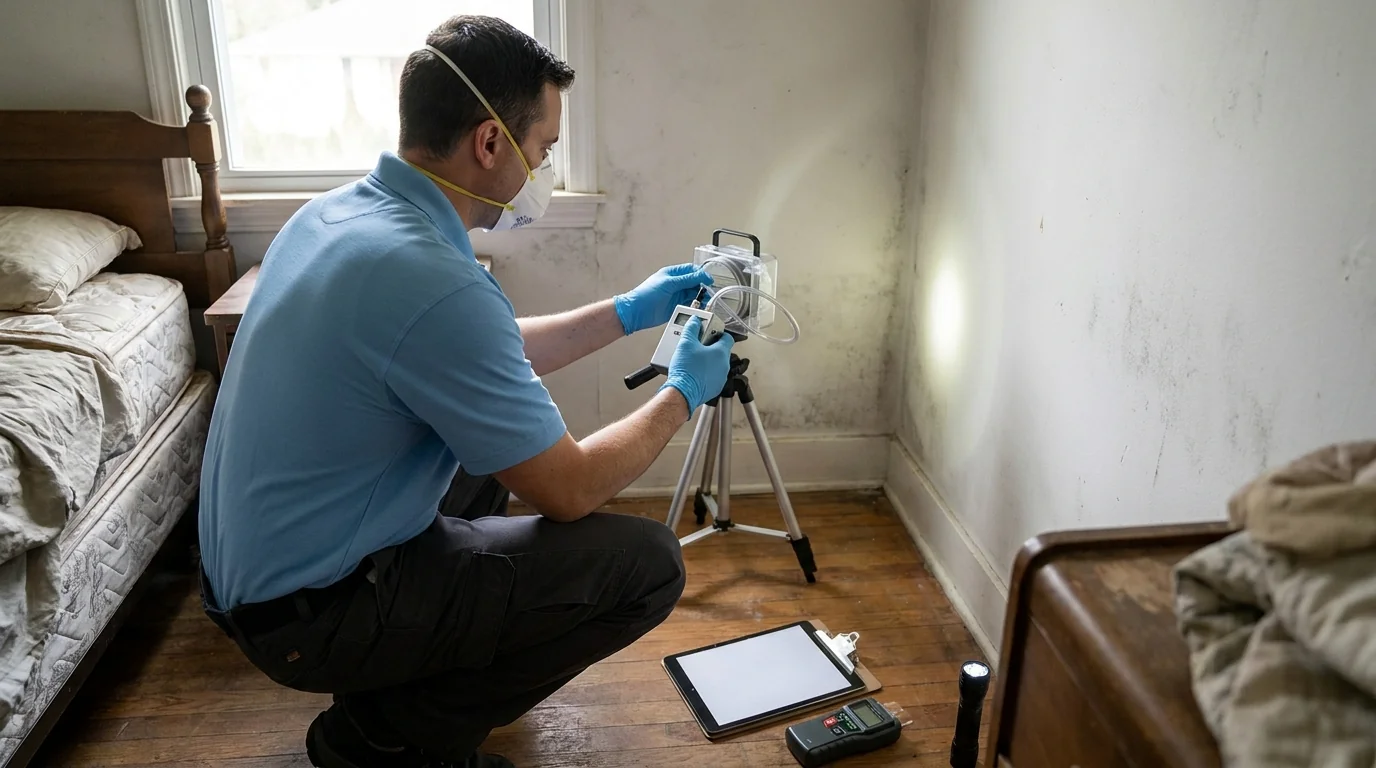
A thorough mold assessment in a pre-1940s Westfield home requires more than a visual walkthrough. Our IICRC Certified Firm (#210213) inspectors begin with a moisture mapping phase using thermal imaging and calibrated moisture meters to locate elevated readings inside wall cavities, beneath subfloors, and along rim joists — areas that a surface inspection simply cannot reach. In older plaster construction, moisture gradients can be steep: the wall face reads dry while the lath behind it is at 30% moisture content or higher.
Air sampling for mold spore testing is conducted in each area of concern plus a control sample from outside the structure, giving us a baseline comparison that reflects Westfield’s actual outdoor spore counts on the day of testing — those counts shift seasonally and matter for interpreting results accurately. Surface swab or tape-lift samples are collected from any visible growth or staining. All samples are submitted to an accredited third-party laboratory, and we walk you through the written report in plain language, not mycology shorthand. If remediation is warranted, the inspection report serves as the scope document — so you’re not paying for a second assessment.
Reaching Westfield from Our Kenilworth Base
Our team operates out of Kenilworth, placing us within a short drive of Westfield via Central Avenue or the Route 28 corridor. Because our hours are 24/7, we can schedule inspections around the demands of Westfield homeowners — early morning before a school run, evenings when both decision-makers are home, or same-day when a real estate transaction is on the line. Downtown Westfield properties near Quimby Street and Mindowaskin Park are straightforward to reach; we’re familiar with parking constraints on the narrower residential blocks and plan accordingly.
Local Note: What Westfield’s Older Homes Teach Us About Mold Sampling
One thing that comes up repeatedly in Westfield inspections is the behavior of horsehair plaster as a moisture reservoir. Unlike modern drywall, which wicks and releases moisture relatively quickly, original plaster walls absorb water into their mass and release it slowly over weeks. This means that even after a leak is repaired, the wall cavity can sustain elevated relative humidity — and active mold growth — long after the source is gone. In practice, this changes how we interpret moisture readings and how many air samples we collect per room: a single reading in a plaster-walled space is rarely the whole picture. We account for this in every inspection we conduct in Westfield’s older neighborhoods, and it’s a detail that matters when you’re deciding whether remediation is truly complete.
If you’ve noticed a musty odor in a finished basement, discovered staining behind a bookcase, or are navigating a home sale that requires documentation of indoor air quality, call (908) 970-8533. We’ll schedule a mold inspection and testing visit, give you laboratory-backed answers, and help you understand exactly what the results mean for your Westfield home.
Mold Inspection and Testing in Westfield: Service Coverage
Frequently Asked Questions
How fast can you arrive for mold inspection and testing in Westfield?
Are older homes in Westfield neighborhoods like Indian Forest or Manor Park more likely to have hidden mold?
What does a mold inspection involve in a Westfield home with a finished basement?
How do outdoor mold spore counts in Westfield affect my indoor air quality test results?
If a home sale in the 07090 ZIP code requires mold documentation, how quickly can you provide a written report?
What's the difference between a mold inspection and mold testing, and do I need both for a Westfield property?
Will my homeowners insurance cover mold inspection and testing in Westfield?
Mold Inspection and Testing response in Westfield
Most Westfield calls see a technician on-site within 60 minutes from our Fair Lawn headquarters.