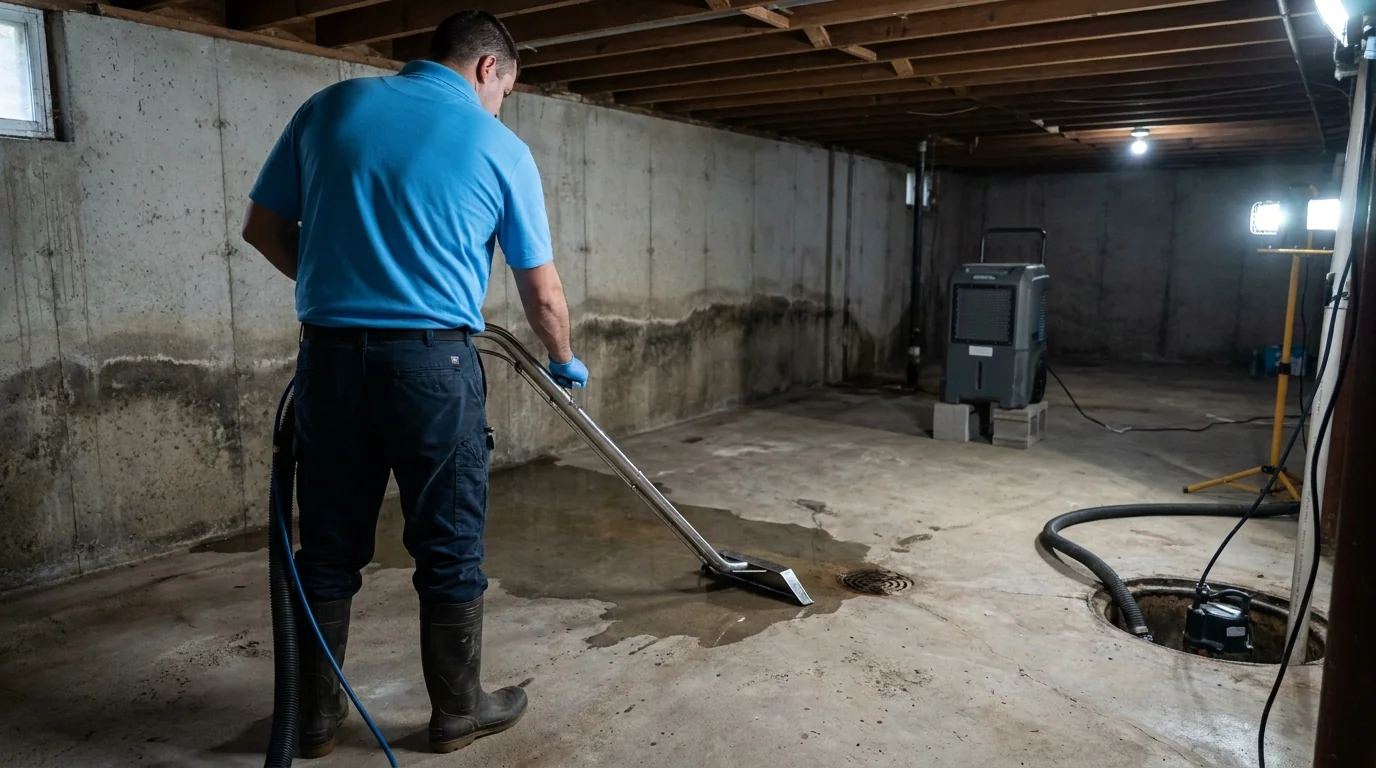
Basement Flooding Cleanup in Brooklyn
24/7 basement flooding cleanup in Brooklyn, NY. IICRC-certified, insurance billing accepted. Call (908) 970-8533.
Our IICRC-certified technicians are dispatched from our Fair Lawn, NJ headquarters and are typically on-site in Brooklyn within 60 minutes of your call.
Brooklyn’s basement flooding problem isn’t just about heavy rain — it’s about what happens when 140-year-old masonry meets a storm drain system that was never designed for it. When Ida dropped nearly two inches of rain in an hour across the borough in 2021, garden-level apartments from Park Slope to Flatbush turned into wading pools faster than any sump pump could respond. If you’re standing in water right now, or you’ve just discovered a soaked cellar after a pipe let go overnight, The Restoration Group dispatches crews around the clock and can reach most Brooklyn neighborhoods from our Kenilworth, NJ base via the Goethals and the Staten Island Expressway — call (908) 970-8533.
Why Brooklyn Properties Flood the Way They Do
Brooklyn’s housing stock is its own category. The brownstone belt running through Park Slope, Brooklyn Heights, and the Bed-Stuy fringe is dominated by 1880s–1920s masonry rowhouses, and their below-grade construction — garden apartments, cellar storage, finished basements — sits at or below the water table in several neighborhoods. Brick and brownstone foundations were built without modern waterproofing membranes. Over a century of freeze-thaw cycles has opened hairline cracks in mortar joints that funnel groundwater inward during sustained rain events.
Coastal neighborhoods tell a different story. Red Hook, Canarsie, and the areas near the Coney Island boardwalk carry genuine storm-surge exposure — Sandy’s floodwaters are still a reference point for what a worst-case event looks like in those ZIP codes. Homes in 11235 and 11226 that sit in FEMA-designated flood zones often see water intrusion from below-slab hydrostatic pressure, not just surface runoff. That distinction matters for how we approach extraction and drying.
Party-wall construction adds another layer of complexity. When a basement floods in a rowhouse, water doesn’t always respect property lines — it migrates laterally through shared foundation walls. A neighbor’s burst supply line can saturate your cellar before you smell anything wrong.
Our Basement Flooding Cleanup Process in Brooklyn
The first thing we do on arrival is assess the water source and category — clean supply water, gray water from a drain backup, or black water from a sewer surcharge — because that determines how aggressively we protect your space and what personal protective equipment the crew wears. Brooklyn’s aging combined sewer system means drain backups during heavy rain events often carry category 3 contamination, which requires a different protocol than a burst copper pipe.
Once the source is controlled, truck-mounted extraction equipment pulls standing water from the floor. In finished basements, we remove baseboards and drill weep holes low in drywall to allow trapped water to drain before we run drying equipment. In original plaster-and-lath cellars — common in pre-war Brooklyn Heights and Williamsburg brownstones — we adjust our approach: plaster is denser than drywall and releases moisture more slowly, so we extend drying time and monitor with daily moisture readings rather than pulling materials prematurely.
Structural drying uses commercial-grade dehumidifiers and high-velocity air movers positioned to create a controlled airflow pattern across wet materials. We log temperature, relative humidity, and moisture content at each visit and provide you with a written drying log — documentation your insurer or co-op board will need.
Reaching Brooklyn from Kenilworth
Our Kenilworth headquarters puts us on the road toward Brooklyn via the Goethals Bridge and the Staten Island Expressway to the Verrazzano-Narrows, or through the Holland Tunnel depending on traffic. We dispatch 24/7, which matters when a sewer backup hits at 2 a.m. in a Canarsie two-family or a supply line lets go in a Bay Ridge co-op on a Sunday. We stage equipment in the vehicle before we leave, so the crew arrives ready to extract — not waiting on a second trip for gear.
Brooklyn Insurance and Co-op Board Documentation
Brooklyn’s mix of brownstone owners, co-op shareholders, condo unit owners, and commercial landlords means we deal with a wide range of documentation requirements. Co-op and condo boards often require a licensed contractor’s written scope of work before authorizing access to building systems or shared spaces. We produce photo documentation, moisture mapping, and a detailed loss report formatted for submission to your carrier or managing agent.
For brownstone owners carrying flood insurance through the National Flood Insurance Program — common in the coastal ZIP codes — we document the loss in a format that aligns with adjuster expectations, including pre- and post-mitigation moisture readings and an itemized equipment log.
Local Note
In Brooklyn’s pre-war rowhouses, the party wall between your basement and your neighbor’s is often uninsulated rubble stone or soft brick — not poured concrete. When water migrates laterally through that wall, it’s easy to mistake a neighbor’s plumbing failure for your own foundation leak. We’ve seen this pattern repeatedly in the brownstone blocks east of Prospect Park. Before we finalize a scope of work, we check both sides of any shared wall for moisture — because misidentifying the source means the problem comes back after we leave.
If your Brooklyn basement has taken on water — from a storm, a sewer backup, or a plumbing failure — call The Restoration Group at (908) 970-8533. We’re available around the clock, we carry IICRC Firm Certification (#210213), and we’ll bring the documentation your insurer, co-op board, or property manager needs to move the claim forward.
Basement Flooding Cleanup in Brooklyn: Service Coverage
Frequently Asked Questions
How fast can you arrive for basement flooding cleanup in Brooklyn?
How quickly can The Restoration Group reach a flooded basement in Brooklyn?
Brooklyn's sewer system backs up during heavy rain — does that change how you clean up a flooded basement?
Are Park Slope and Brooklyn Heights brownstone basements harder to dry than a modern finished basement?
My co-op board in Brooklyn requires documentation before authorizing any contractor work — can you provide that?
Does flooding risk differ between a brownstone in ZIP code 11215 and a home near Canarsie in 11236?
Will my homeowners insurance cover basement flooding cleanup in Brooklyn?
Basement Flooding Cleanup response in Brooklyn
Most Brooklyn calls see a technician on-site within 60 minutes from our Fair Lawn headquarters.