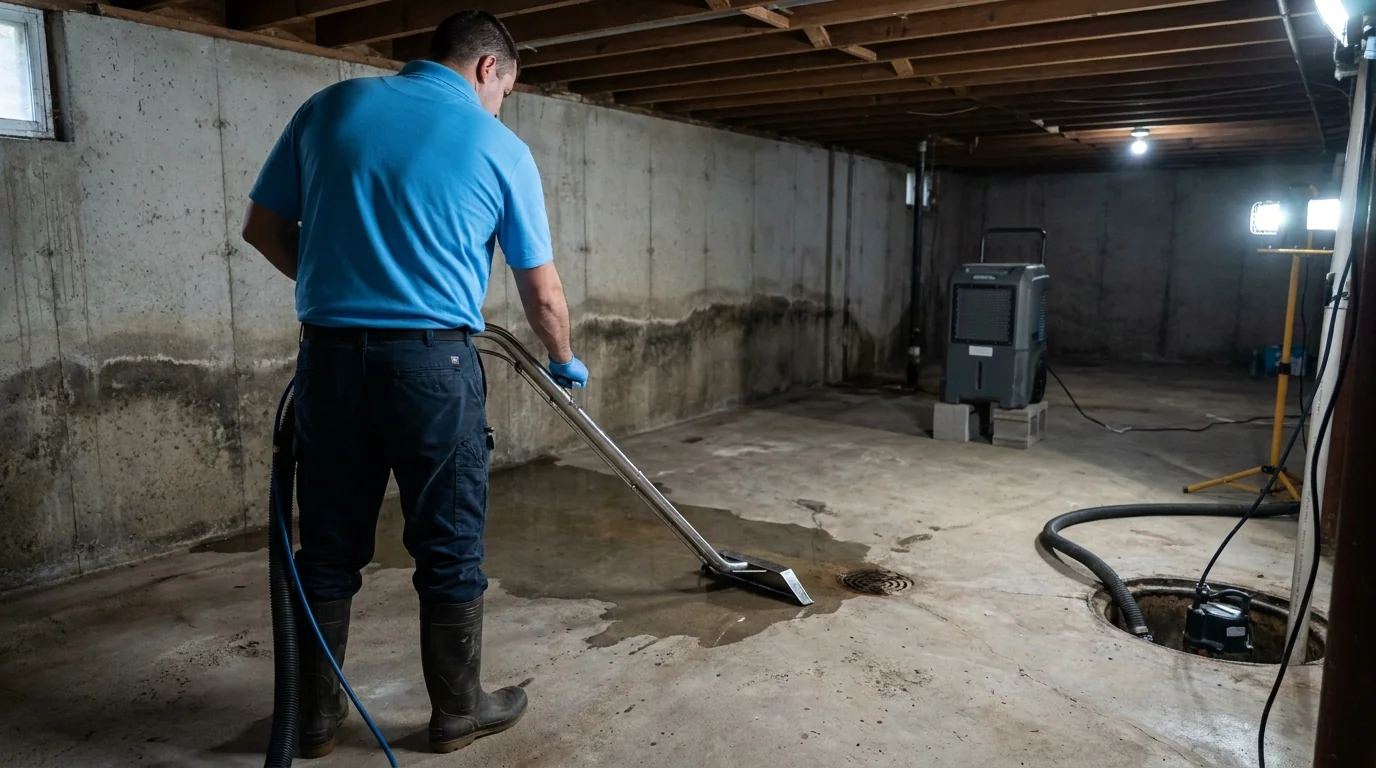
Basement Flooding Cleanup in Cranford
24/7 basement flooding cleanup in Cranford, NJ. IICRC-certified, insurance billing accepted. Call (908) 970-8533.
Our IICRC-certified technicians are dispatched from our Fair Lawn, NJ headquarters and are typically on-site in Cranford within 60 minutes of your call.
Cranford’s nickname — the Venice of New Jersey — tells you everything you need to know about basement flooding here. The Rahway River doesn’t just pass through town; it bends and loops through neighborhoods like Riverside Drive and Sunny Acres, and when it rises, it rises fast. Storms like Irene in 2011 and Ida in 2021 put entire blocks underwater within hours, and the town’s aging storm sewer network means even a heavy overnight rain can back water into basements that never touched the river at all. If you’re standing in a wet basement in 07016 right now, the clock on mold colonization started the moment the water arrived.
Why Cranford Properties Flood Differently Than Most Towns
The geography here creates two distinct flooding patterns that don’t always show up elsewhere. Properties near the Rahway River Parkway and Droescher’s Mill corridor deal with true riverine flooding — the kind that comes in through foundation walls and window wells as the river overtops its banks. The rest of town, including streets further inland toward Cranford West and Lincoln Park East, tends to flood from overwhelmed municipal storm sewers that back up through floor drains and sump pits during sustained rainfall.
The housing stock compounds the challenge. Most of Cranford’s residential neighborhoods were built between the 1910s and 1940s — full-depth basements with stone or cinder-block foundations, original clay drainage tile, and in many cases no vapor barrier between the footing and the slab. Those older materials absorb water laterally in ways that poured-concrete foundations don’t. Water that looks contained to a 200-square-foot mechanical room can actually be wicking through the block cores across the entire perimeter. Thermal imaging during the assessment phase frequently reveals saturation well beyond the visible waterline.
Our Basement Flooding Cleanup Process in Cranford
Every job starts with a documented assessment — moisture readings, photos, and a written scope — before a single pump runs. That documentation matters here more than in most markets because a significant share of Cranford homeowners carry National Flood Insurance Program (NFIP) policies, and NFIP adjusters require itemized loss documentation that goes well beyond what a standard homeowner’s policy adjuster expects. We photograph affected materials at every stage and produce a moisture log that travels with the claim file.
Once the scope is confirmed, high-capacity truck-mounted extraction pulls standing water from the floor. For the cinder-block and stone foundations common near Nomahegan Park and the older sections of Downtown Cranford, we follow extraction with structural drying that targets the wall cavities themselves — not just the air in the room. Desiccant or refrigerant dehumidifiers run continuously, and we set calibrated airflow across the base of the walls to draw residual moisture out of the masonry rather than just surface-drying the finish materials. Moisture readings are logged daily until the structure reaches the dry standard outlined in the IICRC S500.
Contents — furniture, stored items, mechanical equipment — are assessed for salvageability and either moved to a dry area of the home or documented as a total loss for the claim. Flooring decisions get made on day two once subfloor moisture readings are available, not on day one when the situation looks worst.
Reaching Cranford from Our Kenilworth Headquarters
The Restoration Group operates out of Kenilworth, one town over, which puts Cranford closer to our crew staging area than almost any other market we serve. We’re available around the clock — call (908) 970-8533 at any hour and you’ll reach a live dispatcher, not a voicemail. For addresses near the Cranford Canoe Club or along the Riverside Drive corridor, where road access can be complicated during active flooding events, we confirm the approach route before dispatch to avoid staging delays.
Cranford Insurance & NFIP Coordination
Cranford sits in one of Union County’s highest-density NFIP enrollment areas — not surprising given the flood history. We work with both standard homeowner’s carriers and NFIP write-your-own policies and understand that the documentation requirements differ significantly between the two. Our project managers can walk you through what your adjuster will need and what we’ll provide at each stage. We don’t submit inflated scopes; we submit complete ones, which is what actually protects your claim.
Local Note
One thing that catches out-of-area crews in Cranford: the cinder-block basement walls in pre-war colonials here hold water in their cores long after the visible surface feels dry to the touch. A crew that pulls equipment after hitting a surface moisture reading of 16% on the face of the block may be leaving 30–40% moisture trapped inside the cores — enough to feed mold growth behind any finish material reinstalled over it. We drill test holes in the mortar joints on older block walls to read core moisture directly before signing off on structural drying. It adds a step, but it’s the difference between a closed job and a callback six weeks later with a mold problem.
If your basement took water — whether from the river, a sewer backup, or a sump that couldn’t keep up — call (908) 970-8533. We’ll assess the damage, document it properly, and get the drying process moving before the timeline for mold growth closes.
Basement Flooding Cleanup in Cranford: Service Coverage
Frequently Asked Questions
How fast can you arrive for basement flooding cleanup in Cranford?
Are homes near the Riverside Drive area more likely to need structural drying after a flood than homes further inland?
My Cranford home has an NFIP flood policy, not a standard homeowner's policy — does that change how you document the loss?
How quickly can you reach the Sunny Acres or Lincoln Park East neighborhoods after I call?
What's different about drying a 1920s Cranford colonial basement compared to a newer home?
After Ida-level flooding in Downtown Cranford, how do you decide what flooring and wall material can be saved versus what has to go?
Will my homeowners insurance cover basement flooding cleanup in Cranford?
Basement Flooding Cleanup response in Cranford
Most Cranford calls see a technician on-site within 60 minutes from our Fair Lawn headquarters.