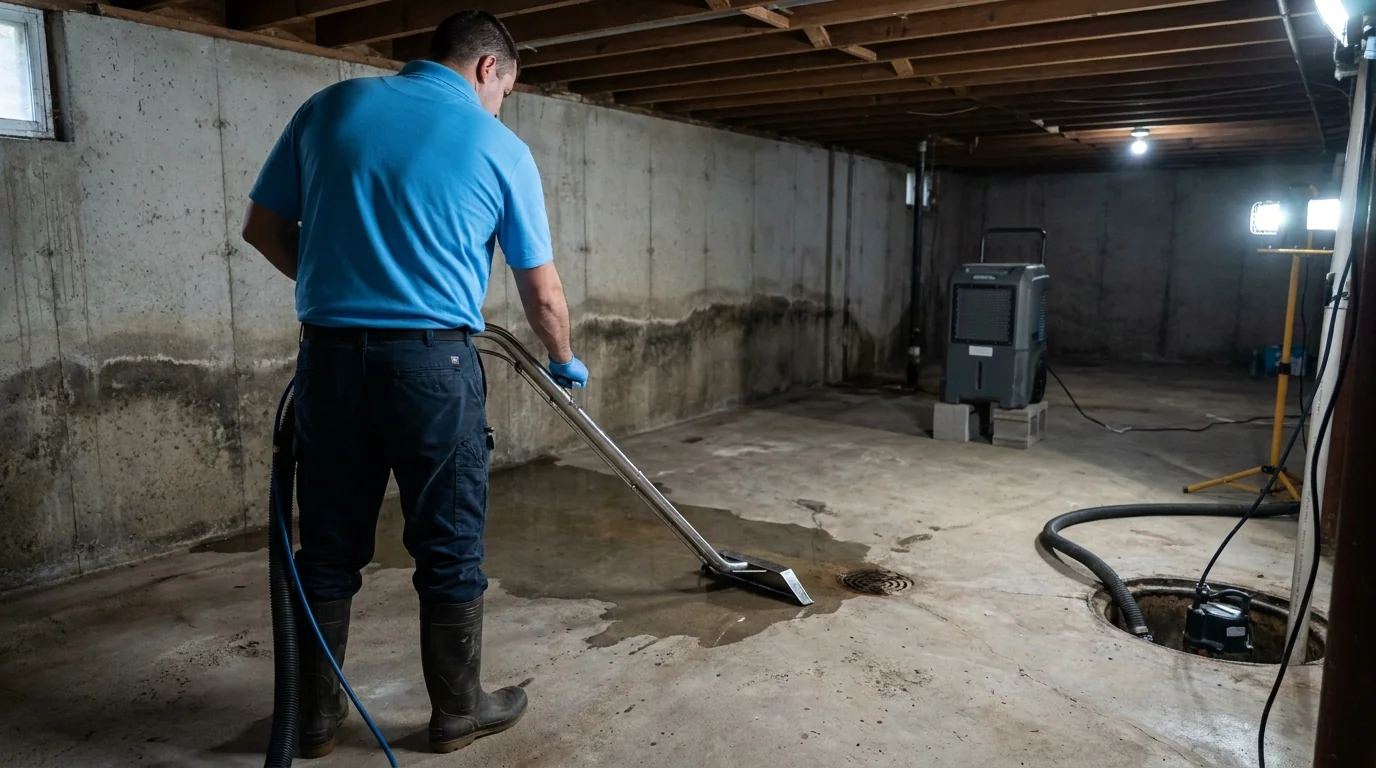
Basement Flooding Cleanup in Kenilworth
24/7 basement flooding cleanup in Kenilworth and surrounding areas. IICRC-certified, insurance billing accepted. Call (908) 970-8533.
Standing water in a basement moves fast. Within the first hour, it wicks into drywall, soaks into insulation, and begins saturating the subfloor above — materials that look fine on the surface but are already holding moisture that will feed mold within 24 to 48 hours. Whether the source is a failed sump pump, a backed-up floor drain, a cracked foundation wall, or a storm that overwhelmed your lateral line, the clock on secondary damage starts the moment the water stops rising.
What basement flooding cleanup actually involves
Basement flooding is its own category of water damage — not just because of the volume of water involved, but because of where it sits. Basements are below grade, which means limited airflow, higher ambient humidity, and materials like concrete block, fiberglass insulation, and OSB subfloor that absorb and hold water differently than above-grade construction. Cleanup isn’t just pumping out the puddle.
A proper flooded basement cleanup starts with high-capacity truck-mounted or portable extraction equipment rated for standing water — not a shop vac. Once bulk water is out, the real work begins: identifying how far moisture has migrated into walls, floors, and structural framing using thermal imaging cameras and calibrated moisture meters. Wet insulation behind an intact vapor barrier, saturated bottom plates behind drywall, and waterlogged concrete block cavities are all invisible to the naked eye and all capable of sustaining mold growth for weeks.
Drying a basement correctly typically takes three to five days with commercial-grade desiccant or refrigerant dehumidifiers and high-velocity air movers positioned to create a directed airflow pattern — not just placed randomly around the room. Moisture readings are logged daily against the IICRC S500 standard drying goals for each material class. The job isn’t done when it feels dry; it’s done when the numbers confirm it.
Our process
-
Source identification and water classification — Before extraction begins, we identify the water source and classify the contamination level. A sump failure bringing in groundwater is typically Category 1 or 2. A backed-up floor drain connected to a sanitary line is Category 3 (black water), which changes every downstream decision: PPE requirements, what materials can be dried versus must be removed, and how waste water is handled.
-
Bulk water extraction — Truck-mounted extractors remove standing water quickly. In finished basements, we also extract from carpet and pad before deciding whether salvage is feasible — carpet saturated with Category 2 or 3 water is almost always a removal candidate regardless of how new it is.
-
Controlled demolition and material removal — Wet drywall below the flood line, saturated insulation, and compromised flooring are removed to expose the structural framing for drying. We cut drywall in straight lines at a consistent height (typically 12 to 24 inches above the waterline) so replacement panels align cleanly. This step is where inexperienced crews cut corners — leaving wet insulation in place because it looks intact is one of the most common causes of post-remediation mold claims.
-
Structural drying with daily monitoring — Commercial dehumidifiers and air movers run continuously. We return each day to log moisture readings at consistent test points in concrete, framing lumber, and any remaining wall assemblies. If readings plateau or rise, we adjust equipment placement or add capacity. Documentation of daily readings is part of the file we provide for your insurance claim.
-
Final moisture verification and clearance — When all materials reach their dry standard, we do a final pass with the moisture meter and thermal camera, document the readings, and provide a drying completion report. This report is what your insurance adjuster and any future buyer’s inspector will want to see.
What separates a good basement flooding response from a bad one
The most common failure point in flooded basement cleanup is stopping at what’s visible. Water follows gravity and capillary action — it travels horizontally through concrete block cores, vertically up wall cavities through insulation, and laterally under floating floors before it ever shows up as a wet spot on the surface. Operators who rely on visual inspection alone miss moisture that shows up as mold two weeks after they’ve packed up.
A second common mistake is under-sizing drying equipment for the space. A single consumer dehumidifier in a 1,200-square-foot basement is not a drying system — it’s a gesture. Proper basement drying requires equipment sized to the cubic footage, the material types, and the ambient conditions, with airflow engineered to move moisture from materials into the air column and out of the space.
Insurance adjusters look for a moisture log — a daily record of readings at documented test points that shows a drying curve moving toward goal. Without that documentation, claims can be disputed and mold discovered later is harder to tie to the original loss event.
As an IICRC Certified Firm (#210213) and NJ Licensed Home Improvement Contractor, the work we do and the documentation we produce is built to hold up to adjuster review.
Seasonal and regional considerations
In northern New Jersey, basement flooding peaks in two windows: the spring thaw in March and April, when frozen ground can’t absorb snowmelt fast enough and hydrostatic pressure against foundation walls spikes, and the late-summer storm season when fast-moving thunderstorms overwhelm municipal storm drains and push water back through floor drains. Kenilworth’s older housing stock — much of it built before modern waterproofing standards — sees both patterns regularly. Basements that have flooded once are statistically more likely to flood again, and pre-existing moisture damage in block foundations or deteriorated drain tile can make each event worse than the last.
Service area
The Restoration Group is based in Kenilworth and handles basement flooding cleanup throughout Union County and surrounding areas, including Cranford, Westfield, Springfield, Mountainside, Garwood, Roselle Park, and Clark. City-specific pages for each of those communities link back here for the full technical detail on how the work gets done.
If your basement has water in it right now, call (908) 970-8533 — we’re available 24/7. The sooner extraction starts, the narrower the window for mold to take hold and the less structural material ends up in a dumpster. Schedule your basement moisture assessment today.
Frequently Asked Questions
How do I know whether my flooded basement water is Category 1, 2, or 3 — and why does it matter?
My basement flooded but the water is gone now — do I still need professional drying?
Can basement carpet and flooring be saved after a flood, or does it always have to come out?
What should I do — and not do — while waiting for the crew to arrive?
How long does basement structural drying typically take, and what affects the timeline?
Looking for the best basement flooding cleanup company in Fair Lawn?
The Restoration Group provides licensed and insured basement flooding cleanup in Fair Lawn, NJ and the surrounding area, and has served local property owners since 2021. We answer calls 24/7 — call (908) 970-8533 for immediate help.
Need Basement Flooding Cleanup now?
We respond 24/7 across Fair Lawn and surrounding NJ cities.
Related Coverage
- Our Restoration Services
- Contact The Restoration Group
- Basement Flooding Cleanup in Brooklyn
- Basement Flooding Cleanup in Cranford
- Basement Flooding Cleanup in Elizabeth
- Basement Flooding Cleanup in Jersey City
- Basement Flooding Cleanup in Kenilworth
- Basement Flooding Cleanup in Manhattan
- Basement Flooding Cleanup in Newark
- Basement Flooding Cleanup in Springfield
- Basement Flooding Cleanup in Summit
- Basement Flooding Cleanup in Union
- Basement Flooding Cleanup in Westfield