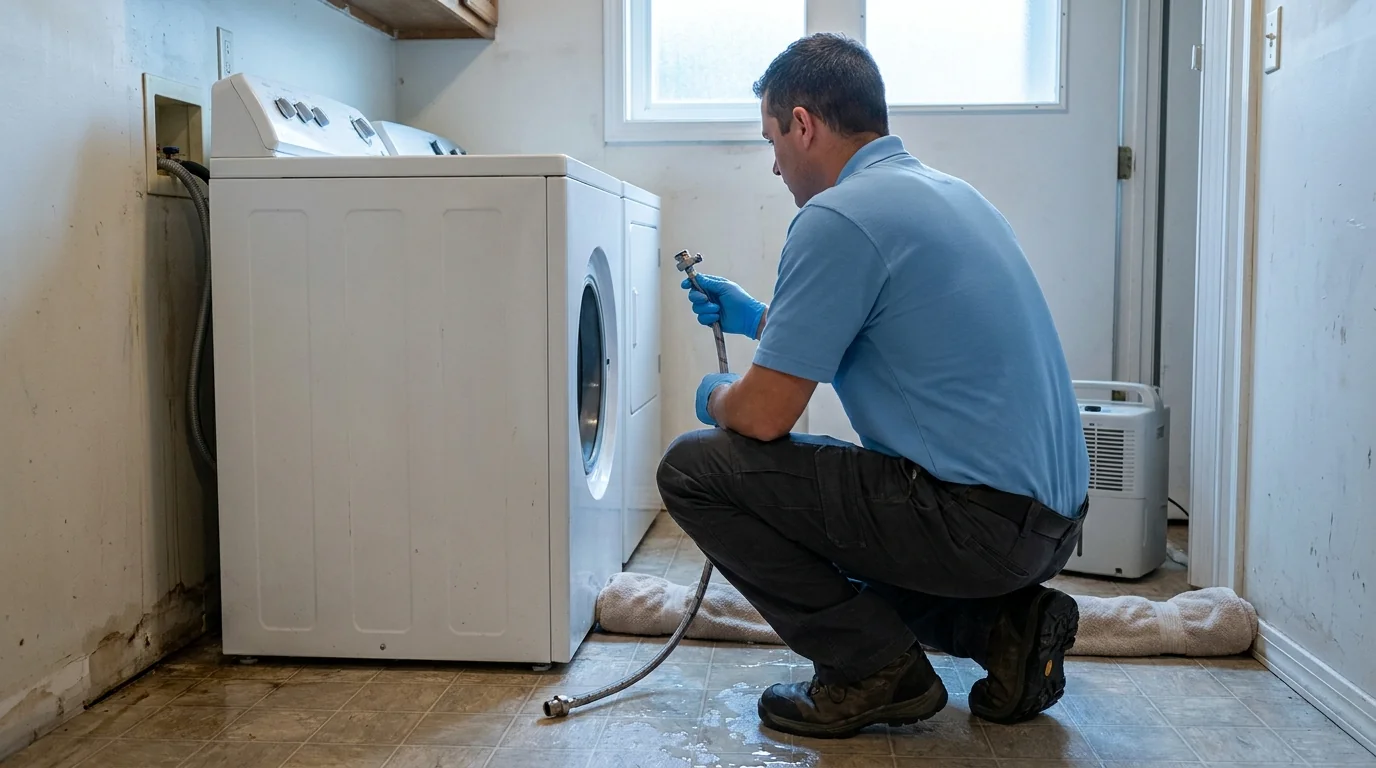
Appliance Leak Cleanup in Elizabeth
24/7 appliance leak cleanup in Elizabeth, NJ. IICRC-certified, insurance billing accepted. Call (908) 970-8533.
Our IICRC-certified technicians are dispatched from our Fair Lawn, NJ headquarters and are typically on-site in Elizabeth within 60 minutes of your call.
An ice maker line that splits overnight or a washing machine hose that lets go mid-cycle can push dozens of gallons across a kitchen or laundry room floor before anyone notices the damage. In Elizabeth’s dense stock of early-1900s two- and three-family frame homes — the kind packed shoulder-to-shoulder through Elmora and Peterstown — that water doesn’t stop at your unit. It follows gravity through subfloor gaps, down interior walls, and into the apartment below, turning a single appliance failure into a multi-tenant emergency that landlords and property managers need documented fast.
Why Elizabeth Properties See More Appliance Leak Damage
The housing stock here is the first factor. Many homes in the 07202 and 07206 ZIP codes were built before modern moisture barriers and vapor retarders were standard practice. Subfloors are often diagonal-board pine over solid joists — absorbent, slow to release moisture, and prone to cupping and swelling when saturated. A refrigerator supply line that drips for two weeks behind a toe-kick can rot out a section of subfloor that looks perfectly fine from above.
The second factor is plumbing age. Galvanized supply lines and original cast-iron drain stacks are still common in the older multifamily corridors near Elizabethport and Bayway. When a washing machine drain hose disconnects from an aging standpipe, the resulting backup can carry sediment and gray water across a finished floor in minutes. Combined with Elizabeth’s known combined-sewer infrastructure — which can push sewage up through floor drains during heavy rain events — a simple appliance leak can escalate to a contaminated-water loss that requires a different cleanup protocol entirely.
Water heater failures deserve special mention. Many Elizabeth multifamily buildings house the water heater in a shared basement or utility closet. When a tank-style heater fails, it can release 40 to 80 gallons directly onto a concrete slab, wicking into adjacent framing and insulation before the first tenant notices a warm floor overhead.
Our Appliance Leak Cleanup Process in Elizabeth
When you call, we dispatch from our Kenilworth shop — a ten-minute run down Route 28 or the Garden State Parkway depending on traffic — and we operate around the clock. The first thing our crew does on-site is identify the water source and confirm it’s isolated. If the supply valve is corroded and won’t close — common on older Elizabeth installations — we’ll walk you through shutting off at the main while we work.
From there, the process follows a structured sequence:
- Moisture mapping using thermal imaging and calibrated moisture meters to trace how far water has traveled through walls, floors, and ceilings — including into lower units if the building is multifamily.
- Extraction of standing water with truck-mounted or portable extraction equipment, including weighted extraction tools for saturated carpet and pad.
- Drying system placement — commercial-grade desiccant or refrigerant dehumidifiers and high-velocity air movers positioned to dry the structure per IICRC S500 drying standards, not just the surface.
- Daily monitoring with logged moisture readings so your insurance adjuster has a documented drying record, not just a verbal estimate.
- Material assessment — we identify which flooring, drywall, or insulation can be dried in place and what needs to come out to prevent secondary mold growth, which can begin colonizing wet organic material in as little as 48 to 72 hours in New Jersey’s humid summers.
If gray water or sewage is involved — a real possibility given Elizabeth’s combined-sewer exposure — we adjust the protocol to include appropriate disinfection and personal protective equipment, and we document the contamination category for your insurance file.
Elizabeth Insurance Coordination
Appliance leak claims in New Jersey are typically filed under the sudden-and-accidental discharge provision of a standard homeowner’s or landlord policy. The key word is sudden — a slow drip that’s been staining a cabinet for months is often disputed by carriers. Our documentation process is built around that distinction: we photograph the failure point, note the condition of supply lines and connections, and produce a moisture map that shows the scope of damage at the time of our arrival.
For landlords managing multifamily properties in Elizabeth, we can produce separate damage summaries by unit when multiple tenants are affected, which simplifies the claims process when more than one household is involved. We bill most major carriers directly and work with your adjuster through the estimate review process.
Local Note
In Elizabeth’s older two- and three-family homes, the space between the first-floor ceiling and second-floor subfloor is often filled with original vermiculite or loose cellulose insulation — not the fiberglass batts you’d find in newer construction. When appliance leak water saturates that cavity, the insulation acts like a sponge and holds moisture long after the visible surfaces feel dry. We’ve learned to probe those interstitial spaces with pin meters before calling a structure dry, because a ceiling that reads 12% moisture content on the surface can be hiding a saturated insulation layer running 40% or higher just two inches above it. Missing that layer is how mold problems start weeks after a cleanup looks finished.
If you’re dealing with a dishwasher overflow, a burst washing machine hose, a refrigerator ice maker line, or a failed water heater anywhere in Elizabeth — from North Elizabeth down through Peterstown to Bayway — call The Restoration Group at (908) 970-8533. We’ll assess the damage, start drying, and build the documentation your insurance company needs from the first hour on-site.
Appliance Leak Cleanup in Elizabeth: Service Coverage
Frequently Asked Questions
How fast can you arrive for appliance leak cleanup in Elizabeth?
How quickly can you reach Elmora or Peterstown from your Kenilworth location?
My Elizabeth multifamily has tenants in two units affected by the same washing machine flood — how do you handle that?
In Elizabethport and Bayway, could a refrigerator or dishwasher leak mix with sewage from a combined-sewer backup?
How long does it typically take to dry out a water-damaged subfloor in one of Elizabeth's older frame homes?
Will my insurance cover an ice maker line leak in a 07201 or 07202 ZIP code home, and what documentation do I need?
Appliance Leak Cleanup response in Elizabeth
Most Elizabeth calls see a technician on-site within 60 minutes from our Fair Lawn headquarters.