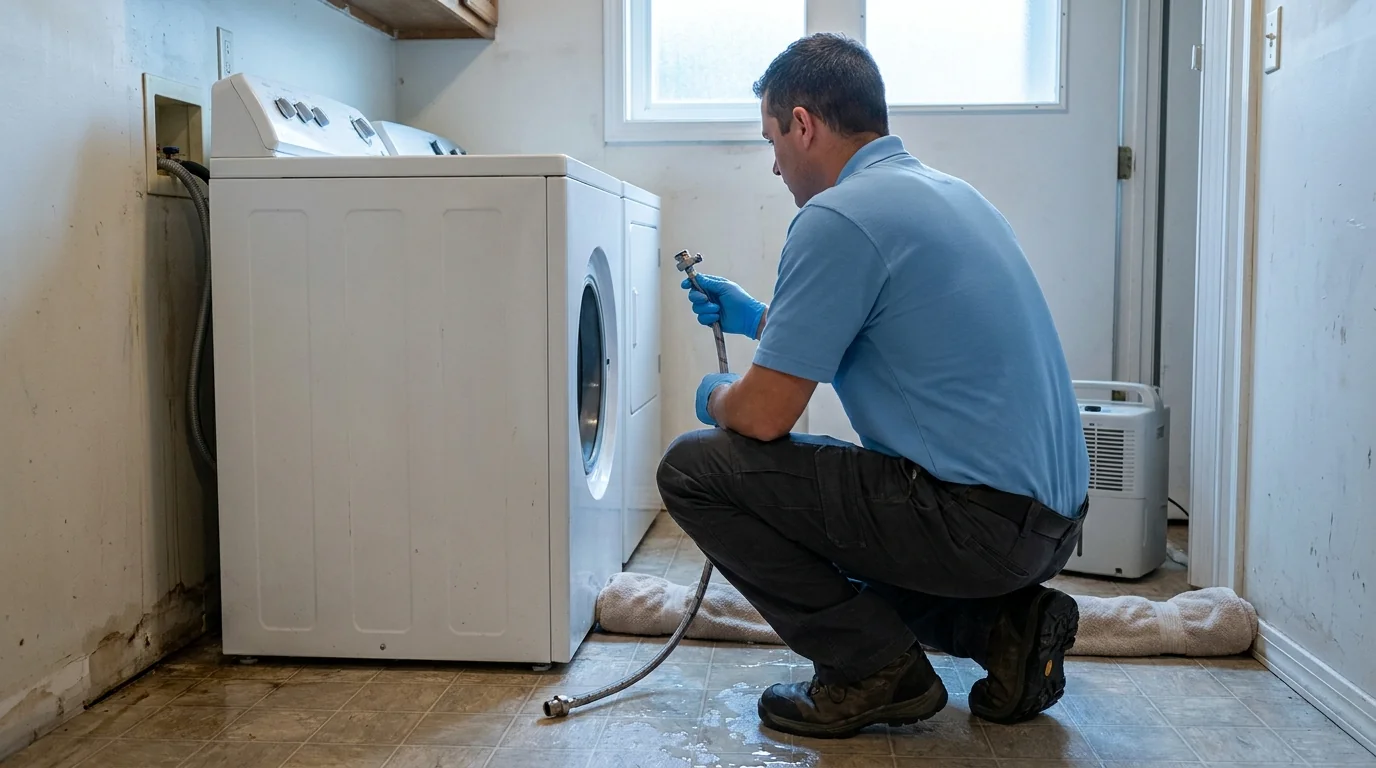
Appliance Leak Cleanup in Brooklyn
24/7 appliance leak cleanup in Brooklyn, NY. IICRC-certified, insurance billing accepted. Call (908) 970-8533.
Our IICRC-certified technicians are dispatched from our Fair Lawn, NJ headquarters and are typically on-site in Brooklyn within 60 minutes of your call.
A refrigerator ice maker line that weeps for weeks behind a cabinet, a washing machine hose that lets go at 2 a.m. in a Park Slope garden apartment, a dishwasher door seal that fails and soaks through a century-old fir subfloor — appliance leaks in Brooklyn rarely behave the way they do in newer construction. The borough’s brownstone belt is built on masonry and plaster, and water moves through those materials in ways that a moisture meter alone can miss. Call (908) 970-8533 any time, day or night, and The Restoration Group will dispatch a crew.
Why Brooklyn Properties See More Appliance Leak Damage
Brooklyn’s housing stock is one of the oldest in the country. The rowhouses running from Brooklyn Heights south through Flatbush were built between roughly 1880 and 1930, and most of them were never designed around modern appliances. Washing machines and dishwashers were retrofitted into kitchens and laundry closets that sit directly above garden-level or cellar units — the apartments that flood first. When a supply line fails on the parlor floor, the water doesn’t pool; it travels down through plaster ceilings, original tongue-and-groove subfloors, and into the unit below before anyone notices a drip.
Refrigerator ice maker lines are a particular problem in pre-war buildings. The copper or braided-steel supply lines are often routed through cabinet toe-kicks with no shutoff within reach, and because the leak rate is slow, saturation can build inside wall cavities for weeks. By the time a resident smells something musty, the framing behind the kitchen wall may already be supporting mold growth. The IICRC S500 standard for water damage response exists precisely because hidden moisture like this requires systematic documentation, not just a shop vac and a fan.
Coastal neighborhoods add another layer of complexity. Canarsie and the areas closer to the waterfront carry residual soil saturation from storm events — Sandy’s surge is still referenced by local engineers when assessing foundation drainage. A water heater that fails in a basement in those ZIP codes isn’t just a plumbing problem; it’s a leak into ground that may already be at capacity.
Our Appliance Leak Cleanup Process in Brooklyn
When we arrive, the first step is source control — confirming the appliance is off, the supply line is isolated, and no water is still entering the structure. In co-op and condo buildings, that sometimes means coordinating with a super or building manager to locate the riser shutoff, which in older Brooklyn buildings can be in a locked mechanical room or a shared basement.
Once the source is controlled, we map the moisture. We use thermal imaging cameras alongside calibrated moisture meters to trace where water traveled through floors, walls, and ceilings — including into adjacent units if there’s a party wall involved. In brownstones, water often migrates laterally through shared masonry before it drops, which means a dishwasher leak on the third floor can show up in a neighbor’s second-floor wall.
Extraction and drying follow a structured protocol. We place desiccant or refrigerant dehumidifiers and directed air movers calibrated to the material — plaster dries differently than drywall, and hardwood flooring in a Williamsburg loft requires different airflow than engineered flooring in a newer build. We monitor daily with readings logged to a drying report, which becomes part of the documentation package for your insurer or co-op board.
Materials that cannot be dried in place — saturated plaster, swollen subfloor sections, compromised insulation — are removed, documented with photographs, and itemized for the claim.
Brooklyn Insurance and Co-op Board Coordination
Insurance claims for appliance leaks in Brooklyn often involve more parties than a single-family home claim would. A brownstone owner in the 11215 ZIP code may have their own homeowner’s policy, a tenant’s renters policy below them, and a shared building policy if the structure is held in a trust or LLC. We photograph affected materials before anything is removed, generate a scope of loss in line with Xactimate line items, and communicate directly with adjusters to reduce the back-and-forth that slows settlements.
Co-op boards in particular tend to require documentation that goes beyond what a standard insurance photo log provides. Many boards want a written drying report, a moisture clearance reading at job completion, and confirmation that work in common areas met building management’s access requirements. We’ve worked through that process enough times to know what to prepare before the board asks.
Reaching Brooklyn from Kenilworth
Our crews run 24/7, and Brooklyn is a regular part of our NY-metro service area. From our Kenilworth, NJ base, we route through the Goethals or Outerbridge to the Belt Parkway for southern Brooklyn neighborhoods like Bay Ridge and Canarsie, or through the Holland Tunnel and across the BQE for Williamsburg, Brooklyn Heights, and points north. Traffic on the BQE is what it is — we don’t promise a minute count we can’t keep — but we dispatch immediately on every call and keep you updated on ETA.
Local Note
In Brooklyn’s brownstone neighborhoods, plaster walls and ceilings are often three-coat lime plaster applied over wood lath — a system that can absorb a significant volume of water before showing visible damage. The catch is that lime plaster releases that moisture slowly and unevenly, which means drying times run roughly 40 to 60 percent longer than comparable drywall assemblies. Crews unfamiliar with pre-war construction sometimes pull equipment too early, leaving residual moisture in the lath cavity that feeds mold weeks after the job closes. We extend monitoring periods on plaster structures and don’t sign off on drying clearance until readings are stable across multiple days.
If you’re dealing with an appliance leak anywhere in Brooklyn — from a water heater failure in a Canarsie basement to an ice maker line soaking through a Williamsburg kitchen wall — call (908) 970-8533. We document thoroughly, work within your building’s access requirements, and carry the paperwork your insurer and co-op board will need to close the claim.
Appliance Leak Cleanup in Brooklyn: Service Coverage
Frequently Asked Questions
How fast can you arrive for appliance leak cleanup in Brooklyn?
How does your crew handle appliance leak calls in Brooklyn co-op buildings where the super controls basement shutoffs?
Are Park Slope and Brooklyn Heights brownstones more difficult to dry after a washing machine or dishwasher leak?
Can water from an appliance leak on one floor reach a neighbor's unit through a party wall in a Brooklyn rowhouse?
What does the drying process look like for a refrigerator ice maker leak that went undetected for several weeks?
Does the 11215 or 11201 ZIP code affect how insurance claims are handled for appliance water damage in Brooklyn?
Appliance Leak Cleanup response in Brooklyn
Most Brooklyn calls see a technician on-site within 60 minutes from our Fair Lawn headquarters.