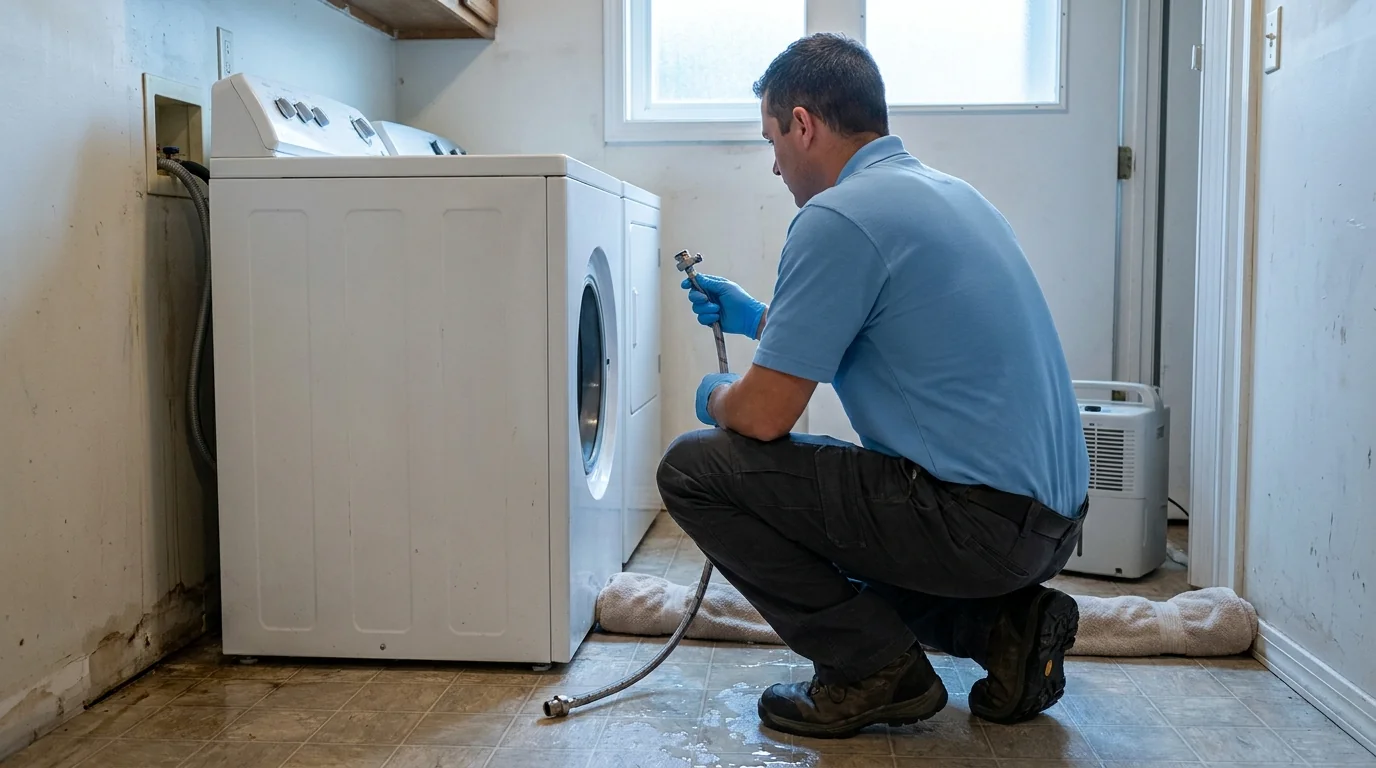
Appliance Leak Cleanup in Cranford
24/7 appliance leak cleanup in Cranford, NJ. IICRC-certified, insurance billing accepted. Call (908) 970-8533.
Our IICRC-certified technicians are dispatched from our Fair Lawn, NJ headquarters and are typically on-site in Cranford within 60 minutes of your call.
Cranford’s reputation as the ‘Venice of New Jersey’ is well-earned — the Rahway River winds through town, and the borough has absorbed three major flood events in living memory. But the water that quietly ruins a kitchen or laundry room most often doesn’t come from the river at all. It comes from inside: a dishwasher door seal that finally gives out, a refrigerator ice maker line that weeps behind the cabinet for weeks, a washing machine hose that blows on a Sunday morning when no one is home. In Cranford’s older housing stock — most of it 1920s–1940s colonials and capes sitting on full basements — that kind of slow or sudden appliance leak can saturate subfloor, travel down rim joists, and reach a finished basement before you notice anything wrong.
Why Cranford Homes Are Particularly Vulnerable to Appliance Leaks
The homes along Riverside Drive and throughout Cranford West were built in an era when plumbing supply lines were often galvanized steel and drain connections were hand-packed lead or oakum. Decades of mineral deposits, pressure cycling, and vibration leave braided hoses and compression fittings on the edge. When a washing machine supply hose finally lets go in a home like this, water doesn’t just pool on a vinyl floor — it finds the gaps between original hardwood planks, wicks into the subfloor sheathing, and drips into the basement ceiling cavity below.
Cranford’s clay-heavy soil compounds the problem. Basements in the 07016 ZIP code hold humidity at levels that would be unusual in newer construction on sandy fill. When an appliance leak adds bulk moisture to a space that’s already running 65–70% relative humidity in summer, mold colonization can begin on wood framing within 48 to 72 hours. That window is shorter than most homeowners expect, and it’s why the response timeline matters as much as the cleanup method.
Water heater failures deserve a specific mention here. Many Cranford colonials have their water heater tucked into a mechanical corner of the basement, sometimes against a stone or poured-concrete foundation wall. A slow tank weep in that location can saturate the concrete base, wick into adjacent framing, and go undetected for weeks — especially in homes where the basement is used for storage rather than living space.
Our Appliance Leak Cleanup Process in Cranford
When we arrive at a Cranford property, the first step is containment and source confirmation — making sure the appliance is isolated and water is no longer flowing before any equipment goes down. From there, the process follows the IICRC S500 standard for water damage remediation, calibrated to what we actually find in these homes.
Thermal imaging lets us trace moisture migration behind cabinets and under flooring without tearing into surfaces unnecessarily — important in homes where original hardwood or period tile is worth preserving. Moisture readings are logged at every affected material so we have a documented baseline for drying progress. That documentation matters for insurance claims, and it matters even more in Cranford, where many homeowners carry both standard homeowners policies and NFIP flood coverage and need to clearly separate an appliance-origin loss from a flood-origin loss when filing.
Drying typically involves a combination of low-grain refrigerant dehumidifiers and axial air movers positioned to create directional airflow through cavities. In full-basement colonials, we often run a secondary dehumidifier in the basement even when the primary damage is on the first floor, because moisture migrates downward through the structure. Daily monitoring continues until all readings return to dry standard — we don’t pull equipment on a schedule, we pull it when the numbers say the structure is dry.
Reaching Cranford from Our Kenilworth Location
The Restoration Group operates out of Kenilworth, which puts us one town over from Cranford — a straight shot via North Michigan Avenue to Springfield Avenue, or through the Nomahegan Park corridor depending on traffic. For calls that come in during overnight hours or early morning, we’re typically on-site faster than a crew dispatching from Linden or Elizabeth. We’re available 24/7, so there’s no waiting until business hours to get extraction equipment running — and in a situation where mold can take hold in under 72 hours, that matters.
Local Note: What Cranford’s Flood History Means for Appliance Leak Claims
Here’s something that comes up regularly in Cranford and almost nowhere else in Union County: because the borough has such a documented flood history — Floyd in 1999, Irene in 2011, Ida in 2021 — some insurance adjusters initially flag any water loss in Cranford as potentially flood-related and route it toward NFIP review. An appliance leak is categorically different from a flood loss and is covered under standard homeowners policies, not flood policies. The way to protect that distinction is thorough documentation: photos of the failed appliance or supply line, moisture mapping that shows the damage pattern radiating from the appliance location rather than entering through the foundation, and a written scope that identifies the loss origin clearly. We produce that documentation as a standard part of every job, not as an add-on — it’s the kind of detail that keeps a legitimate appliance claim from getting misrouted and delayed.
If your dishwasher, refrigerator, washing machine, water heater, or ice maker line has let go anywhere in Cranford, call (908) 970-8533. We’ll assess the damage, start drying, and handle the documentation so you’re not left managing adjusters while your subfloor is still wet.
Appliance Leak Cleanup in Cranford: Service Coverage
Frequently Asked Questions
How fast can you arrive for appliance leak cleanup in Cranford?
How quickly can The Restoration Group reach a home in the Riverside Drive area or Cranford West after an appliance leak?
My Cranford home was built in the 1930s and has original hardwood floors. Will cleanup require tearing them up?
Because Cranford has so much flood history, will my insurance company treat my washing machine leak as a flood claim?
How long does appliance leak drying typically take in a Cranford basement home?
Can a slow refrigerator ice maker line leak cause mold in a Cranford home, and how would I know?
Appliance Leak Cleanup response in Cranford
Most Cranford calls see a technician on-site within 60 minutes from our Fair Lawn headquarters.