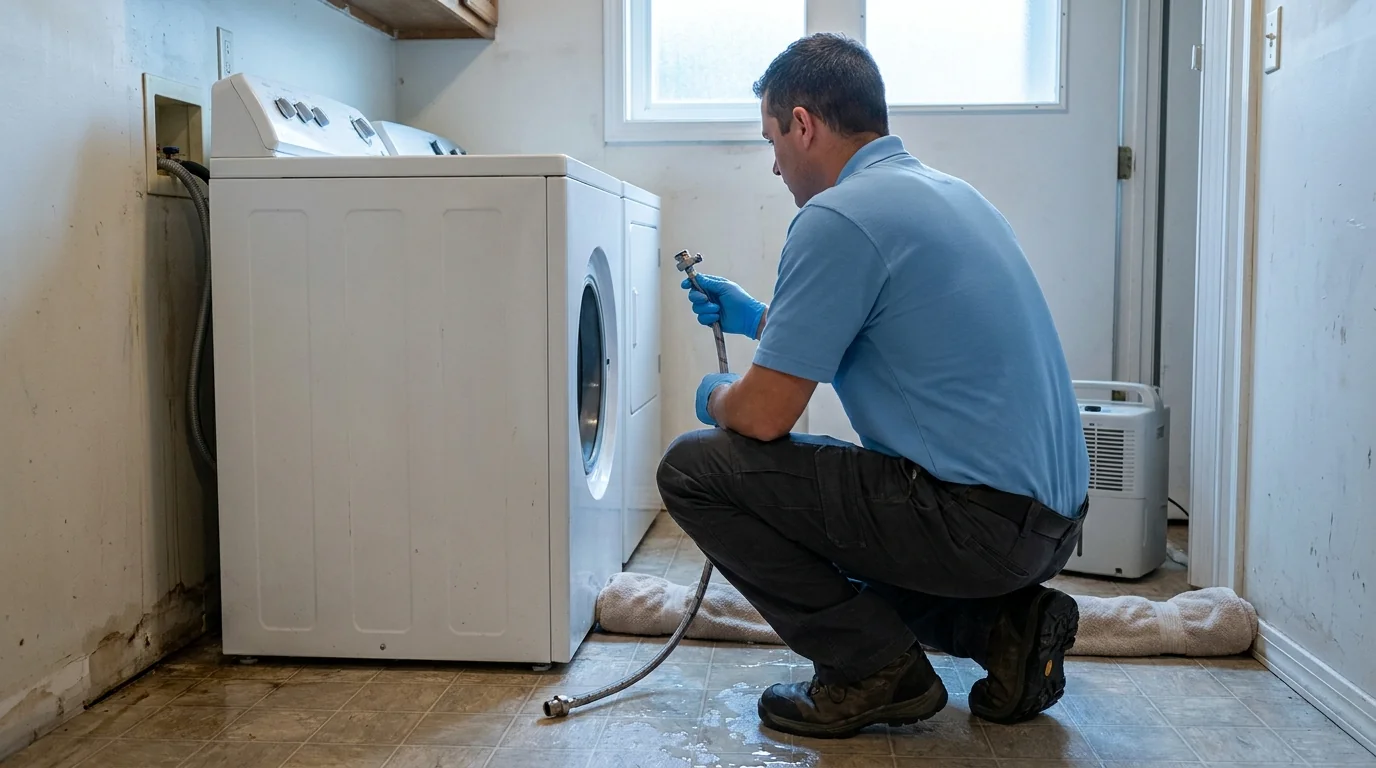
Appliance Leak Cleanup in Kenilworth
24/7 appliance leak cleanup in Kenilworth and surrounding areas. IICRC-certified, insurance billing accepted. Call (908) 970-8533.
You noticed a puddle under the dishwasher last night, mopped it up, and thought nothing of it. Three days later the laminate is bubbling, the cabinet toe-kick smells like a basement, and you’re wondering how a slow drip turned into a flooring replacement. Appliance leaks are deceptive — the water source stops, the visible moisture disappears, and the damage keeps moving through subfloor and wall cavities long after the machine is repaired or replaced.
What appliance leak cleanup actually involves
Unlike a burst pipe that announces itself immediately, appliance leaks often run for days or weeks before anyone notices. A refrigerator ice maker line weeping behind the unit, a washing machine hose failing at the wall connection, or a water heater sacrificial anode corroding through its fitting — each scenario delivers water slowly and quietly into materials that absorb it efficiently: hardwood, OSB subfloor, drywall, and cabinet particleboard.
The cleanup work is not simply drying the floor. It means tracing the moisture migration path from the appliance outward — often under adjacent cabinetry, beneath flooring transitions, and into the toe-kicks and lower wall cavities that share the same subfloor plane. Depending on how long the leak ran, affected materials may need to be removed rather than dried in place. A dishwasher leak cleanup under a tile floor, for example, frequently requires pulling the appliance, removing the kick panel, and inserting drying mats directly against the subfloor — because tile and its mortar bed trap moisture and prevent surface evaporation entirely.
Equipment on a typical appliance leak job includes low-grain refrigerant (LGR) dehumidifiers, axial or centrifugal air movers positioned to drive airflow under cabinetry, and penetrating moisture meters to track readings in the subfloor and wall framing daily. Drying times for a contained appliance leak caught within 24–48 hours typically run 3–5 days. A washing machine flood that soaked through to the subfloor and wasn’t discovered for a week can push that to 7–10 days, with a higher likelihood of secondary mold colonization in the framing.
Our process
-
Source confirmation and appliance isolation. Before any drying equipment is placed, we confirm the leak source is stopped — supply line, drain connection, or the appliance itself — and document the point of origin with photographs for your insurance file. A refrigerator leak cleanup and a water heater leak cleanup require different containment approaches, and misidentifying the source leads to recurring moisture readings.
-
Moisture mapping. Using penetrating and non-penetrating meters, we map the full extent of saturation across the floor, subfloor, adjacent cabinetry, and lower wall cavities. This step produces a baseline moisture reading at every affected location — the numbers that drying progress is measured against each day.
-
Material assessment and selective demolition. Particleboard cabinet bases and laminate flooring generally cannot be dried in place — they swell, delaminate, and harbor mold even after surface moisture is gone. We identify what can be dried versus what needs to come out before equipment is set, so the drying system is working on salvageable material rather than trapping moisture behind unsalvageable material.
-
Structural drying system placement. LGR dehumidifiers are sized to the cubic footage of the affected space, and air movers are directed to maximize airflow across wet surfaces and into cavities. For ice maker line leaks or dishwasher leak cleanup under tile, drying mats are placed directly against the subfloor after the appliance is pulled. We monitor and log moisture readings every 24 hours.
-
Drying verification and documentation package. Drying is complete when all affected materials reach equilibrium moisture content consistent with unaffected areas of the same material type — not when the floor feels dry underfoot. We produce a drying log with daily readings at every monitoring point, equipment placement records, and photo documentation — the same package your insurance adjuster will request.
What separates a good appliance leak response from a bad one
The most common mistake in appliance leak cleanup is treating the visible wet area as the full extent of the damage. Water follows the path of least resistance — it travels along the paper facing of drywall, wicks up wall framing, and migrates under flooring transitions into adjacent rooms. A washing machine flood on the second floor can show up in the ceiling below before it’s visible on the laundry room floor. Operators who set drying equipment only where the floor looks wet and call it done in 48 hours routinely leave elevated moisture in subfloor framing that produces mold growth within two weeks.
Insurance adjusters look specifically for daily moisture logs with meter readings at each monitoring location, equipment placement documentation, and a clear record of when affected materials were assessed for salvageability versus removal. A drying report without daily readings — or one that shows the same readings every day — is a red flag in the claims process. The IICRC S500 standard governs structural drying protocol, and our documentation is built to satisfy it.
A water heater leak cleanup also carries a water classification consideration: if the heater is a gas unit and the flue or combustion chamber was involved, or if the water sat long enough to contact biological material, the water category may affect what PPE and cleaning protocols apply to affected surfaces.
Seasonal and regional considerations
In northern New Jersey, the combination of older housing stock and seasonal temperature swings creates specific appliance leak risk patterns. Refrigerator ice maker lines in homes that drop below 55°F in unheated garages or utility rooms are prone to freeze-thaw cracking in late winter. Water heater leak cleanup calls spike in early spring when sediment buildup from a winter of hard water use accelerates corrosion. Homes in Kenilworth and surrounding Union County communities built before 1980 often have subfloor assemblies — tongue-and-groove boards over joists rather than OSB panels — that absorb and release moisture differently than modern construction, and drying timelines need to account for that.
Service area
The Restoration Group is based in Kenilworth, NJ and handles appliance leak cleanup across Union County and into Essex, Middlesex, and Morris counties. The city-specific pages for this service — covering communities like Summit, Westfield, Cranford, Springfield, and others — link back here for full process detail. Wherever you are in the region, the crew and equipment are the same.
If you’re standing in front of a wet floor right now, call (908) 970-8533 — we’re available around the clock. The sooner moisture mapping begins, the narrower the damage footprint stays. Schedule your appliance leak moisture assessment today.
Frequently Asked Questions
My appliance has been repaired — why do I still need a cleanup crew if the floor looks dry?
How do I know whether my laminate or hardwood floor can be saved after a dishwasher or refrigerator leak?
What's the difference between a Category 1 and Category 2 water loss, and does it matter for an appliance leak?
What documentation should I expect from the drying process for my insurance claim?
An ice maker line behind my refrigerator has been leaking slowly for weeks. Is that a different situation than a sudden washing machine flood?
Looking for the best appliance leak cleanup company in Fair Lawn?
The Restoration Group provides licensed and insured appliance leak cleanup in Fair Lawn, NJ and the surrounding area, and has served local property owners since 2021. We answer calls 24/7 — call (908) 970-8533 for immediate help.
Need Appliance Leak Cleanup now?
We respond 24/7 across Fair Lawn and surrounding NJ cities.
Related Coverage
- Our Restoration Services
- Contact The Restoration Group
- Appliance Leak Cleanup in Brooklyn
- Appliance Leak Cleanup in Cranford
- Appliance Leak Cleanup in Elizabeth
- Appliance Leak Cleanup in Jersey City
- Appliance Leak Cleanup in Kenilworth
- Appliance Leak Cleanup in Manhattan
- Appliance Leak Cleanup in Newark
- Appliance Leak Cleanup in Springfield
- Appliance Leak Cleanup in Summit
- Appliance Leak Cleanup in Union
- Appliance Leak Cleanup in Westfield
- Burst Pipe Emergency Checklist: Step-by-Step Response