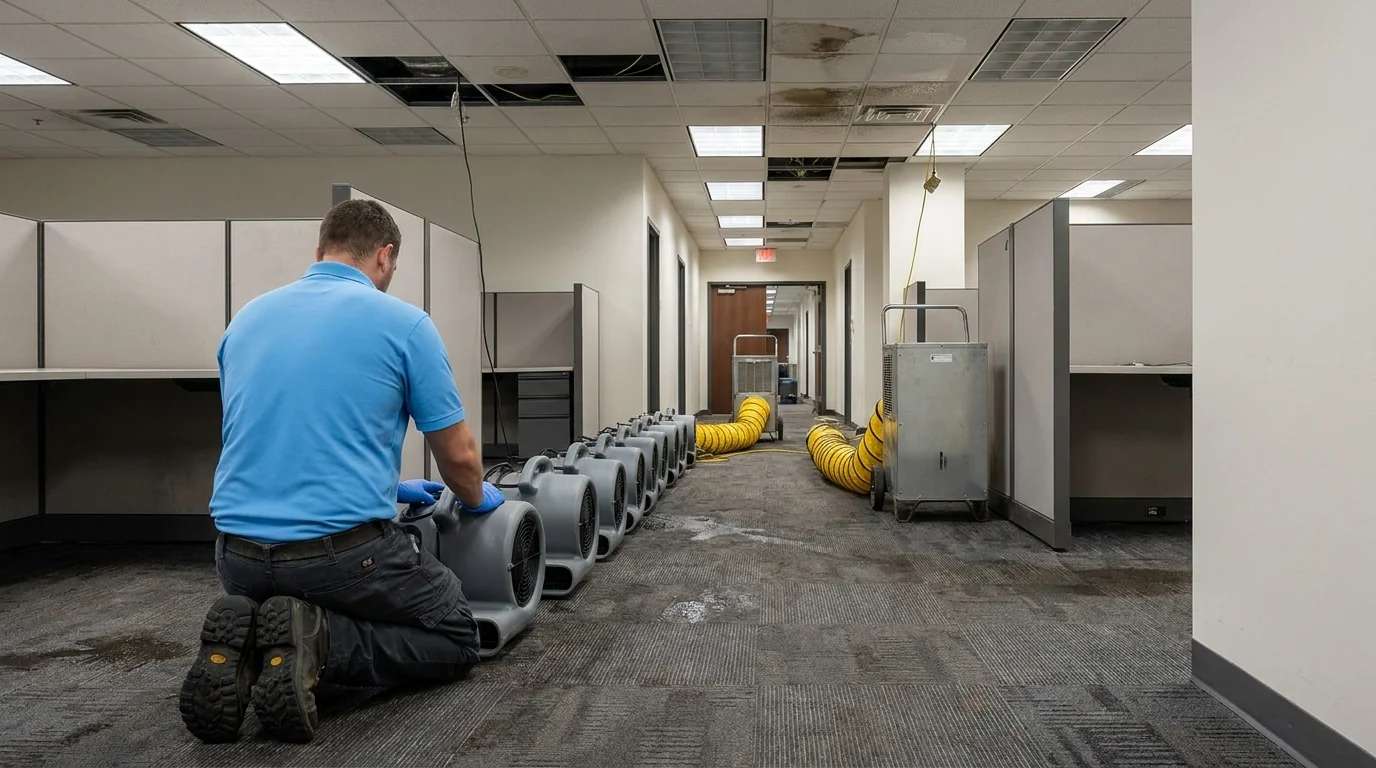
Commercial Restoration in Jersey City
24/7 commercial restoration in Jersey City, NJ. IICRC-certified, insurance billing accepted. Call (908) 970-8533.
Our IICRC-certified technicians are dispatched from our Fair Lawn, NJ headquarters and are typically on-site in Jersey City within 60 minutes of your call.
When a supply-line failure on the 18th floor of a Newport high-rise sends water cascading through six stacked units below, or a grease fire shuts down a Journal Square retail corridor during the lunch rush, the clock starts immediately — and so does the financial exposure. Jersey City’s commercial real estate spans two very different worlds: glass-and-steel waterfront towers along Exchange Place where a single riser break can affect dozens of tenants and trigger building-association insurance claims requiring unit-by-unit moisture documentation, and pre-WWI brick and brownstone stock in neighborhoods like The Heights and Bergen-Lafayette where aging infrastructure, combined-sewer backups, and decades of deferred maintenance create chronic vulnerability. The Restoration Group responds to both.
Why Jersey City Commercial Properties Face Distinct Restoration Challenges
Jersey City’s geography does a lot of the damage before any equipment failure even occurs. The city’s low-lying blocks — particularly those closest to the Hudson waterfront and the older residential-commercial corridors in ZIP code 07306 — proved catastrophically exposed during Hurricane Sandy and again during Ida, when basements and ground-floor commercial spaces flooded citywide. For business owners, that history is not abstract: it shapes what your insurer expects in documentation, what your lease says about restoration timelines, and how quickly mold colonization can begin in a space that sat wet for even 48 hours.
Waterfront high-rises at Newport and Exchange Place present a different set of problems. Riser and supply-line failures in stacked residential and mixed-use towers require floor-by-floor moisture mapping — thermal imaging and calibrated moisture readings at every affected unit — because building management and condo associations need that documentation before their carrier will authorize repairs. A verbal assessment is not enough. The paperwork has to match the damage.
In older commercial corridors — think ground-floor retail beneath walk-up apartments in Bergen-Lafayette or Greenville — the building materials themselves complicate drying. Brick cavity walls and original plaster absorb water slowly and release it even more slowly. Standard drying timelines built around modern drywall do not apply. Restoration that looks complete on the surface can leave elevated moisture readings inside wall assemblies for weeks if the process is not calibrated to the actual substrate.
Our Commercial Restoration Process in Jersey City
Every commercial job begins with a documented scope — not an estimate, a scope. That distinction matters in Jersey City because building management companies, condo boards, and commercial landlords all need something they can hand to an adjuster or a board meeting. We photograph affected materials, log moisture readings room by room, and produce a written loss summary before any demolition begins.
For water damage, we follow the IICRC S500 standard for drying validation, which means we do not call a job dry because it looks dry — we call it dry when calibrated readings confirm it. For fire and smoke damage in commercial spaces, we assess both the visible char and the invisible: smoke residue migrates through HVAC systems, settles into ceiling tile, and embeds in soft goods well beyond the fire’s origin point. A thorough commercial fire restoration in a Jersey City office or retail space typically involves HVAC cleaning, content pack-out or on-site cleaning, and odor neutralization before any rebuild begins.
As an IICRC Certified Firm (#210213) and NJ Licensed Home Improvement Contractor, we carry the documentation that commercial property managers and their insurers require to close a claim cleanly.
Reaching Jersey City from Kenilworth
Our Kenilworth headquarters puts Jersey City within practical reach via the New Jersey Turnpike (I-95) or Routes 1 and 9 north. Because we operate 24/7, a call at 2 a.m. from a building superintendent at a Newport tower or a restaurant owner near Grove Street PATH plaza gets the same response as a call at noon. We stage equipment at the site, not in a warehouse waiting for morning.
For larger commercial losses — multi-floor water intrusion, post-fire structural assessment — we coordinate with building management on access logistics before arrival, particularly in high-rises where elevator access and freight restrictions affect how quickly equipment reaches upper floors.
Jersey City Insurance and Building-Management Coordination
Commercial claims in Jersey City frequently involve multiple parties: a building owner, a commercial tenant, a condo association, and sometimes a property management company acting as the intermediary for all three. We document losses in a format that supports each party’s claim independently — unit-by-unit moisture logs for association insurers, separate scope documents for tenant personal property, and a master loss summary for the building owner.
For landlords managing older multifamily stock in The Heights or Greenville, we are also familiar with the documentation requirements that come with lead-paint-era construction. Any demolition in pre-1978 commercial or mixed-use buildings triggers specific handling protocols, and we factor that into scope and timeline from the start.
Local Note
One thing that surprises commercial clients new to Jersey City’s older corridors: combined-sewer backups — where stormwater and sanitary lines share infrastructure — are classified as Category 3 (grossly contaminated) water intrusion under IICRC standards, regardless of how the water looks when it enters. That classification changes the remediation protocol significantly. Affected materials that might be dried in place after a clean-water pipe burst must instead be removed and disposed of after a sewer backup. Building owners and landlords in ZIP codes 07304 and 07305, where this infrastructure pattern is most common, should expect a more extensive scope and a longer timeline than a surface inspection might suggest — and should communicate that reality to tenants early.
If your Jersey City commercial property has been affected by water, fire, smoke, or storm damage, call The Restoration Group at (908) 970-8533. We document the loss, coordinate with your insurer and building management, and get your space back to operational — without leaving moisture or liability behind.
Commercial Restoration in Jersey City: Service Coverage
Frequently Asked Questions
How fast can you arrive for commercial restoration in Jersey City?
How does a high-rise riser failure at a Newport or Exchange Place tower differ from a standard commercial water loss, and how do you handle the documentation?
Jersey City basements flooded during both Sandy and Ida — if my commercial ground floor floods again, what's the realistic timeline for getting back to operational?
Do combined-sewer backups in neighborhoods like Bergen-Lafayette or Greenville require a different remediation approach than a standard water loss?
Our Journal Square retail space had a fire — how far does smoke damage typically spread beyond the origin room, and what does your commercial fire restoration process cover?
What documentation does The Restoration Group provide for commercial losses in Jersey City that involve both a building owner and a commercial tenant?
Will my homeowners insurance cover commercial restoration in Jersey City?
Commercial Restoration response in Jersey City
Most Jersey City calls see a technician on-site within 60 minutes from our Fair Lawn headquarters.