Mold Inspection and Testing in Jersey City
24/7 mold inspection and testing in Jersey City, NJ. IICRC-certified, insurance billing accepted. Call (908) 970-8533.
Our IICRC-certified technicians are dispatched from our Fair Lawn, NJ headquarters and are typically on-site in Jersey City within 60 minutes of your call.
Jersey City’s two-speed building stock creates mold conditions that don’t look alike and don’t test alike. A riser leak in a Newport high-rise can saturate gypsum board behind a finished wall for weeks before anyone notices a smell, while a combined-sewer backup in a Bergen-Lafayette brownstone basement can deposit enough organic material in a single event to support visible growth within 48 to 72 hours. Knowing which scenario you’re walking into — and choosing the right sampling strategy before the first swab touches a surface — is what separates a useful mold assessment from one that generates paperwork without answers.
Why Jersey City Properties See Elevated Mold Risk
Geography and building age conspire here in ways that don’t apply to most of New Jersey. The low-lying blocks between the Exchange Place waterfront and the older residential grid to the west sat under surge water during Sandy and took on basement flooding again during Ida. Even properties that weren’t directly flooded absorbed elevated ambient humidity for weeks afterward, and in older construction that moisture had nowhere fast to go.
The Heights and Greenville carry a different but equally persistent risk. Frame rowhouses and attached brownstones built between roughly 1890 and 1930 were constructed before vapor barriers existed. Their rubble-stone or brick foundations wick groundwater passively, and their cellar floors — often bare concrete or flagstone — stay cool enough year-round to condense summer humidity. Combined-sewer backups, which remain a recurring issue in several ZIP codes including 07304 and 07305, introduce not just water but nutrient-rich organic matter that accelerates mold colonization dramatically compared to a clean-water intrusion.
Waterfront towers at Newport present a different challenge: stacked ownership. One supply-line failure on an upper floor can affect six or eight units below it, and building management typically needs moisture documentation for each affected unit separately — both for the association’s insurer and to satisfy individual unit owners who want proof their space is clear.
Our Mold Inspection and Testing Process in Jersey City
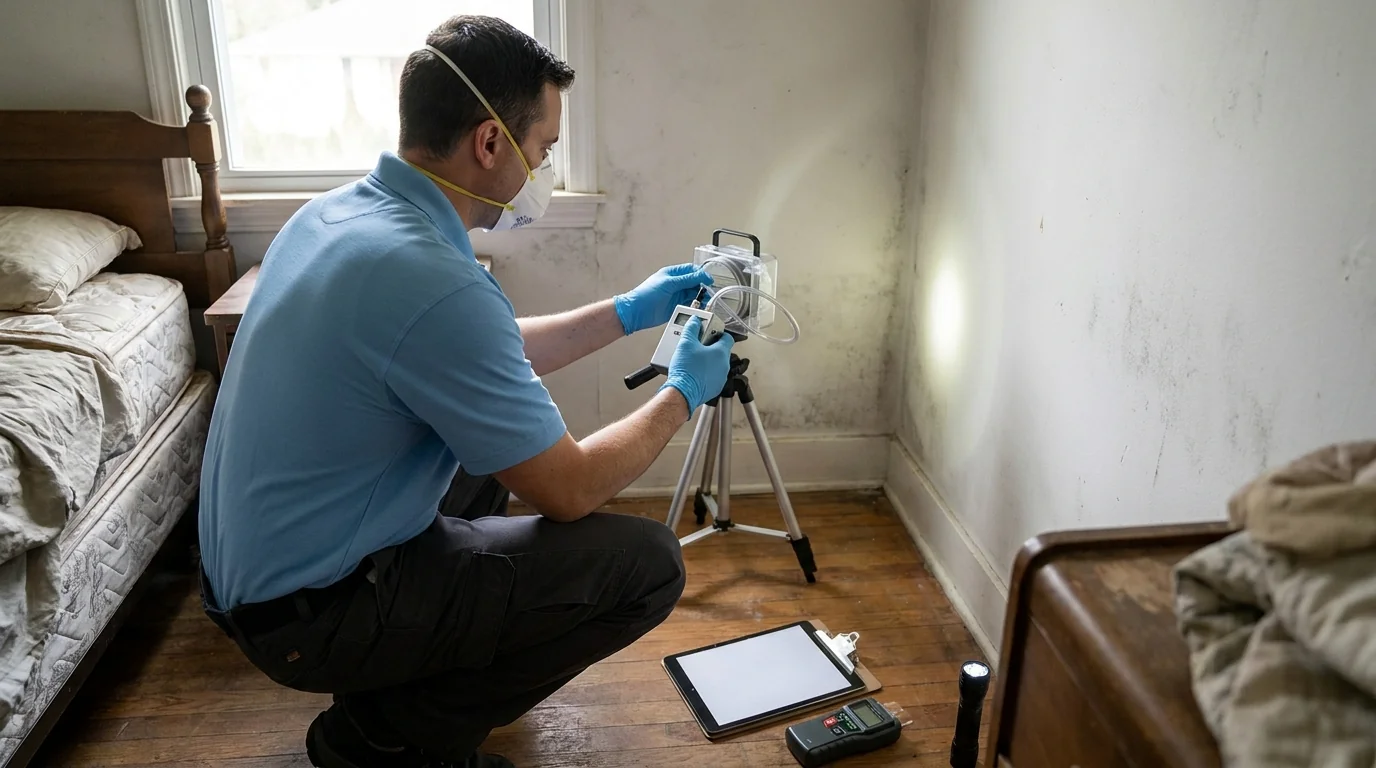
Every assessment begins with a visual survey and moisture mapping using thermal imaging and calibrated moisture meters. In Jersey City’s older rowhouse stock, that means checking not just the obvious surfaces but the interior faces of exterior walls, the underside of first-floor framing above cellars, and the areas around cast-iron drain stacks — spots where condensation and slow seepage accumulate invisibly.
Sampling follows the inspection findings rather than a fixed template. Air samples capture total spore counts and species ratios; surface swabs or tape lifts confirm what’s actively growing on a specific material. In high-rise units where the source may be inside a wall cavity or above a drop ceiling, we use borescope inspection to avoid unnecessary demolition before we know what we’re dealing with. All samples go to an accredited third-party laboratory — results typically return within 24 to 48 hours, and we walk you through the report in plain language, not just hand you a PDF.
For condo associations and landlords managing multiple affected units, we structure the documentation so each unit’s findings are discrete and insurer-ready. That matters when six unit owners are each filing separately through the same building policy.
Reaching Jersey City from Kenilworth
The Restoration Group dispatches from Kenilworth, and Jersey City is a routine service area — teams travel the New Jersey Turnpike or Routes 1 and 9 depending on traffic and destination. Downtown Jersey City, Journal Square, and the Newport corridor are all reachable without navigating the city’s more congested interior streets. Because the team is available around the clock, scheduling an inspection doesn’t mean waiting until the next business-day window opens.
For landlords managing properties across multiple neighborhoods — say, a portfolio that spans Journal Square and Bergen-Lafayette — a single call to (908) 970-8533 can coordinate inspections across addresses on the same visit when scheduling allows.
Jersey City Insurance and HOA Coordination
Mold claims in Jersey City’s condo market involve layers that single-family claims don’t: the master policy, individual unit policies, and sometimes a subrogation dispute between the two when the source is a common-area pipe. The documentation we produce — moisture maps, lab reports, photo logs keyed to unit and floor — is formatted to support that process rather than complicate it.
For rental properties, New Jersey’s warranty of habitability creates real urgency around mold documentation. A written assessment from a certified firm gives landlords a defensible record of when a condition was identified and what steps followed. That paper trail matters whether the conversation is with a tenant, an attorney, or a municipal housing inspector.
Local Note
One pattern that comes up repeatedly in the Heights and in parts of Greenville: homeowners or tenants report a musty smell that intensifies in winter, which seems counterintuitive. In uninsulated or under-insulated rowhouses, heating the interior while exterior temperatures drop creates a steep vapor-pressure gradient that drives moisture from the cold exterior wall assembly toward the warm interior — the opposite of the summer condensation problem. Mold that established itself in wall cavities during a wet fall can become more odor-active in January without any new water event. If an inspection is triggered by a smell that’s worse in cold weather, we factor that seasonal dynamic into where we sample and what we’re looking for.
If you’re dealing with a persistent odor, visible growth, or recent water intrusion anywhere in Jersey City — from a waterfront high-rise to a century-old rowhouse in the 07306 corridor — call (908) 970-8533 to schedule a mold inspection and testing visit. Clear answers start with the right questions asked in the right places.
Mold Inspection and Testing in Jersey City: Service Coverage
Frequently Asked Questions
How fast can you arrive for mold inspection and testing in Jersey City?
Are brownstones and rowhouses in the Heights or Bergen-Lafayette more prone to mold than newer construction?
How does mold testing work in a Jersey City high-rise condo where multiple units are affected by one leak?
Can a mold inspection help a Jersey City landlord respond to a tenant complaint or housing inspection?
What types of samples do you collect during a mold inspection, and how long do results take?
Does flooding history — like Sandy or Ida — affect mold risk in Jersey City properties that weren't visibly damaged?
Will my homeowners insurance cover mold inspection and testing in Jersey City?
Mold Inspection and Testing response in Jersey City
Most Jersey City calls see a technician on-site within 60 minutes from our Fair Lawn headquarters.