Odor Removal and Deodorization in Jersey City
24/7 odor removal and deodorization in Jersey City, NJ. IICRC-certified, insurance billing accepted. Call (908) 970-8533.
Our IICRC-certified technicians are dispatched from our Fair Lawn, NJ headquarters and are typically on-site in Jersey City within 60 minutes of your call.
The combined-sewer backups that flood basements in Bergen-Lafayette and Greenville don’t just leave behind water — they leave behind a persistent, sulfurous odor that seeps into concrete block walls and subfloor framing and refuses to leave on its own. At the same time, a kitchen fire on the 14th floor of a Newport high-rise can push smoke particulate through HVAC returns into units two floors away, turning a contained incident into a building-wide complaint. Odor in Jersey City isn’t a single problem with a single fix, and treating it like one is how properties end up smelling the same six weeks after the fans are gone.
Why Jersey City Properties See Persistent Odor Problems
Jersey City sits on a narrow peninsula between the Hudson River and Newark Bay, which means humidity rarely has anywhere to go. That marine air keeps indoor relative humidity elevated for much of the year — a condition that reactivates odor-causing compounds that might otherwise stay dormant in drier climates. Smoke residue on plaster walls, mold metabolites in a crawl space, or sewage-contaminated subfloor framing will off-gas more aggressively on a humid July afternoon than they would in, say, a desert climate.
The building stock makes this worse. The Heights and Bergen-Lafayette are dense with 1890s–1920s brownstones and frame rowhouses built before vapor barriers existed. Their horsehair plaster walls, balloon-frame cavities, and unlined stone foundations absorb odor molecules deeply — far deeper than modern drywall would. A surface spray accomplishes almost nothing in these structures. The odor source is often inside the wall assembly or beneath the finished floor, not on it.
On the waterfront, the calculus is different but equally complicated. A single supply-line failure in a Newport or Exchange Place high-rise can cascade through stacked units, and if any unit sits unoccupied long enough for mold to establish — mold colonization can begin within 24 to 48 hours of a moisture event — the musty odor becomes a liability for the entire floor when units turn over.
Our Odor Removal and Deodorization Process in Jersey City
Effective odor elimination starts with identifying the source, not masking it. When we arrive at a property — whether a rowhouse in the 07304 ZIP code or a condo tower near the Exchange Place waterfront — we conduct a room-by-room assessment using thermal imaging and moisture meters alongside a sensory inspection to locate where odor compounds are concentrated.
From there, the method depends on what we find:
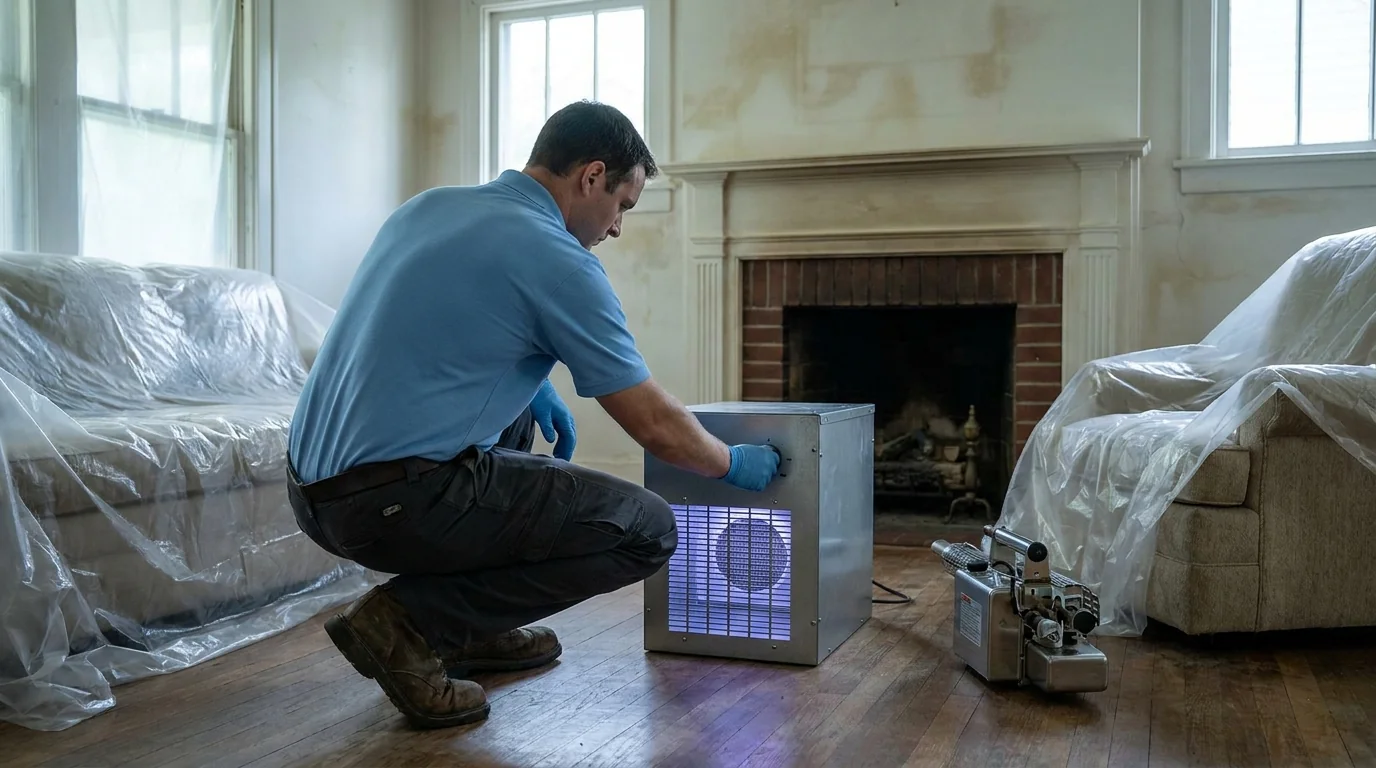
- Thermal fogging penetrates porous surfaces and wall cavities where smoke or sewage odor has migrated. The fog follows the same pathways the odor took, reaching areas that surface treatments cannot.
- Hydroxyl deodorization uses UV-generated hydroxyl radicals to break down odor molecules at a chemical level. Unlike ozone, hydroxyl generators can run while occupants remain in adjacent spaces, which matters in multifamily buildings where full evacuation is rarely practical.
- Ozone treatment is reserved for unoccupied spaces with severe odor loading — a fire-damaged unit, a long-vacant basement, a vehicle. We do not use ozone in occupied spaces or where re-entry cannot be controlled.
- HEPA air scrubbing and negative air pressure contain odor-laden particulate during the process and prevent cross-contamination to adjacent units — a critical step in attached rowhouses and multifamily buildings.
After treatment, we verify results before we close out the job. That means a clearance check, not just a visual walkthrough.
Coordinating with HOAs and Building Management in Jersey City
Jersey City’s density means most odor calls involve at least one party beyond the unit owner: a condo association, a property manager, a landlord, or an adjacent tenant. High-rise buildings near Newport and the Exchange Place waterfront typically require written documentation of the scope of work and the methods used before a contractor can access common mechanical rooms or shared HVAC systems — and some associations require that work be performed during specific hours to limit disruption to other residents.
As an IICRC Certified Firm (#210213) and NJ Licensed Home Improvement Contractor, we carry the documentation that building managers and association insurers typically request. We photograph affected areas before and after treatment, note the equipment used and dwell times, and provide a written summary that can go directly into the building’s incident file or to the carrier handling the claim.
Local Note
In the Heights and Bergen-Lafayette, balloon-frame construction — common in rowhouses built before 1920 — means wall cavities run continuously from the basement to the attic with no fire blocking. Smoke and odor from a first-floor event can travel vertically through those cavities and emerge at the roofline, making the odor seem to come from everywhere at once. When we encounter this pattern, we treat the entire vertical cavity, not just the floor where the incident occurred. Skipping that step is the most common reason a deodorization job in an older Jersey City rowhouse fails the first time.
Reaching Jersey City from Kenilworth
Our team dispatches from Kenilworth and is available around the clock, every day of the year. The New Jersey Turnpike and Routes 1 and 9 connect Kenilworth to Jersey City’s major corridors, and we’re familiar with the access patterns in dense neighborhoods — the narrow one-way streets near Journal Square, the loading dock requirements at waterfront high-rises, the permit zones near the Grove Street PATH plaza. We call ahead when access coordination is needed so equipment is staged correctly from the start.
When you call (908) 970-8533, you reach a live person who can dispatch a crew and begin the intake process — not a voicemail box that routes to a callback the next morning.
If your Jersey City property is carrying an odor that hasn’t responded to cleaning or time, the source is still there. Call us and we’ll find it.
Odor Removal and Deodorization in Jersey City: Service Coverage
Frequently Asked Questions
How fast can you arrive for odor removal and deodorization in Jersey City?
Are older rowhouses in Bergen-Lafayette and the Heights harder to deodorize than newer construction?
A sewer backup flooded my basement in Greenville. The water is gone but the smell is still there weeks later — is that normal?
My condo building near Newport requires documentation before any contractor accesses shared mechanical spaces. Can you provide that?
What's the difference between ozone treatment and hydroxyl deodorization, and which is used in occupied Jersey City buildings?
Does homeowner's or renter's insurance typically cover odor removal after a fire or flood in Jersey City?
Odor Removal and Deodorization response in Jersey City
Most Jersey City calls see a technician on-site within 60 minutes from our Fair Lawn headquarters.