Storm Damage Restoration in Jersey City
24/7 storm damage restoration in Jersey City, NJ. IICRC-certified, insurance billing accepted. Call (908) 970-8533.
Our IICRC-certified technicians are dispatched from our Fair Lawn, NJ headquarters and are typically on-site in Jersey City within 60 minutes of your call.
When a nor’easter or a fast-moving summer storm rolls through Hudson County, Jersey City takes the hit differently than most of New Jersey. The waterfront blocks around Exchange Place and Newport sit at near-sea-level elevation, and the older rowhouse neighborhoods climbing toward The Heights carry decades of deferred drainage infrastructure. That combination — low-lying exposure plus aging building stock — means storm damage here often arrives in layers: wind-driven rain through failing window flashing, then water tracking down interior walls, then basement flooding from a combined sewer that simply can’t move the volume fast enough. The Restoration Group responds 24/7 and can be on-site to begin assessment the same day you call.
Why Jersey City Properties Are Especially Vulnerable to Storm Damage
Jersey City’s geography puts a wide range of properties in the path of serious weather. The low-lying blocks between Liberty State Park and the Exchange Place waterfront were among the hardest-hit areas during Hurricane Sandy’s surge, and Ida proved that even a fast-moving tropical remnant can flood basements citywide within hours. Storm surge, heavy rainfall, and high winds don’t affect a 1920s Bergen-Lafayette brownstone and a 40-story Newport condo tower the same way — but both face real risk.
In the older frame rowhouses and brick buildings throughout Bergen-Lafayette, Greenville, and The Heights, storm damage tends to concentrate at predictable failure points: aging slate or asphalt shingle roofs that lose flashing in high winds, wood window frames that have been painted shut for decades and crack under pressure, and foundation walls that were never waterproofed to modern standards. Combined-sewer backups during heavy rain events push sewage-contaminated water into finished basements — a problem that requires both structural drying and Category 3 water remediation protocols, not just a wet-vac.
At the waterfront high-rises in Newport and along Exchange Place, the storm damage picture is different. Wind-driven rain at elevation finds every imperfect curtain-wall seal and every rooftop mechanical penetration. A single breach can cascade water through multiple stacked units before anyone realizes the source is on the roof. Building management and condo associations in these properties need unit-by-unit moisture mapping and formal documentation — not just a verbal assurance that things are dry.
Our Storm Damage Restoration Process in Jersey City
Every storm damage job starts with a thorough inspection before any equipment goes in. We use thermal imaging and calibrated moisture meters to trace water migration behind walls and under flooring — because in Jersey City’s older construction, water rarely stays where you first see it. A roof breach in a Heights brownstone can wick down through original horsehair-plaster walls and pool at the basement slab before it becomes visible.
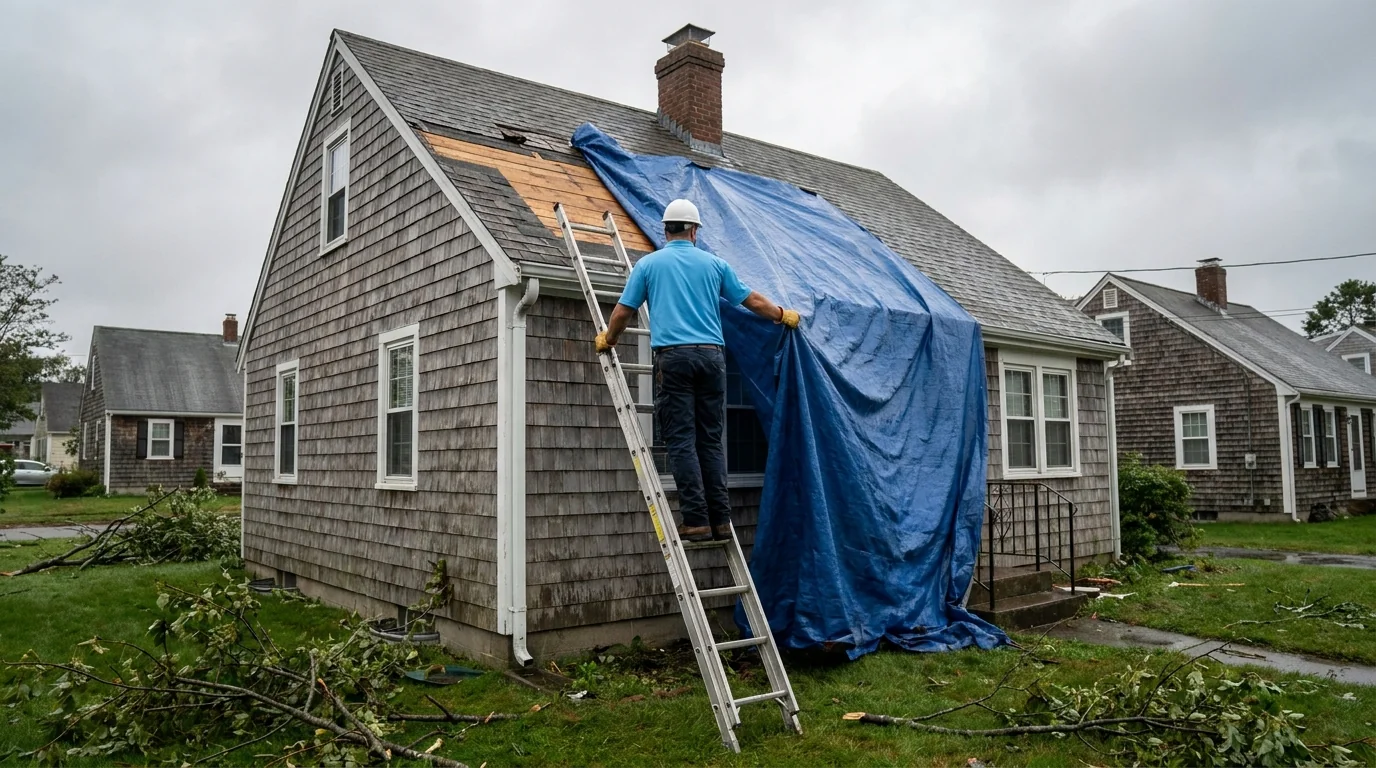
Once the full scope is mapped, we extract standing water, remove unsalvageable materials, and set a drying system calibrated to the building type and the volume of water involved. Structural drying in older masonry and plaster construction takes longer than in modern drywall assemblies — we monitor daily with moisture readings and don’t pull equipment until readings confirm the structure has reached its dry standard, per the IICRC S500 protocol. For tree-impact damage, we coordinate emergency tarping and board-up before interior work begins to stop ongoing water intrusion.
For multifamily properties — whether a six-unit rowhouse in Greenville or a condo building in the 07302 ZIP code — we produce unit-by-unit moisture documentation that satisfies both the building’s insurer and individual unit owners’ carriers. That paperwork trail matters when multiple policies are in play.
Reaching Jersey City from Kenilworth
The Restoration Group operates out of Kenilworth, NJ, and Jersey City is a regular part of our service area. The most direct route runs via the New Jersey Turnpike (I-95) to the Holland Tunnel approach or the Pulaski Skyway corridor, depending on traffic and the specific neighborhood. Downtown Jersey City and the Newport waterfront are accessible via Route 1/9 and the Turnpike’s Exit 14C interchange. The Heights and Journal Square are typically reached via Route 139 west of the tunnel approach. We dispatch 24/7, so our team is moving toward your property while you’re still on the phone with us.
Insurance and HOA Coordination for Jersey City Storm Claims
Storm damage insurance claims in Jersey City carry a few local wrinkles worth knowing. Condo associations at the waterfront high-rises typically have master policies that cover the building envelope — roof, exterior walls, common areas — while individual unit owners carry HO-6 policies for interior finishes and contents. When a storm breaches the roof and water enters three units, sorting out which policy responds to which damage requires clear, unit-specific documentation. We photograph and log every affected area separately so the association’s adjuster and each unit owner’s adjuster are working from the same evidence.
For landlords managing multifamily rentals in Greenville or Bergen-Lafayette, storm damage claims often involve both the property policy and, if a tenant’s belongings are affected, the tenant’s renter’s insurance. We provide the structural loss documentation; tenants handle their own contents claims. We work directly with most major carriers and can communicate with your adjuster throughout the process.
Local Note
One thing that catches property owners off guard in The Heights and Bergen-Lafayette: many of the rowhouses built between 1895 and 1925 have interior party walls — shared masonry walls between attached units — that act as moisture conduits during storm events. Water that enters through one unit’s damaged roof or window can migrate laterally through the party wall and show up as dampness or efflorescence in the adjacent unit days later. We flag this during initial inspection and, when necessary, coordinate access to the neighboring unit with the owner or landlord before closing out a drying job. Skipping that step has caused more than a few callbacks in dense rowhouse blocks.
If your property has been hit by a storm — whether it’s a tree through the roof on a Greenville block or wind-driven rain through a Newport high-rise curtain wall — call The Restoration Group at (908) 970-8533. We’re available around the clock, and we’ll give you a clear picture of the damage and next steps before any work begins.
Storm Damage Restoration in Jersey City: Service Coverage
Frequently Asked Questions
How fast can you arrive for storm damage restoration in Jersey City?
How quickly can The Restoration Group reach a storm-damaged property in The Heights or Bergen-Lafayette?
Jersey City has a lot of condo buildings near Newport and Exchange Place — how do you handle storm damage claims when multiple units and multiple policies are involved?
Are the older rowhouses in Greenville and Bergen-Lafayette harder to dry out after storm flooding than newer construction?
What does storm damage restoration typically involve when a tree falls on a Jersey City rowhouse roof?
Does the combined-sewer backup flooding common in parts of Jersey City — ZIP codes like 07304 and 07305 — require different treatment than regular stormwater flooding?
Will my homeowners insurance cover storm damage restoration in Jersey City?
Storm Damage Restoration response in Jersey City
Most Jersey City calls see a technician on-site within 60 minutes from our Fair Lawn headquarters.