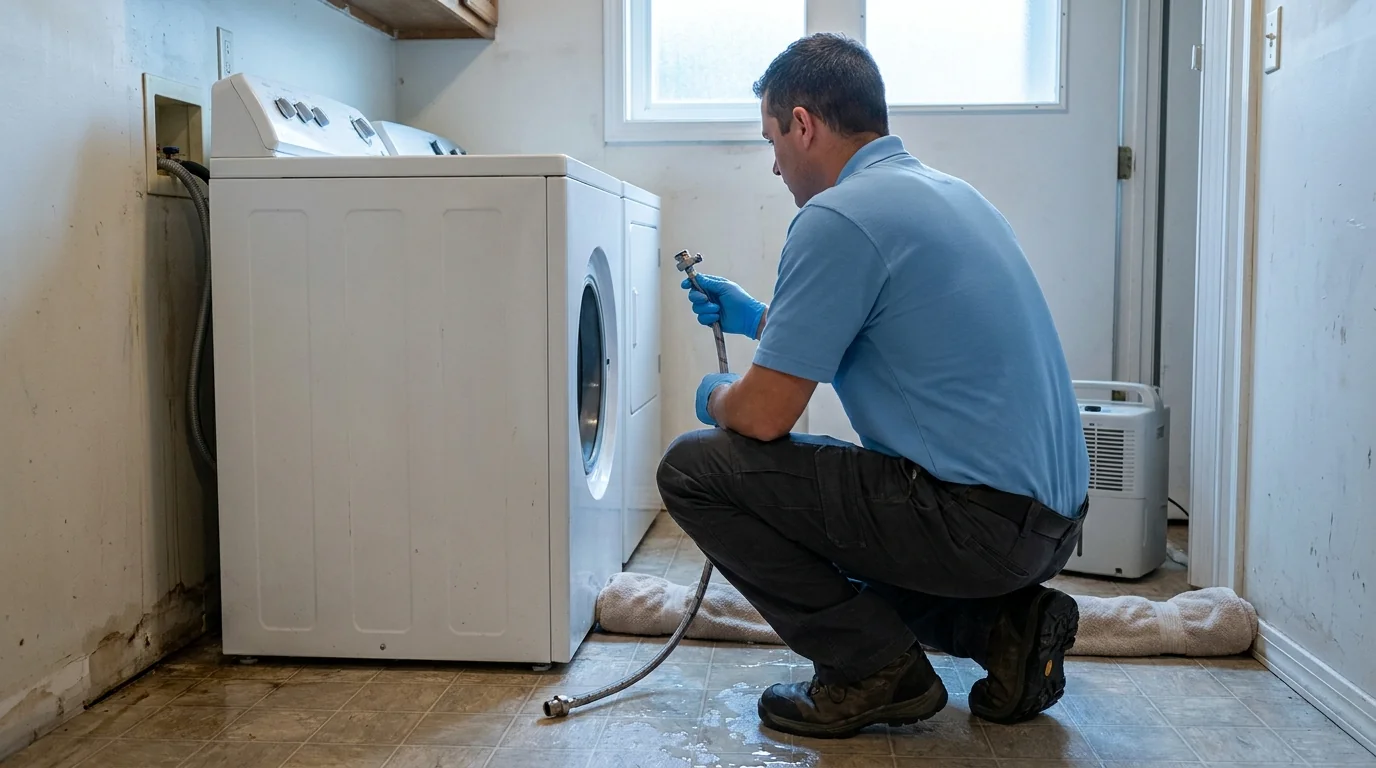
Appliance Leak Cleanup in Kenilworth
24/7 appliance leak cleanup in Kenilworth, NJ. IICRC-certified, insurance billing accepted. Call (908) 970-8533.
Our IICRC-certified technicians are dispatched from our Fair Lawn, NJ headquarters and are typically on-site in Kenilworth within 60 minutes of your call.
An appliance leak in a Kenilworth cape or colonial can go from a puddle under the dishwasher to saturated subfloor and soaked basement insulation faster than most homeowners expect — especially in the older homes along The Boulevard corridor, where original hardwood floors sit directly over full unfinished basements with limited airflow. Because our headquarters is on S 31st Street, we’re rolling a truck into 07033 before most companies have finished taking your call. Whether it’s a washing machine supply line that let go overnight or a water heater that quietly pooled for days, the damage clock starts the moment water hits the floor.
Why Kenilworth Homes See More Appliance Leaks Than You’d Expect
The residential housing stock in this square-mile Union County borough is overwhelmingly 1920s through 1950s construction — capes, colonials, and split-levels built when galvanized steel supply lines were standard. Those lines are now well past their service life, and the connection points behind washing machines and under dishwashers are among the first to fail. A slow drip from a refrigerator ice maker line, for instance, can travel under vinyl flooring for weeks before it becomes visible, by which time the subfloor and the top of the basement ceiling below are already compromised.
Water heaters in Kenilworth’s older homes are frequently tucked into utility corners of finished or semi-finished basements, which means a tank failure doesn’t just flood a utility room — it spreads across finished flooring and into framed walls before anyone notices. The borough’s clay sewer laterals also create backpressure conditions during heavy rain events, which can push water back through floor drains near appliances and compound what started as a simple appliance leak into a mixed-water loss requiring more careful handling.
Our Appliance Leak Cleanup Process in Kenilworth
When we arrive, the first priority is stopping any ongoing water source if it hasn’t been addressed. We then use thermal imaging cameras and calibrated moisture meters to map exactly where water has traveled — under finished flooring, into wall cavities, and down into basement framing. In Kenilworth’s older homes, water often migrates farther than it appears on the surface because original plank subfloors have wider gaps than modern OSB, and basement rim joists are frequently uninsulated, giving water a direct path into the framing.
Extraction comes next: truck-mounted or portable extraction units pull standing water and water trapped in carpet or padding. We then set a drying system calibrated to the specific materials — hardwood, plaster, or drywall each release moisture at different rates, and Kenilworth’s prewar plaster walls in particular hold moisture longer than modern drywall, which means drying timelines here often run longer than a homeowner might expect based on what they’ve read online. Desiccant or refrigerant dehumidifiers, air movers, and in some cases injectidry systems for wall cavities run continuously until moisture readings confirm the structure is dry. Every reading is logged and documented for your insurance claim.
Reaching Kenilworth — Response Time and Coverage
Being headquartered in Kenilworth is a genuine operational advantage for residents in this borough. We’re not dispatching from a regional hub miles away — we’re already here. North Kenilworth addresses near David Brearley High School and South Kenilworth homes closer to the Garden State Parkway Exit 138 corridor are both within minutes of our team. We operate 24/7, so a washing machine flood at 2 a.m. or a water heater failure discovered on a Sunday morning gets the same response as a weekday call. We’re an IICRC Certified Firm (#210213) and a licensed NJ Home Improvement Contractor, which matters when your insurance adjuster asks for documentation.
Insurance Coordination for Kenilworth Appliance Losses
Appliance leaks are among the most commonly covered water losses under standard homeowner’s policies — but the documentation has to be done correctly from the start. We photograph all affected materials before anything is moved, log moisture readings at each inspection point, and provide a detailed scope of loss that aligns with the format adjusters expect. Kenilworth homeowners whose policies run through carriers familiar with the Union County market will find our documentation straightforward to submit. We bill most major carriers directly, which means you’re not fronting the full remediation cost out of pocket while waiting for reimbursement.
Local Note
One thing we’ve learned working Kenilworth specifically: homes in the blocks closest to Black Brook Park and the storm drain network along that corridor tend to have higher ambient moisture levels in their basements year-round — not just after events like the September 2021 flooding from Ida. That chronic dampness means that when an appliance leak adds water to an already-elevated moisture environment, mold colonization can begin faster than the standard 48–72 hour window you’ll read about elsewhere. If your home is in that zone and you’ve had a leak sitting for more than a day, ask us to run a baseline moisture assessment on the surrounding materials even if the visible water is already cleaned up.
If water from an appliance has reached your floors, walls, or basement in Kenilworth, call The Restoration Group at (908) 970-8533 — we’re already in the borough, we’re available around the clock, and we’ll have eyes on the damage and a drying plan in place before the situation gets worse.
Appliance Leak Cleanup in Kenilworth: Service Coverage
Frequently Asked Questions
How fast can you arrive for appliance leak cleanup in Kenilworth?
How quickly can The Restoration Group reach a home in North Kenilworth or near David Brearley High School for an appliance leak?
My Kenilworth home was built in the 1940s — does that affect how long appliance leak drying takes?
Are homes near Black Brook Park at higher risk for mold after an appliance leak?
Will my homeowner's insurance cover an appliance leak cleanup in Kenilworth, and how does documentation work?
What's the difference between cleaning up a refrigerator ice maker line leak versus a washing machine flood in a Kenilworth cape or colonial?
Appliance Leak Cleanup response in Kenilworth
Most Kenilworth calls see a technician on-site within 60 minutes from our Fair Lawn headquarters.